Monday, August 27, 2007

Inquilaab Zindabad

Down with the dictatorships in Bangladesh and Pakistan.


Maha bidrohi rana klanto,
Ami sheidin hobo shanto,
Jobe utpiriter krondon roll akashe batashe dhonibe na,
Ottacharir kharga kripan bheem rana bhume ranibe na...

(The battle-fatigued rebel
I will only rest,
When the cries of the oppressed no longer reach the sky,
When the sound of the oppressor's scimitar no longer rings in the battlefield...)

- Kazi Nazrul Islam (25 May 1899 - 29 August 1976).

Tuesday, August 14, 2007

Sixty years of Independence

In 1997, BBC ran a series called Fifty years of Independence. Hosted by Sir Mark Tully Padma Bhushan, each 3 minute long daily episode showed a major event or topic in Desh’s post‑independence history. Covered were: freedom, the tragedies of partition, the assassination of the Mahatma and Kashmir; birth of the Indian democracy and the rise of the generals in Pakistan; five year plans and the non aligned movement; 1962 and 1965 wars; Mrs Gandhi’s ascendance and the fall of Ayub; nationalists and Naxalites in the east; the Bangladesh War; populist demagogues in New Delhi and Islamabad; two elections of 1977; Zia-ul-Huq and Afghanistan; deaths of Zulfi Bhutto and Mrs Gandhi; Khalistan, Kashmir and the north east; Rajiv, Rao and reforms; caste and communalism; coalition governments in India; and presidents, prime ministers and generals keeping each other in check in Pakistan; and, SAARC. Bangladesh, too, saw the end of the Empire sixty years ago today. If Tully had covered that country, he would have shown violent coups, dictators and political instability.

Inspired by many of these great events, Shashi Tharoor wrote the Great Indian Novel a decade or so earlier. Of course in about another decade prior to that, Salman Sahib wrote the novel that created a new literature. We can’t claim to have the talent for such high brow stuff, so last year we conjured up the Great Desi TV serial.

If one were to add the ten years since, which events would be added? Coalition governments and communal violence in India, military coup and political violence in Pakistan, in the shadow of another war in Afghanistan. Both countries exploded nuclear devices. And Desh came close to full scale war on a number of occasions. That is, the past decade has not been all that different from the previous five.

Or has it? Anyone visiting any major cities in Desh would say that things have changed radically. We see the emergence of new societies, new values and new culture, hand in hand with rapid economic progress. We see the awakening of a generation, we see changes in what the heart desires. And we like what we see.

Monday, August 13, 2007

On (profiling) the Hyderabadis….

Indian Hyderabadis that is –not the Pakistan side Sindhi Hyderabadis. Sindhis are too cunning and nice to be Indian. Look at Bhutto –what a nice cunning guy!!

Having spent two years of my career so far sitting next to one and interacting with 5 others on a daily basis, I have a fair idea to be able to write something on Hyderabadi ‘muslim’ men and their ways.

In short, they are the kind who perform ablution not to pray but to eat biryani or kichdi (a kind of lentil mixed with rice concoction –fed in Pakistan to the poor and constipated) depending on day of the week. Generally it is a Tuesday or it could also be a ‘ChaarShamba’ –(a weird hyderabadi word for Wednesday as opposed to the standard Urdu -budh).

Both ways the biryani begins the day and kichdi ends it. In between come the lethargy, pussy and insatiable cunning ‘pull your pant down along with your leg’ kind of jealousy –especially at workplace.

Sitting next one, I realized the importance of keeping good relations with your Mamu (maternal uncle) –especially if he is a land owning multi millionaire – note owning land is not a credit for talent –jus the bastard’s luck.

Second –as soon as you get a decent job –GET MARRIED.

Food and marriage can be such emotional issue for my Hyderabadi friends, to the point of their ego being hurt. Although a common desi understanding is that if a man hasn’t married by 33 -35, he must be gay or have a weakness.

Well for Hyderabadis, it’s all the above and it’s the exclusion from the group of friends who used to be single and biryani mates and now are married. It is the silent accusative sense of being an outcast.

And as for food, if you manage to forget to invite a friend to your wedding reception, it can mean years of kichdi situation with the friend.

With their typical high pitched nasal accent, Hyderabadis can be one trusted Pakistani loyalist. Take the 1992 cricket world cup. When Pakistan won, most of Hyderabad celebrated the win – some say at a grander scale than the Pakistanis. Who celebrated Pakistani nukes in India? Hyderabadis. Whose fission material is being used in a Hyderabadi Nuclear Plant- the one and only Pakistan’s Dr. A.Q. Khan. (facts not verified).

Only if they knew what a fantastic roller coaster they would be on had they moved to Pakistan.

Somehow understanding Hyderabadis enabled me to a slightly to understand the working meaning of life. It just is. That’s how things are for them and that’s how you are supposed to deal with it.

There is no life is too short, life planning, or what am I doing in this world kind chasing your tail questions. Sweet and practical –the ones who do turn out to be philosophical turn into match fixing Azharuddins. The ones who go haywire by divorcing a wife of 10+ yrs for a hot model –sensible thing to do for some or maybe carrying around a wad of cash in their cricket gear bag enabling them to buy their roommate’s watch off their wrist- simply out of whim or fancy.

When married –they are self educated in dealing with wives – one has to cajole them, negotiate persuade. You marry because you friend/class fellow 'Rizwan' married. You marry for kids, to expand the generation. All that talk about true love, mutual understanding, altruistic orientations, sacrifice, and companionship is nonsense – practical is the way to go.

And as every hyderabadi phrase to confirm understading of the above ends with - HOU!?

Friday, August 10, 2007

Austrian days

Some time ago, I posted this joke that, quite scarily, I found funny. In addition to the real business cycle — negative technological shocks — and Keynesian — fall in aggregate demand — stories of why recessions happen, there is also the ‘hangover theory’. The story of recessions in this theory goes like this: in the beginning, there is loose money that leads to bad investment, at some point the easy money runs out and the day of reckoning arrives, and the painful adjustment process is what we call recession.

A major proponent of this theory is Friedrich von Hayek, the doyen of Austrian school of economic thought. Listening to the school’s ideas in his iPod (yes, he is a very disturbed young man), Amar thought the Austrians were a cult who believed in the god of market called the invisible hand. Well, Paul Krugman compared Austrian macroeconomics with phlogiston theory of fire in the late 1990s. But as De Long notes here, Krugman had a sort of change of heart after the 2001 US recession.

Perhaps I should start a bit further back. Once upon a time, there was chairman of the Federal Reserve called Alan Greenspan. When the unemployment rate in the US fell to 6 per cent in the mid-1990s and everyone feared a break out of inflation, Greenspan held steady and didn’t raise rates. In the event, joblessness fell further, to 5 per cent and then to 4 per cent. And there was no inflation. What happened? It was the beginning of the new economy — the IT and globalisation inspired productivity pick up.

Stronger productivity growth led to rallying share prices, and before long, there was a full-blown bubble in the share market. Even though inflation was moderate, many crypto-Austrians, but not Krugman, thought there was too much money in the system, and Greenspan should prick the bubble. Greenspan did nothing. The bubble ran its course and burst in April 2000.

Then for the next 30 or so months, share prices fell steadily. By 2002, there were talks of a Japanese-style deflationary slump in the US. Bush administration cut taxes heavily and Greenspan slashed interest rates sharply. The economy was flooded with liquidity. Consumers borrowed, and spent, heavily. And the 2001 recession turned out to be one of the mildest on record. Greenspan became a legend.

Tax cuts and cheap money fend of a deflationary slump — sounds like textbook Keynesianism. And it seemed to have worked. Or did it? There were doubters, of the Austrian kind, but also a reformed Krugman, who thought that the tax cuts were poorly designed and money became too cheap. They argued that Greenspan merely replaced the bubble in the tech stock with one in the housing market. And sooner or later, that bubble would burst, leaving Greenspan’s successor to with a mess.

The housing bubble burst last year. It appears that there were a lot of bad loans to the sub prime mortgage market. Other financial institutions had link with these bad mortgage loans. And now it appears that the rabbit hole is much deeper than what anyone thought.
The general view it seems is that it’s Greenspan’s fault (here’s what Stiglitz says). It seems that we are all Austrians now.

Or are we? The first reaction of the central bankers seem to be to pump more money into the market, exactly the opposite of what the Austrians would suggest. Hmmm… stay tuned for what happens next.

And oh, if you have lost money in the last few days, oh well, remember, money can’t buy you love.

Thursday, August 09, 2007

A-A-A on the Song of Hind

Some time ago, we wrote about songs of Hind. We didn’t cover the song of Hind — Iqbal’s Tarana-e-Hind (audio and lyrics here). We did, however, discuss the song.

Amar:

I read something by Naipaul to the effect that Iqbal never identified with Hind. I don’t really remember what Naipaul said. But here’s what I’ve been thinking.

Iqbal says: Sare Jahan se achachha Hindustan hamara, hum bulbulen hain iski yeh gulistan hamara. Generally we assume he means everyone in Hindustan. But then he also says: Aiy ab-e-rood-i-Ganga woh din hain yaad tujhko, utra tere kinare jab karavan hamara. Here he seems to be talking about Muslims specifically when he says hamara.

If one use of hamara seems to be as a Muslim, then isn't it inconsistent to interpret the other hamaras as meaning Muslims and Hindus and Christians and Buddhists and Jews and Sikhs and tribals and Zoroastrians and Jains?

But then, he does say: Mazhab nahin sikhata apas men bair rakhna, Hindi hain ham watan hai Hindustan hamara. And when he says aapas mein, it seems to imply different religions...

So my query about Ganga is, in this bit of song he seems to use hamara for Muslims, whereas other bits are supposed to be all communities. Of course Muslims are part of hamara, so it's not necessarily wrong, but I was just wondering what he was thinking.

Anthony:

I think Iqbal seems to be using a nuanced multilayered concept of identity. He has a sentence mentioning himself: Iqbal! koi mehram apna nahin jahan men Ma'loom kya kisi ko dard-i-nihan hamara. Then there is the Muslim identity in the Ganga line. And overlaying all this is the Hindi identity.

Another reading of it could mean all hamaras are referring to Muslim Hind. But when he says Hindustan hamara (hamara being Muslim Hind), he isn't suggesting Hind is no one else's (unlike the Hindutva brigade). Rather, he means Hindi Muslims are Hindis and Hindustan is their watan. That is, he rejects Muslim separatism and urges Muslims to accept a sort of Hindustan nationalism.

This reading is just as valid.

One way to decipher this is to see where the poem was originally published.

Amar:

Here is what google pulls up.

“Centenary Of Iqbal's Tarana-e-Hind
by nkdatta8839@[EMAIL PROTECTED] (nkdatta8839) Aug 20, 2004 at 06:25 PM
Mohammad Iqbal composed the poem "Tarana-e-Hind" on August 10, 1904,
and sent it to Munshi Daya Narain Nigam, editor of Zamana of Kanpur. It was published in the September issue of the journal. The following month it was published in Makhzan of Lahore, edited by Abdul Qadir “

Check this line out: Yunan-o-misr-o-Roma sab mit gaye jahan se, ab tak magar hai baqi nam-o-nishaan hamara.

Surely the reference to the surviving civilization when Greece, Rome and Egypt are destroyed refers to the recorded Desi civilization of 4500 years. And he uses hamara here, so clearly he identifies with that as well, which Naipaul and the Hindutva moan doesn't happen. There we go, this guy identifies with everyone. He is one comfortable guy. He belongs everywhere.

Anthony:

Iqbal is clearly identifying with Hind, there's no doubt about that. Naipaul and the Hindutva are clearly wrong on this (and many other) count. The question is, whether he is urging only Muslims to identify with Hind, or is his message directed at everyone.

I presume these magazines were in Urdu, with primary readership being Muslim, and thus it's probably safe to say that he is urging his fellow Muslims to accept Hindustan and reject Muslim separatism. Mind you, this doesn't make the poem sectarian by itself — non-Muslims can still identify with Hindustan just as much as anyone else.

Amar:

While I agree these magazines were probably in Urdu, I don't think we have any reason to think he is focussing on Muslims. He wrote in Urdu, so he published in Urdu magazines. Why would he be appealing to Muslims any more than to Sikhs or Hindus? I have seen plenty of old timers, Sikh and Hindu, who were familiar with Urdu (one relative was still subscribing to Urdu papers in Delhi in the 1980s, another who was English principal made a hobby of doing Urdu crosswords), and the editor of the first magazine also seems to have been Hindu.

Anthony:

You're right. Urdu was used more widely than Hindi 100 years ago and his readership probably included as many non-Muslims as Muslims. Okay then, he was definitely endorsing Hindustan nationalism — so Naipaulian Hintdutva types are wrong. Even the most sectarian interpretation of this is championing Hind.

Akbar:

Yeah man, championing Hind, even if it means fantasizing a rule over Nepali-Tibetan glaciers: Parbat woh sab se uncha hamsaya aasmaan ka, woh santari hamara, woh pasban hamara.

England 2009

There exists the exciting possibility that sometime in the future (2008 onwards), we will see an England cricket team go into a test match with three specialist spin bowlers, representing each of the three main disciplines of spin bowling (the fourth, left arm chinamen, are extremly uncommon).

Even more amazing, all three of them could be desis.

The potential line up:
Adil Rashid - leg spin
Saqlain Mushtaq - off spin
Monty Panesar - left arm orthodox.

Monty Panesar has already secured his place in the England team. Adil Rashid is an 18 year old doing phenomenally well in county cricket and has already been identified as a future star by a number of experts. Saqlain Mushtaq previously played for Pakistan with great success at international level, but disappeared from the scene due to injury. He now holds a British Passport and becomes eligible to play for England in 2008. He also took his first 5 wicket haul on return from injury yesterday, in the process out bowling Mushtaq Ahmed, the leading spin bowler in English County Cricket.

Monday, August 06, 2007

Once upon a time in India (cont'd)

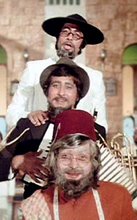
Amar and Akbar arrive in a large covered market. They walk through the myriad of stores selling clothes, jewellery, furniture and household items to arrive in front of a tailors’.

The sign reads PIPALINAGAR TAILORS’. There is an elderly man in one corner reading a vernacular newspaper. A man is haggling over the price of a suit. A schoolboy is having his uniform measured.

Amar walks up to the counter and asks: Me and my brother here were wondering if you had a pair of Japanese shoes?

It’s a tailors’, not a shoe shop. The man in the counter replies. But we do have a number of fine English trousers.

No thank you. But I would be interested in a red Russian hat. Amar responds.

The elderly man leaves his newspaper and steps in: Ah we have just the thing for you, please come this way.

Sunday, August 05, 2007


An experiment with camera settings in Birmingham

Thursday, August 02, 2007

A-A have a deep discussion

Brothers A-A-A are children of hegira. Parts of our families moved from one part of Desh to another when different parts fell apart during the tumultuous 1970s, and before that, the 1940s. Our parents left Desh for work. And now, the time has come for one of them to make a choice: return to Desh in search of a home that they may not recognise, or stay in a land that they do not recognise as home.

Reflecting this, Amar noted: Strange is the life of the exile and the emigrant.

From this, the following conversation ensued.

Anthony: Ah, but it is the sedentary life that is an aberration when you consider the history of humanity. We are a roaming species.

Amar: We were a roaming species. And when we stopped roaming, that was when we progressed spectacularly, that was when civilisation was born. The years of roaming were lost years.

Anthony: We stopped roaming, developed agriculture and formed a civilisation which was the exploitation of many by a few. Sedentary peoples were less healthy than their pastoral nomadic neighbours. Agricultural civilizations produced priests and royal classes that built pyramids and monuments on the back of hardworking and hungry peasant, who was was worse off than his hunter-gatherer cousin. Real spectacular progress came in the more recent times, when we started roaming again. It started when a new civilization, based on the elegant faith of a nomadic people, allowed migration from one end of the known world to the other, trading ideas and commodities. It gathered pace when their rivals ventured to the unknowns beyond the oceans. The prosperity of today's cities on the hill, promised lands and new Jerusalems are all built by the roaming folks, the exile and the immigrant. This is true in Queens, New York and Southall, London, and it is true in the slums of Mumbai and Nairobi. It is the years of cultivating rice in swamps that were lost years!

Amar: A new civilisation based on the elegant faith of a nomadic people? You overlook that a recurring consequence of people venturing away from home in last five hundred years has been wars, imperialism, colonialism, vicious exploitation of others. Two world wars in the last century were also the result of people wanting to move to new places.

Anthony: Wars and invasion of others' territory didn't exactly begin in the last 500 years. Troops of chimpanzees and baboons fight wars of attrition, remember that scene in 2001: A Space Odyssey? Folks in PNG highland have a higher probability of meeting a violent death in the hands of a stranger than anywhere else in the world. And as for exploitation, well vicious exploitation of others begun with agriculture. Slavery, serfdom, caste system – that's exploitation. Yes people moving around causes problem. But for the millions exploited in the farms around the world, migration is the only root to salvation.

Amar: And when they find salvation, don't they settle down?

Anthony: I wouldn’t know, as I still haven’t found what I’m looking for.