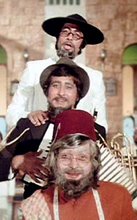
Just in case you are not familiar with the world of Hindi movies, Jodhaa Akbar is one of the most expensive movies ever made in India. Set in the 16th century, it is based on Emperor Akbar's relationship with his Rajput wife Jodhaa Bai. This is my take on the movie. Short version: it lacks direction. Long version, read on.
Let's begin with the things that I liked. I liked the language. I had to use the subtitle to understand many of the Farsi words. But I did get the feeling that this is how the elite of North India might have conversed in the Sultani era and beyond. Also, listening to the Rajput’s Sanskritised Hindi and the chaste Urdu of akbar, one appreciates just how syncretic Bollywood is. And that’s a good thing. Bollywood for a peaceful Desh!
I also liked the costumes and sets. Again, I got the feeling that this is what people in 1550s India (not just the rich, but also the men in bazaar) wore, and this is what the place might have looked like.
And at 200 minutes, the movie didn’t really sag. The set, costume and dialogue kept it going. But the core of it — the love story between the Emperor and his wife — was at most 100 minutes. So the makers of this movie had two options they wasted: they could have done more with the love story, or they could show more battles and politics.
Amar or I would have liked the second option. As it were, the movie didn't have much of politics. It didn’t show any of Akbar’s reign. And I think that was good. The historical basis of the events covered in the movie are 6 months of akbar’s 62 years of life. I’m glad that the movie didn’t explicitly say that Akbar was a great king because of his marriage to a Rajput princess.
In fact, it almost certainly got the history wrong. For one thing, the 6 feet plus Roshan is a very improbable Akbar - according to the historical record, Akbar was a rather short fellow. But the movie doesn't claim to get the history right. It is billed as ‘one narrative of what happened’ in those months.
I was rather disappointed about the battle scenes though. I wasn’t expecting Lord of the Rings, sure. But Bollywood probably has reached a stage where we can expect something like Gladiator (the battle between the Romans and Goths). And I don’t think the problem was money or technology. I think the issue was more with direction. Even the one-on-one combats were not anywhere near as awe-inspiring as they could have been.
In any case, packing in more politics and battles probably would have made it a very different movie from what they set out to make. But there is really no reason why they couldn’t have taken the first option.
I think they could have done a much better job with the love story.
Now, romances are hard to do. A love story with a happy ending is even harder — to paraphrase Tolstoy, all happy endings are alike and so on. But even then, one can think of a number of possible avenues not pursued (or not pursued enough).
For example, Jodhaa could have had feelings for someone else, but she’d come to love Akbar: she was engaged, she could have had developed feelings for his fiance — Rai’s debut movie was based on the theme of love and marriage, and that was a great love story.
And if the romance didn't have a third person, then it needed other enemies and obstacles. They could have had lot more court intrigue. Indeed, there was a bit of it, with tensions leading up to the intermission, but then it all fell through.
They could have shown a lot more verbal jousting and battles of wit. Think of Katharine Hepburn and Cary Grant in The Philadelphia Story. In fact, Bollywood and Urdu literature have a rich tradition of this. One wonders, why wasn’t more made of that heritage?
I should also note couple of other things.
I was extremely disappointed with the Khawaja song. It's meant to be a Sufi devotional number. The idea is that the song should lead to the listener transcend into some ‘deeper meaning’ and dance away in a haze (I think ganjah helps). I love the genre, whether in Urdu, Punjabi or Bangla (in Bangla they mix Radha-Krishna/Ali/Rasul/pirs/tigers the whole lot — talk about a confused syncretic bunch). This particular song was just boring though.
I liked some of the lesser characters. The guy playing the renegade Rajput prince looks like Amitabh Bachchan circa 1975. Him and the guy playing akbar’s brother-in-law were both impressive. Maham Anaga was also really cool. But the evil mullah could have been a lot more evil.
Finally, having seen Taare Zameen Par, and noting Gowarikar and Farhan Akhter's recent outputs, one must wonder how much of Lagaan and Dil Chahta Hai were Aamir Khan.
Monday, July 28, 2008
Thursday, July 24, 2008
Ramayana
This summer, the British Library in London have been hosting a fascinating exhibition on the Indian epic, the Ramayana. Not only that, they are hosting online the 17th century illuminated manuscript which forms the centre piece of the exhibition. They have done a brilliant job, and you can and should go view it here.

I have alway been interested by the Ramayana story and its characters (Sympathy for Ravan, Translating Ramayana and Other Thoughts, Sita the Bitch, Chat-up Lines of the Ancients), but am not as familiar with the story as I would like to be, so when I visited a couple of months ago, some things struck me as unexpected. At the time I scribbled them down on a brochure, and now I jot them down here to share my ignorance and thoughts with my friends. These unexpected realisations were:
1. Rama is shown with blue skin and a moustache.
Thinking about it, Krishna is blue, and Rama and Krishna are both avtars of Vishnu, so perhaps that is not so odd. There is some logic, though I have not previously seen Rama depicted as blue-skinned. Why should Vishnu be blue though? It was Shiva who was neel-kantha or blue throated, from drinking the poison of the cosmic ocean.
The moustache thing is fascinating. From casual observation, a majority of Indian men seem to have a moustache, but in the popular depictions of Hindu Gods and Epics, only the demons, the villains seem to have moustaches, while the male Gods are depicted clean-shaven and looking somewhat androgynous. Is this perhaps only a recent innovation? I was thrilled to see a more hirsute Indian hero.
2. Why does Ravana have a donkey's head as one of his 10 heads in this image? Also, why was he shown with a donkey's head only on this manuscript page (page 38), but none of the other pages?

3. Don't you love the crazy faces of the women in the photo? One has a disturbingly wide smile, one appears to be a Zombie. But even the Zombie has found a lover. Ravana's Lanka seems a haven for those who are different, a kind of Amsterdam of its day.
4. Why are there bears (yes, they do look like boars, but the commentary said bears) fighting in Rama's army? What is the story here?

5. Did you know monkeys come in two colours?
6. I was amused in a juvenile kind of way by the anatomical accuracy of the monkeys in the manuscripts. They all seemed to have visible male genitalia! If this casual observation was correct, this suggests that Rama's vanar-sena, or monkey army, was also exclusively male. This raises:
7. Why aren't there any female monkeys fighting? Are female monkeys not as good at fighting, and not even of some relative utility? Is war an exclusively male preserve across species? I don't know about the warrior capabilities of female monkeys, but it seems wasteful to leave them out fully!
8. This wasn't something I noticed, but rather I overheard. There were a group of serious sounding women discussing the Ramayana story. One said she was troubled as it began with a queen who controlled the king, and ended with a queen controlled by a king. This, she declared, made the Ramayana story quite problematic from a feminist perspective.
No comments!
I have alway been interested by the Ramayana story and its characters (Sympathy for Ravan, Translating Ramayana and Other Thoughts, Sita the Bitch, Chat-up Lines of the Ancients), but am not as familiar with the story as I would like to be, so when I visited a couple of months ago, some things struck me as unexpected. At the time I scribbled them down on a brochure, and now I jot them down here to share my ignorance and thoughts with my friends. These unexpected realisations were:
1. Rama is shown with blue skin and a moustache.
Thinking about it, Krishna is blue, and Rama and Krishna are both avtars of Vishnu, so perhaps that is not so odd. There is some logic, though I have not previously seen Rama depicted as blue-skinned. Why should Vishnu be blue though? It was Shiva who was neel-kantha or blue throated, from drinking the poison of the cosmic ocean.
The moustache thing is fascinating. From casual observation, a majority of Indian men seem to have a moustache, but in the popular depictions of Hindu Gods and Epics, only the demons, the villains seem to have moustaches, while the male Gods are depicted clean-shaven and looking somewhat androgynous. Is this perhaps only a recent innovation? I was thrilled to see a more hirsute Indian hero.
2. Why does Ravana have a donkey's head as one of his 10 heads in this image? Also, why was he shown with a donkey's head only on this manuscript page (page 38), but none of the other pages?

3. Don't you love the crazy faces of the women in the photo? One has a disturbingly wide smile, one appears to be a Zombie. But even the Zombie has found a lover. Ravana's Lanka seems a haven for those who are different, a kind of Amsterdam of its day.
4. Why are there bears (yes, they do look like boars, but the commentary said bears) fighting in Rama's army? What is the story here?

5. Did you know monkeys come in two colours?
6. I was amused in a juvenile kind of way by the anatomical accuracy of the monkeys in the manuscripts. They all seemed to have visible male genitalia! If this casual observation was correct, this suggests that Rama's vanar-sena, or monkey army, was also exclusively male. This raises:
7. Why aren't there any female monkeys fighting? Are female monkeys not as good at fighting, and not even of some relative utility? Is war an exclusively male preserve across species? I don't know about the warrior capabilities of female monkeys, but it seems wasteful to leave them out fully!
8. This wasn't something I noticed, but rather I overheard. There were a group of serious sounding women discussing the Ramayana story. One said she was troubled as it began with a queen who controlled the king, and ended with a queen controlled by a king. This, she declared, made the Ramayana story quite problematic from a feminist perspective.
No comments!


Monday, June 30, 2008
A-A-A talk Fatherland
Akbar: I am reading Fatherland. In so many ways the Nazi Germany is similar to Saudi Arabia. For example Saudis require all nationals to get pre-marital medical check up, which is also mentioned in Fatherland.
Anthony: I’d have thought most totalitarian regimes have that kind of behaviour in common. Anyhow, what do you think of the story?
Akbar: It’s good. Better than the movie. But the ending was, well, hmm.. shrug.
Anthony: Yes, the ending was thoroughly disappointing.
Amar: Yeah, it's a total copout. If I remember correctly, it is that they succeed in giving the information to the Americans, who are stunned by the horror of what happened and stop becoming friends with the Germans. A better novel, more chilling and probably more believable, would have been to give the information to the Americans, then realise the Americans have known it all along, and that they don't really care — it makes sense to be friends with the Germans, and raking up past just gets in the way.
Or have I got the ending wrong?
If I have it right, I think it was probably the Publishers who made him change the ending to appeal to Americans — I can't believe such a good writer would pick such a crappy ending.
Akbar: The book leaves it ambiguous as to what happens — it implies without saying the information gets across — it doesn't deal with what happens afterwards.
It's the movie which shows the information reaching the Americans at the last moment, and stopping the American rapprochement with the Germans.
Amar: I still think the better ending would be the throwing of cold water on the fire of hope.
Anthony: I’d have thought most totalitarian regimes have that kind of behaviour in common. Anyhow, what do you think of the story?
Akbar: It’s good. Better than the movie. But the ending was, well, hmm.. shrug.
Anthony: Yes, the ending was thoroughly disappointing.
Amar: Yeah, it's a total copout. If I remember correctly, it is that they succeed in giving the information to the Americans, who are stunned by the horror of what happened and stop becoming friends with the Germans. A better novel, more chilling and probably more believable, would have been to give the information to the Americans, then realise the Americans have known it all along, and that they don't really care — it makes sense to be friends with the Germans, and raking up past just gets in the way.
Or have I got the ending wrong?
If I have it right, I think it was probably the Publishers who made him change the ending to appeal to Americans — I can't believe such a good writer would pick such a crappy ending.
Akbar: The book leaves it ambiguous as to what happens — it implies without saying the information gets across — it doesn't deal with what happens afterwards.
It's the movie which shows the information reaching the Americans at the last moment, and stopping the American rapprochement with the Germans.
Amar: I still think the better ending would be the throwing of cold water on the fire of hope.
Tuesday, May 06, 2008
I didn't get 'Life of Pi'
First published in September 2001, Life of Pi by Canadian author Yann Martel is a novel that explores religion and spirituality. It won the prestigious Booker Prize in 2002. This alone is a good reason for reading the book, and if you haven’t, don’t read any further because it may spoil an otherwise good yarn for you.
This is not a book review as such. Rather, it shows why I didn’t get the ‘deeper meaning’ of the novel.
The novel promises a story that will make one believe in God. So, what’s the story? Well, there is this confused kid who gets shipwrecked and survives 200 something days in the Pacific Ocean. Pretty amazing stuff. The thing is, there are two versions of the story, one more fantastic and less sad than the other. There is no way to tell which is true. The only thing we know is that the ship sank and the boy survived. And so it is with God, we’re told.
I read it and went, huh?
Okay, so we — the human civilisation — are a ‘miracle’. For life to form, we need a certain kind of star, and a planet that is a certain distant from the star, with a certain kind of atmosphere and mass and structure. Then that life will have to evolve in a certain way for there to be any intelligence. And the intelligence will have to be used in a certain way for there to be any civilisation. And chances of all this happening is very low, and yet here we are.
We have two sets of stories to choose from. One story has a cosmic being / nature / supreme order / authority / God that gives this ‘miracle’ a sense of meaning and purpose. The other story says that yes it’s a low probability event, but it has happened and there is no underlying rhyme or reason for it.
The first is a more fantastic story. The second is sad because it means that our lives don’t really mean much — the whole unbearable lightness of being.
I knew all this before reading Life of Pi. So after reading the book, I thought huh, this is not making me believe in God any more than what I did (or didn’t) before. But then I thought, hmm, perhaps the idea of the book is to put doubt into the minds of believers. But that just sounds far-fetched.
Then I remembered something I read about the Holocaust survivors. The ones who were religious going in found their faith strengthened — didn’t their very survival prove God’s existence? Those who were doubters on the other hand became even more so — what kind of God allows his chosen people to get wiped out?
I guess so it is with this book — believers will believe, and the doubters will doubt.
This is not a book review as such. Rather, it shows why I didn’t get the ‘deeper meaning’ of the novel.
The novel promises a story that will make one believe in God. So, what’s the story? Well, there is this confused kid who gets shipwrecked and survives 200 something days in the Pacific Ocean. Pretty amazing stuff. The thing is, there are two versions of the story, one more fantastic and less sad than the other. There is no way to tell which is true. The only thing we know is that the ship sank and the boy survived. And so it is with God, we’re told.
I read it and went, huh?
Okay, so we — the human civilisation — are a ‘miracle’. For life to form, we need a certain kind of star, and a planet that is a certain distant from the star, with a certain kind of atmosphere and mass and structure. Then that life will have to evolve in a certain way for there to be any intelligence. And the intelligence will have to be used in a certain way for there to be any civilisation. And chances of all this happening is very low, and yet here we are.
We have two sets of stories to choose from. One story has a cosmic being / nature / supreme order / authority / God that gives this ‘miracle’ a sense of meaning and purpose. The other story says that yes it’s a low probability event, but it has happened and there is no underlying rhyme or reason for it.
The first is a more fantastic story. The second is sad because it means that our lives don’t really mean much — the whole unbearable lightness of being.
I knew all this before reading Life of Pi. So after reading the book, I thought huh, this is not making me believe in God any more than what I did (or didn’t) before. But then I thought, hmm, perhaps the idea of the book is to put doubt into the minds of believers. But that just sounds far-fetched.
Then I remembered something I read about the Holocaust survivors. The ones who were religious going in found their faith strengthened — didn’t their very survival prove God’s existence? Those who were doubters on the other hand became even more so — what kind of God allows his chosen people to get wiped out?
I guess so it is with this book — believers will believe, and the doubters will doubt.
Friday, April 25, 2008
Jis Desh Main Ganga Behti Hai
The Mumbai Indians' next home game on April 27 may not feature the much talked about cheerleaders. Though there is no official word as yet, a minister in the Maharashtra government spoke out against them. "We live in India where womanhood is worshipped. How can anything obscene like this can be allowed?," asked Siddharam Mhetre, the minister of state for home affairs.
***
The Minister then started singing Hum us desh ke vasi hai jis desh main Ganga behti hai. That's when everyone realised the Minister had been living in his own fantasy world since 1960.

Tuesday, April 01, 2008
Dates with destiny
Long years ago we made a tryst with destiny, and now the time comes when we shall redeem our pledge, not wholly or in full measure, but very substantially. At the stroke of the midnight hour, when the world sleeps, India will awake to life and freedom. A moment comes, which comes but rarely in history, when we step out from the old to the new, when an age ends, and when the soul of a nation, long suppressed, finds utterance. It is fitting that at this solemn moment we take the pledge of dedication to the service of India and her people and to the still larger cause of humanity.
Thus Pundit Nehru greets India's freedom in one of the most wellknown speeches of the 20th century.
I came across this the other day:
There is a mysterious cycle in human events. To some generations much is given. Of other generations much is expected. This generation of Americans has a rendezvous with destiny.
I know you are thinking 'cool, Obama channels Nehru'. Unfortunately, it's not Obama. It's Franklin D Roosevelt, speaking before the Democratic Convention on 27 June 1936, well over 11 years before Nehru. The above sentences appear towards the end of the speech, followed by this:
In this world of our in other lands, there are some people, who, in times past, have lived and fought for freedom, and seem to have grown too weary to carry on the fight. They have sold their heritage of freedom for the illusion of a living. They have yielded their democracy.
I believe in my heart that only our success can stir their ancient hope. They begin to know that here in America we are waging a great and successful war. It is not alone a war against want and destitution and economic demoralization. It is more than that; it is a war for the survival of democracy. We are fighting to save a great and precious form of government for ourselves and for the world.

Here is the rest of FDR's speech.
Wednesday, March 12, 2008
Incredible movie biology
Some time ago, Amar talked about the Giant Rat of Sumatra, er New Guinea. Well, islands are conducive for things like Giant Rats, and other odd-sized animals. Islands typically don’t have large carnivores — not enough food supply for their survival. So, in the absence of large carnivores, smaller carnivores and herbivores grow bigger than their mainland counterparts. And at the same time, large herbivores tend to shrink over time. That’s why islands could have Dwarf Elephants. These phenomena are called island gigantism and insular dwarfism respectively.
Could something like this have happened in Skul Island? The wiki link says that the island has an unstable ecosystem. What does that mean? Those dinosaurs have survived 65 million years in the island, how unstable could the ecosystem really be then? And how the hell did those insect grow so big?
And what about Kong himself? How did his kind get to grow so big? The wiki says it was the last of its species. How did it get to the island?
And what about the human inhabitants? I thought the scene where they came to get Ann was genuinely cool. Obviously their religion is a cult of Kong. But what is Kong meant to do with Ann? Gorillas don’t eat meat (they eat insects if occasionally). Does Kong eat meat?
I watched King Kong in the plane few weeks ago, and started wondering these. You see, one really can’t enjoy the grandeur of King Kong in the tiny screen that one gets in the economy class in a Boeing 777. This is one big screen movie.
I watched I am Legend in the big screen. I was looking forward to it eagerly. Will Smith is cool. The idea of the original novel seemed cool. A deserted New York City could have been cool. And I happened to be there when they were shooting it. How could it go wrong?
Well, it did go wrong. Neville, Smith’s character, was hunting the mutants. But the mutants were also hunting Neville. They were watching him. They laid traps for him. I’m sure New York’s concrete jungle could have been exploited for some really spine tingling cat and mouse spooky scenes. Shame nothing like that happened.
And since it wasn’t thrilling enough, I started wondering about the mutants’ biology. So the virus that was supposed cure cancer had terrible side effects — it killed most of the humanity, and resulted in rabies, hair loss, loss of resistance to the UV ray and extreme aggression among most of the survivors. Only a very small number of people were resistant to the mutated virus.
Okay, so far so good. But why the hell do all the mutants look similar? Surely CGI doesn’t have to mean that. These creatures only come out at night because of their problem with the UV ray. But does a problem with the UV ray give them night vision? Does the virus affect their optic nerves? And how did the creatures get to be so powerful? And how did they develop spiderman-like climbing abilities?
You see, if you start thinking about this stuff, the movie is obviously not going so well for you. But I’m still curious enough about the book to read it. Perhaps I’ll write about it some other time. Meanwhile, if you want more such stuff (physics, not biology), check this out.
Could something like this have happened in Skul Island? The wiki link says that the island has an unstable ecosystem. What does that mean? Those dinosaurs have survived 65 million years in the island, how unstable could the ecosystem really be then? And how the hell did those insect grow so big?
And what about Kong himself? How did his kind get to grow so big? The wiki says it was the last of its species. How did it get to the island?
And what about the human inhabitants? I thought the scene where they came to get Ann was genuinely cool. Obviously their religion is a cult of Kong. But what is Kong meant to do with Ann? Gorillas don’t eat meat (they eat insects if occasionally). Does Kong eat meat?
I watched King Kong in the plane few weeks ago, and started wondering these. You see, one really can’t enjoy the grandeur of King Kong in the tiny screen that one gets in the economy class in a Boeing 777. This is one big screen movie.
I watched I am Legend in the big screen. I was looking forward to it eagerly. Will Smith is cool. The idea of the original novel seemed cool. A deserted New York City could have been cool. And I happened to be there when they were shooting it. How could it go wrong?
Well, it did go wrong. Neville, Smith’s character, was hunting the mutants. But the mutants were also hunting Neville. They were watching him. They laid traps for him. I’m sure New York’s concrete jungle could have been exploited for some really spine tingling cat and mouse spooky scenes. Shame nothing like that happened.
And since it wasn’t thrilling enough, I started wondering about the mutants’ biology. So the virus that was supposed cure cancer had terrible side effects — it killed most of the humanity, and resulted in rabies, hair loss, loss of resistance to the UV ray and extreme aggression among most of the survivors. Only a very small number of people were resistant to the mutated virus.
Okay, so far so good. But why the hell do all the mutants look similar? Surely CGI doesn’t have to mean that. These creatures only come out at night because of their problem with the UV ray. But does a problem with the UV ray give them night vision? Does the virus affect their optic nerves? And how did the creatures get to be so powerful? And how did they develop spiderman-like climbing abilities?
You see, if you start thinking about this stuff, the movie is obviously not going so well for you. But I’m still curious enough about the book to read it. Perhaps I’ll write about it some other time. Meanwhile, if you want more such stuff (physics, not biology), check this out.
Sunday, March 02, 2008

Friday, February 29, 2008


Monday, February 11, 2008
Subhanllah!!

SubhanAllah! Prophet's Mosque, Medinah - drowned in a sea of lights -All thanks and credit to the skillfull Saudi Binladin Group (yes- Osama relatives) whose worker tolied day and night to build such a magnificent mosque - and continue to renovate and refurnish. By God! Osama and family shall be granted a place in Heaven -Inshallah! and so shall the King -All Hail the dead fat King!!
All hail Akbar's Samsung D-900 mobile, whose magnifient 3.0 megapixel camera captured this beautiful view for the world. All hail Akbar's vanity, for the camera is better than Amar's Gheesa Peeta (worn/torn) Canon, which has captured all sinful anatomic statues/busts of Florence and Spain. By God Amar and his Cannon will rot in hell.
Monday, January 28, 2008

Saturday, January 26, 2008

Saturday, January 19, 2008
Accommodation
| Suite | ||
The Simple but Stylish Executive Suits Are Favoured by Toop-level Business Travellers. Each Comes with Extra Ordinary Views and First Class Amenities. | ||
:-) I will not name and shame the people who offer the Suit, but I have stayed with them, and the people working there are very nice. But their claims and their language are still ridiculous!
Wednesday, January 16, 2008
Losers
When I was young, I did not care for Losers. I had not then realised that these were my brethren, that I was one of them, that in their pain, in the emptiness and misery of their existence I would find kinship, that sense of belonging, that feeling of understanding and being understood. The Losers, I now realise, are my people. And Loss is my intimate companion.
I came across this marvellous loser earlier this week:
How wonderfully and ridiculously tragic our fellow loser is! His song is miserable and self-pitying enough. He says some people's fate is wine, for others it's thirst. We know which one he is. He is singing about his loss, because having lost everything he cared for, the loss itself is all he has now.I came across this marvellous loser earlier this week:
But to return to the action on scene. It is clear that not only is our loser tragic and sad, he is also literally blind. Thus he does not see his lost beloved walk through the door. She hears his every word, our loser oblivious to her presence in the room (though not of her presence in the world). At the end of his song, she walks up to him. And slaps him! She accuses him of having seen her earlier, thus inadvertently revealing to us that he has lost his sight since their parting, she tells him she hates him, and storms out the door.
Our loser is left standing, hurt, lost, alone, and also despised. We sigh in pleasure at the exquisiteness of his pain, as it connects to the solitary pain of our own hearts. We can rejoice that our own suffering is so unworthy compared to his. Truly, this man is a badshah among losers, and to him we raise our literal glass of wine, because metaphorically of course ours are all empty as well.
Salut!
Tuesday, January 08, 2008
Garajti Khabrain Thundering News: India Declares War on Australia
State of Emergency Imposed; Indian Prime Minister makes Declaration of War.
In Breaking News coming to us from Delhi, India has made a formal Declaration of War against Australia. In stunning scenes carried live across the nation on Doordarshan, the Indian Prime Minister Manmohan Singh stood on the wall of Delhi's Red Fort with a sword raised in one hand, and declared: This is no monkey business, Yeh Hamara Mulk Hai! Aur Hum Is Ke Jism Par Loot ke Zakham Nahin Dekh Sakte!
Well informed sources from the Defence Ministery say that the Western Fleet of the Indian Navy has already set sail for Perth on Australia's Western Coast to bomb it into submission ahead of the 3rd Test Match. It is believed that the plan is to occupy Western Australia initially and establish a base there, with an autumn offensive to follow against the Sydney and Melbourne Cricket Grounds. Once Australia has been fully captured, it will be renamed Naya Desh and Biharis, Illegal Bangladeshis, Gujarati Muslims, Kashmiri Pundits, BA Graduates and other marginalised sections of society will be encouraged to move there. In Bihar, the first wave of potential emigrants has already started packing their bags and arriving at Patna Bus Station.
The invasion of Australia has near universal support among Indians, and an Indian Victory in Perth will boost the ruling Congress Party's electoral chances. The BCCI is believed to be secretly financing the invasion, as taking over Cricket Australia's infrastructure and players is seen as the best means of increasing Indian Cricket's brand value.
A Congress Party spokesman on condition of anonymity has said that once the invasion is completed, Monkeys will be introduced to Australian continent to make a moral point. "Once these Australians realise what charming animals monkeys are, they will realise that Harbhajan was not being racist. We are a mature and tolerant society, and the Australians should not be so sensitive and touchy. They are clearly over reacting to this incident."
Hear hear!
In Breaking News coming to us from Delhi, India has made a formal Declaration of War against Australia. In stunning scenes carried live across the nation on Doordarshan, the Indian Prime Minister Manmohan Singh stood on the wall of Delhi's Red Fort with a sword raised in one hand, and declared: This is no monkey business, Yeh Hamara Mulk Hai! Aur Hum Is Ke Jism Par Loot ke Zakham Nahin Dekh Sakte!
Well informed sources from the Defence Ministery say that the Western Fleet of the Indian Navy has already set sail for Perth on Australia's Western Coast to bomb it into submission ahead of the 3rd Test Match. It is believed that the plan is to occupy Western Australia initially and establish a base there, with an autumn offensive to follow against the Sydney and Melbourne Cricket Grounds. Once Australia has been fully captured, it will be renamed Naya Desh and Biharis, Illegal Bangladeshis, Gujarati Muslims, Kashmiri Pundits, BA Graduates and other marginalised sections of society will be encouraged to move there. In Bihar, the first wave of potential emigrants has already started packing their bags and arriving at Patna Bus Station.
The invasion of Australia has near universal support among Indians, and an Indian Victory in Perth will boost the ruling Congress Party's electoral chances. The BCCI is believed to be secretly financing the invasion, as taking over Cricket Australia's infrastructure and players is seen as the best means of increasing Indian Cricket's brand value.
A Congress Party spokesman on condition of anonymity has said that once the invasion is completed, Monkeys will be introduced to Australian continent to make a moral point. "Once these Australians realise what charming animals monkeys are, they will realise that Harbhajan was not being racist. We are a mature and tolerant society, and the Australians should not be so sensitive and touchy. They are clearly over reacting to this incident."
Hear hear!
Thursday, January 03, 2008
How the Benazir assassination has affected A-A-A
As his career in the import-export business hit a brick wall, Amar was looking for a new career. His facebook photo provided him with one. He is now Billawal Bhutto Zardari's body double. Girls, the womanising party animal is the real Billawal, so relax. Hardcore PPP activists, that guy quoting obscure Urdu poetry and irrelevant historical facts is Amar, but since the real Billawal can't speak Urdu, you're better off with the double,
Meanwhile, inspired by the fiery rhetorics of pretentious Bangladeshi blogs with names like deepshit and the trailer of Jodha Akbar, Akbar has joined politics. Not electoral politics though, his is the path of revolution. In the first communique of his group Al Akbar, Akbar stated from an undisclosed location that 'democracy has no meaning in Pakistan until all the feudal landlords are liquidated'. Then the crowd, or some kids, were heard chanting 'Nara-e-Akbar Akbar Akbar'. Then an elderly lady was heard yelling 'Oh my son, stop looking at those dirty pictures of Amsterdam'.
Anthony too has been affected by the assassination. Buoyed by the success of his solo investigative writing efforts (which includes such classics such as 'Joe DiMaggio killed JFK because the latter screwed Marilyn'), Anthony is about to unveil the true killer of Bibi - Asif Ali Zardari!
Meanwhile, inspired by the fiery rhetorics of pretentious Bangladeshi blogs with names like deepshit and the trailer of Jodha Akbar, Akbar has joined politics. Not electoral politics though, his is the path of revolution. In the first communique of his group Al Akbar, Akbar stated from an undisclosed location that 'democracy has no meaning in Pakistan until all the feudal landlords are liquidated'. Then the crowd, or some kids, were heard chanting 'Nara-e-Akbar Akbar Akbar'. Then an elderly lady was heard yelling 'Oh my son, stop looking at those dirty pictures of Amsterdam'.
Anthony too has been affected by the assassination. Buoyed by the success of his solo investigative writing efforts (which includes such classics such as 'Joe DiMaggio killed JFK because the latter screwed Marilyn'), Anthony is about to unveil the true killer of Bibi - Asif Ali Zardari!


Wednesday, December 26, 2007
The secret correspondence of the brothers A* and A*
We have recently recovered this exchange of correspondence between the brothers A* and A*. Their obscure expressions and odd style of language seems alien to our modern sensibilities, and it may be that part of the discussion is in fact in a secret code. Certainly the Scholars who have so far inspected the letters, while attesting to their authenticity, have failed to provide any meaningful interpretation of them. One angry Scholar has even suggested that the authors of the letters may in fact just be speaking nonsense. We wholeheartedly agree with the Angry Scholarji.
The first letter:
Dear Dara Sikho
By the Will and Grace of Allah the most merciful, your brother in Islam has reached his destination safely. However as much did the Arab chics lure your brother with their silent beauty, and inspite of the vigorous inspection by the merciless Pakistani female security guard at the check-in counter, your Brother maintained his virginity and awaits a female slave of my right hand in return as gift of my patience.
May this message reach you in peace and may you bear hundreds of kids from the dodgy women of Amsterdam.
Allah O Akbar
Salam and Allah Hafiz
A* yar wali
The Second letter
Has your moustache disappeared due to the inspiration of the prophet, peace be upon him, or because of the hard stares and questions of the bastard bureaucrats of Vilayet?
I am gratified to hear of your safe and timely return to the fortress of Islam, where you will be safe from the unchaste seductresses and temptresses of the wasted west. There in ritual purity you can concentrate on singing the praise of god and earning extravagant tax free salaries as your reward on earth.
Please give my regards to your devout and devoted parents, whose constant prayers and
virtuous lives acted as a prophylactic when their son arrived in the immoral west, protecting him from being impregnated by lustful corruptions and desires, in the same way a condom-shaped Marks and Spencer cap protected your head from the cold.
Since your departure, It has turned much colder here, which would seem to imply that hell has frozen over. We trust that you are in warmth and comfort however.
Allah's curse on all unbelievers,
Yours Sincerely
Your father Shah Jahan.
The first letter:
Dear Dara Sikho
By the Will and Grace of Allah the most merciful, your brother in Islam has reached his destination safely. However as much did the Arab chics lure your brother with their silent beauty, and inspite of the vigorous inspection by the merciless Pakistani female security guard at the check-in counter, your Brother maintained his virginity and awaits a female slave of my right hand in return as gift of my patience.
May this message reach you in peace and may you bear hundreds of kids from the dodgy women of Amsterdam.
Allah O Akbar
Salam and Allah Hafiz
A* yar wali
The Second letter
Dear fratricidal Alamgir Aurangzeb
I am gratified to hear of your safe and timely return to the fortress of Islam, where you will be safe from the unchaste seductresses and temptresses of the wasted west. There in ritual purity you can concentrate on singing the praise of god and earning extravagant tax free salaries as your reward on earth.
Please give my regards to your devout and devoted parents, whose constant prayers and
virtuous lives acted as a prophylactic when their son arrived in the immoral west, protecting him from being impregnated by lustful corruptions and desires, in the same way a condom-shaped Marks and Spencer cap protected your head from the cold.
Since your departure, It has turned much colder here, which would seem to imply that hell has frozen over. We trust that you are in warmth and comfort however.
Allah's curse on all unbelievers,
Yours Sincerely
Your father Shah Jahan.


Wednesday, December 19, 2007
The Giant Rat of Sumatra
The discerning of Sherlock Holmes's readers have long been aware of the existence of a mystery concerning the Giant Rat of Sumatra. But its precise details have remained unknown, and at the end of the Victorian era, Holmes was only willing to say that it was a story for which the world is not yet prepared. Indeed, the Giant Rat itself remained unknown to the Western World.
This has now slightly changed.

ps: Yes, you are right. It's New Guinea not Sumatra. But it's close!
This has now slightly changed.

ps: Yes, you are right. It's New Guinea not Sumatra. But it's close!
Saturday, December 15, 2007
Heroes, villains and ideas
Bangladesh is marking its liberation from Pakistani occupation this weekend. And a few weeks from now, Indians will celebrate the founding of their republic. During these weeks, TV channels in that part of the world play patriotic tunes. This post is about two such songs — both about the land and gold — and how they display a betrayal of a fundamental tenet of each nation’s foundation.
Let’s start with the Bangladeshi song Shona shona shona. The song says the land, mati, of Bangladesh is better than gold, and under this land sleeps many heroes: Rafiq, Shafiq, Barkat, Titu Mir and Isa Khan.
Who are these heroes? Rafiq, Shafiq and Barkat were killed by the authorities during the language riot of 1952 — a milestone moment in Bangladesh’s nationalism. Titu Mir defied the East India Company and organised a peasant revolt in the 19th century. Isa Khan was a Bengali chieftain who resisted the Mughals in the 16th century.
Notice how all of these heroes are Muslim men? Bangladesh was supposed to be a secular people’s republic. The song was written in the late 1960s, when the ethos of secularism and a progressive society were at the mainstream of Bangladeshi politics. And yet, the song didn’t include Surya Sen or Pritilata Waddedar (Chittagong-based militant revolutionaries killed by the Raj in the 1930s).
The Indian Republic of course has the word secularism in its official name. But you wouldn’t know the supposedly secular nature of the republic from one of the most played song on Indian channels in the week preceding its anniversary in January. The song Mere desh ki dharti proclaims that the land produces gold and diamond, and India is home to these heroes: Gautam, Nanak, Gandhi, Subhas Bose, Tagore, Hari Singh Nalwa, Lal Bahadur Shastri, Bhagat Singh and Jawaharlal Nehru. So, the pantheon of Indian heroes includes a fascist and a warlord, but no Muslim or women. We didn’t expect Noor Inayat Khan to be honoured, but surely the Rani of Jhansi or Tipu Sultan deserves a mention.
Both Bangladeshi and Indian songs are from the 1960s, a time when overtly communal politics seemed to be on the wane in our part of the world, a time when women’s rights were being recognised by the society at large. And yet, two very well known songs of that era, listing the respective nations’ heroes, failed to find a place for the silent minorities that make up the majority of those nations.
And today, four decades hence, the very ideas of secular liberalism are under threat in our part of the world. In Bangladesh, villains who committed genocide in their fight against those ideas in 1971 became resurgent. In India, villains who committed genocide in 2002 to turn India into a Hindu state are gathering strength.
Secularism, liberty, equality of opportunity between genders, these ideas are worth fighting for regardless of nationalism or historical divisions. Indeed, I believe those ideas are more valuable than tribalism or dispute over real estate. This December, or this January, when we hear patriotic songs, let’s think about these ideas, and dedicate ourselves to them.
Let’s start with the Bangladeshi song Shona shona shona. The song says the land, mati, of Bangladesh is better than gold, and under this land sleeps many heroes: Rafiq, Shafiq, Barkat, Titu Mir and Isa Khan.
Who are these heroes? Rafiq, Shafiq and Barkat were killed by the authorities during the language riot of 1952 — a milestone moment in Bangladesh’s nationalism. Titu Mir defied the East India Company and organised a peasant revolt in the 19th century. Isa Khan was a Bengali chieftain who resisted the Mughals in the 16th century.
Notice how all of these heroes are Muslim men? Bangladesh was supposed to be a secular people’s republic. The song was written in the late 1960s, when the ethos of secularism and a progressive society were at the mainstream of Bangladeshi politics. And yet, the song didn’t include Surya Sen or Pritilata Waddedar (Chittagong-based militant revolutionaries killed by the Raj in the 1930s).
The Indian Republic of course has the word secularism in its official name. But you wouldn’t know the supposedly secular nature of the republic from one of the most played song on Indian channels in the week preceding its anniversary in January. The song Mere desh ki dharti proclaims that the land produces gold and diamond, and India is home to these heroes: Gautam, Nanak, Gandhi, Subhas Bose, Tagore, Hari Singh Nalwa, Lal Bahadur Shastri, Bhagat Singh and Jawaharlal Nehru. So, the pantheon of Indian heroes includes a fascist and a warlord, but no Muslim or women. We didn’t expect Noor Inayat Khan to be honoured, but surely the Rani of Jhansi or Tipu Sultan deserves a mention.
Both Bangladeshi and Indian songs are from the 1960s, a time when overtly communal politics seemed to be on the wane in our part of the world, a time when women’s rights were being recognised by the society at large. And yet, two very well known songs of that era, listing the respective nations’ heroes, failed to find a place for the silent minorities that make up the majority of those nations.
And today, four decades hence, the very ideas of secular liberalism are under threat in our part of the world. In Bangladesh, villains who committed genocide in their fight against those ideas in 1971 became resurgent. In India, villains who committed genocide in 2002 to turn India into a Hindu state are gathering strength.
Secularism, liberty, equality of opportunity between genders, these ideas are worth fighting for regardless of nationalism or historical divisions. Indeed, I believe those ideas are more valuable than tribalism or dispute over real estate. This December, or this January, when we hear patriotic songs, let’s think about these ideas, and dedicate ourselves to them.
Monday, November 19, 2007
Air Khalistan
Air Khalistan
The Future Vision

Air Khalistan represents the Sikh Nation's committment to comfortable travel for all passengers, state of the culinary art Khalistani Cuisine, enroute strengthening and stretching exercise facility and new nondenominational breakthrough scientific Khalistani Meditation to further enhance the relaxation and minimize the jet lag for the passengers. Outer space flying will also be an option where airplane speed of Mach 3-5 will be the standard norm. It will minimize the travel time and make business travel more efficient. Air Khalistan look forward to serving you with enthusiasm in the future.
Thanks for visiting our web site.
CEO
Air Khalistan
Khalistani Cuisine
-Khalistani Prindey
(Chicken Tandoori)
-Khalistani Haria Maujan
(Saag)
-Khalistani Ladaki Chicken
(Green Chilli Chicken)
-Khalistani Mithian Maujan
(Ras Malai)
.......... and many more1 Please stay tune.
***
Amar: I wish I could say I made this up. But this is from Khalistan.Net, and those are the wise words of Air Khalistan's CEO. They might even be serious. You can visit the original site here:
http://www.khalistan.net/air-khalistan.html
http://www.khalistan.net/air-khalistan.html
Sunday, November 18, 2007
A-A-A on the coming revolution in Khaleejistan
As Chapati reports, they have shut down Geo TV in Dubai. The dictator in Pakistan is afraid of the media. Sheikhs in Dubai are probably afraid too, about possible political tremors in their fiefdoms. While we await the fall of the dictator in Pakistan, here’s a conversation we had some time ago.
Anthony
In Syriana, the disaffected youth from a Dubai-like place turns to Jihad. While this hasn't actually happened, could something similar happen? In next few decades, as the age of oil ends, what will happen to the millions of Desis that make up the underclass in the Gulf?
Akbar
I have never seen/heard about Desi youth in the Gulf being recruited for Jihad. So far I have only heard of the NWFP and Kashmir as recruitment centres. So, a Syriana-like situation is not happening. The only resistance in Saudi is from Shiias and Al Qaeda, who tend to be mostly Arab. Dubai or Oman is the last place I would think about recruiting.
As for when the oil runs out, well, the expats will be f..ked. They are nowhere. Those who have emigrated to the west know that’s where they will settle. People in Desh know their future is, well, either in poverty or in plenty. But people in Middle East don’t know where they belong. If they go back to Desh, they face adjustment problem, and then there is the political uncertainty. If they go West, well, they may not get visa and in any case, they will never save enough to have a comfortable lifestyle similar to what they have in Middle East.
Anthony
See this is my point. Depending on how you count it, 20 to 80% of residents in most cities in the region are expats, and many expats have spent most of the past 3 decades there. One can't seriously expect them to be evicted without tension. I suspect when the oil era ends, the political geography of the region will look very different. When the oil era ends, the current monarchies will probably be overthrown. This could happen in a number of ways.
One scenario, 'good' but very unlikely, is that there would be democratic transformation that gives expats citizenship rights. A more likely, 'bad', scenario is a series of military coups. Some young officer like Nasser will overthrow the house of Saud. But Arab nationalism is a spent force, so these young army men will have to have something else to legitimise their rule, and the support of the expats might be at a premium. The ‘ugly’ scenario, also quite likely, is radical Islam in a new incarnation. Islam is an internationalist ideology. It is very conceivable that Islamist parties with mass support, as opposed to the militants and insurgents, could rise. These parties will have huge support among Desis – for all the pictures of Bose and Bin Laden, Desis like mass parties like Congress and League.
So Akbar, the future belongs to you. In fact, you should start organising this mass party. You could become the Zulfi Bhutto of Khaleejistan. We could call you Khaleej-bandhu. When you take over, hire me as an economic advisor or something. And we'll get Amar to make movies about you.
Amar
Thank you thank you, for this great honour, for which I am fully qualified and all — after all, I have watched Triumph of the Will by Leni Riefenstahl.
First, Akbar, serene, god-like, is seen in his PIA flight high up in the air, eating PIA's delicious poached egg. We hear a divine fart of approval.
Then we see the arrival of the Qaid in the city of Dubai, where the annual party conference has been organised. There is a massive motorcade which unfortunately can't proceed slowly through the city due to suicide bombers. However, skillful cutting and chopping of camera angles shows the Neta’s motorcade sweeping through town
CUT
And crowds cheering as the statue of Saddam Hussein is first covered by US Flag then toppled over
CUT
A sea of demonstrators as far as the eye can see, waving , what is this, photos of Ayatollah Khomeini, yelling "We love...
CUT
"Akbar”
(voiceover) Death to the Shah!
CUT
Akbar, clearly standing in Speaker's Corner in Hyde Park, waving his arms to everyone.
CUT
Back to the convoy speeding through town, and a quick and awkward cut as it is seen running over an old man.
A Sub-title appears on screen: Millions of followers come our to greet their Great Leader.
Anthony
In Syriana, the disaffected youth from a Dubai-like place turns to Jihad. While this hasn't actually happened, could something similar happen? In next few decades, as the age of oil ends, what will happen to the millions of Desis that make up the underclass in the Gulf?
Akbar
I have never seen/heard about Desi youth in the Gulf being recruited for Jihad. So far I have only heard of the NWFP and Kashmir as recruitment centres. So, a Syriana-like situation is not happening. The only resistance in Saudi is from Shiias and Al Qaeda, who tend to be mostly Arab. Dubai or Oman is the last place I would think about recruiting.
As for when the oil runs out, well, the expats will be f..ked. They are nowhere. Those who have emigrated to the west know that’s where they will settle. People in Desh know their future is, well, either in poverty or in plenty. But people in Middle East don’t know where they belong. If they go back to Desh, they face adjustment problem, and then there is the political uncertainty. If they go West, well, they may not get visa and in any case, they will never save enough to have a comfortable lifestyle similar to what they have in Middle East.
Anthony
See this is my point. Depending on how you count it, 20 to 80% of residents in most cities in the region are expats, and many expats have spent most of the past 3 decades there. One can't seriously expect them to be evicted without tension. I suspect when the oil era ends, the political geography of the region will look very different. When the oil era ends, the current monarchies will probably be overthrown. This could happen in a number of ways.
One scenario, 'good' but very unlikely, is that there would be democratic transformation that gives expats citizenship rights. A more likely, 'bad', scenario is a series of military coups. Some young officer like Nasser will overthrow the house of Saud. But Arab nationalism is a spent force, so these young army men will have to have something else to legitimise their rule, and the support of the expats might be at a premium. The ‘ugly’ scenario, also quite likely, is radical Islam in a new incarnation. Islam is an internationalist ideology. It is very conceivable that Islamist parties with mass support, as opposed to the militants and insurgents, could rise. These parties will have huge support among Desis – for all the pictures of Bose and Bin Laden, Desis like mass parties like Congress and League.
So Akbar, the future belongs to you. In fact, you should start organising this mass party. You could become the Zulfi Bhutto of Khaleejistan. We could call you Khaleej-bandhu. When you take over, hire me as an economic advisor or something. And we'll get Amar to make movies about you.
Amar
Thank you thank you, for this great honour, for which I am fully qualified and all — after all, I have watched Triumph of the Will by Leni Riefenstahl.
First, Akbar, serene, god-like, is seen in his PIA flight high up in the air, eating PIA's delicious poached egg. We hear a divine fart of approval.
Then we see the arrival of the Qaid in the city of Dubai, where the annual party conference has been organised. There is a massive motorcade which unfortunately can't proceed slowly through the city due to suicide bombers. However, skillful cutting and chopping of camera angles shows the Neta’s motorcade sweeping through town
CUT
And crowds cheering as the statue of Saddam Hussein is first covered by US Flag then toppled over
CUT
A sea of demonstrators as far as the eye can see, waving , what is this, photos of Ayatollah Khomeini, yelling "We love...
CUT
"Akbar”
(voiceover) Death to the Shah!
CUT
Akbar, clearly standing in Speaker's Corner in Hyde Park, waving his arms to everyone.
CUT
Back to the convoy speeding through town, and a quick and awkward cut as it is seen running over an old man.
A Sub-title appears on screen: Millions of followers come our to greet their Great Leader.
Friday, November 09, 2007
Gonotontro mukti paak

Twenty years ago today, a young political activist protesting a military dictatorship had the words gonotontro mukti paak - roughly translated as 'give back democracy' - painted on his back. Shortly after this photo was taken, the activist named Nur Hossain was killed by the security forces.
Democracy is once again suppressed in Bangladesh and Pakistan. But not for long. Down with military dictatorships. Gonotontro mukti paak. Inquilaab Zindabad.
Tuesday, November 06, 2007
Whisker check

We noted last year that no clean-shaved general has successfully saved Bangladesh and Pakistan. Since then, Moeen U Ahmed has been saving Bangladesh from suicidal inaction in the face of corruption and failed politics. And now, Pakistan also needs saving. If the very moustachoid Musharraf can't do it, will Lt Gen Ashfaq Kiani step in? Will he be successful? He is, after all, also clean-shaved.
Sunday, November 04, 2007
Musharraf's Bitch
Emergency or not
what difference does it make?
Even a four legged animal knows
Musharraf was here and
will stay!!
Why a two legged politician not fathom
this?
Musharraf's bitch is surprised to say!
Know they not this;
Power and love are always in a haste
Even Muhammed rushed to Medina
to save his chair of the day.
Are bengalis so foolish
to accept democracy their only fate?
Even Hasina's Sari
unwraps her body for the Lathi of the day
and BB's salwar
catches the martial color
to remain in place!!
Only a bald man in Makkah knows
Promises are broken to be made.
what difference does it make?
Even a four legged animal knows
Musharraf was here and
will stay!!
Why a two legged politician not fathom
this?
Musharraf's bitch is surprised to say!
Know they not this;
Power and love are always in a haste
Even Muhammed rushed to Medina
to save his chair of the day.
Are bengalis so foolish
to accept democracy their only fate?
Even Hasina's Sari
unwraps her body for the Lathi of the day
and BB's salwar
catches the martial color
to remain in place!!
Only a bald man in Makkah knows
Promises are broken to be made.


Subscribe to:
Posts (Atom)