Sunday, December 23, 2007


Wednesday, December 19, 2007

The Giant Rat of Sumatra

The discerning of Sherlock Holmes's readers have long been aware of the existence of a mystery concerning the Giant Rat of Sumatra. But its precise details have remained unknown, and at the end of the Victorian era, Holmes was only willing to say that it was a story for which the world is not yet prepared. Indeed, the Giant Rat itself remained unknown to the Western World.

This has now slightly changed.


ps: Yes, you are right. It's New Guinea not Sumatra. But it's close!

Saturday, December 15, 2007

Heroes, villains and ideas

Bangladesh is marking its liberation from Pakistani occupation this weekend. And a few weeks from now, Indians will celebrate the founding of their republic. During these weeks, TV channels in that part of the world play patriotic tunes. This post is about two such songs — both about the land and gold — and how they display a betrayal of a fundamental tenet of each nation’s foundation.

Let’s start with the Bangladeshi song Shona shona shona. The song says the land, mati, of Bangladesh is better than gold, and under this land sleeps many heroes: Rafiq, Shafiq, Barkat, Titu Mir and Isa Khan.

Who are these heroes? Rafiq, Shafiq and Barkat were killed by the authorities during the language riot of 1952 — a milestone moment in Bangladesh’s nationalism. Titu Mir defied the East India Company and organised a peasant revolt in the 19th century. Isa Khan was a Bengali chieftain who resisted the Mughals in the 16th century.

Notice how all of these heroes are Muslim men? Bangladesh was supposed to be a secular people’s republic. The song was written in the late 1960s, when the ethos of secularism and a progressive society were at the mainstream of Bangladeshi politics. And yet, the song didn’t include Surya Sen or Pritilata Waddedar (Chittagong-based militant revolutionaries killed by the Raj in the 1930s).

The Indian Republic of course has the word secularism in its official name. But you wouldn’t know the supposedly secular nature of the republic from one of the most played song on Indian channels in the week preceding its anniversary in January. The song Mere desh ki dharti proclaims that the land produces gold and diamond, and India is home to these heroes: Gautam, Nanak, Gandhi, Subhas Bose, Tagore, Hari Singh Nalwa, Lal Bahadur Shastri, Bhagat Singh and Jawaharlal Nehru. So, the pantheon of Indian heroes includes a fascist and a warlord, but no Muslim or women. We didn’t expect Noor Inayat Khan to be honoured, but surely the Rani of Jhansi or Tipu Sultan deserves a mention.

Both Bangladeshi and Indian songs are from the 1960s, a time when overtly communal politics seemed to be on the wane in our part of the world, a time when women’s rights were being recognised by the society at large. And yet, two very well known songs of that era, listing the respective nations’ heroes, failed to find a place for the silent minorities that make up the majority of those nations.

And today, four decades hence, the very ideas of secular liberalism are under threat in our part of the world. In Bangladesh, villains who committed genocide in their fight against those ideas in 1971 became resurgent. In India, villains who committed genocide in 2002 to turn India into a Hindu state are gathering strength.

Secularism, liberty, equality of opportunity between genders, these ideas are worth fighting for regardless of nationalism or historical divisions. Indeed, I believe those ideas are more valuable than tribalism or dispute over real estate. This December, or this January, when we hear patriotic songs, let’s think about these ideas, and dedicate ourselves to them.

Monday, November 19, 2007

Air Khalistan

Air Khalistan

The Future Vision

Air Khalistan represents the Sikh Nation's committment to comfortable travel for all passengers, state of the culinary art Khalistani Cuisine, enroute strengthening and stretching exercise facility and new nondenominational breakthrough scientific Khalistani Meditation to further enhance the relaxation and minimize the jet lag for the passengers. Outer space flying will also be an option where airplane speed of Mach 3-5 will be the standard norm. It will minimize the travel time and make business travel more efficient. Air Khalistan look forward to serving you with enthusiasm in the future.

Thanks for visiting our web site.

CEO

Air Khalistan

Khalistani Cuisine

-Khalistani Prindey

(Chicken Tandoori)

-Khalistani Haria Maujan

(Saag)

-Khalistani Ladaki Chicken

(Green Chilli Chicken)

-Khalistani Mithian Maujan

(Ras Malai)

.......... and many more1 Please stay tune.


***

Amar: I wish I could say I made this up. But this is from Khalistan.Net, and those are the wise words of Air Khalistan's CEO. They might even be serious. You can visit the original site here:
http://www.khalistan.net/air-khalistan.html

Sunday, November 18, 2007

A-A-A on the coming revolution in Khaleejistan

As Chapati reports, they have shut down Geo TV in Dubai. The dictator in Pakistan is afraid of the media. Sheikhs in Dubai are probably afraid too, about possible political tremors in their fiefdoms. While we await the fall of the dictator in Pakistan, here’s a conversation we had some time ago.

Anthony

In Syriana, the disaffected youth from a Dubai-like place turns to Jihad. While this hasn't actually happened, could something similar happen? In next few decades, as the age of oil ends, what will happen to the millions of Desis that make up the underclass in the Gulf?

Akbar

I have never seen/heard about Desi youth in the Gulf being recruited for Jihad. So far I have only heard of the NWFP and Kashmir as recruitment centres. So, a Syriana-like situation is not happening. The only resistance in Saudi is from Shiias and Al Qaeda, who tend to be mostly Arab. Dubai or Oman is the last place I would think about recruiting.

As for when the oil runs out, well, the expats will be f..ked. They are nowhere. Those who have emigrated to the west know that’s where they will settle. People in Desh know their future is, well, either in poverty or in plenty. But people in Middle East don’t know where they belong. If they go back to Desh, they face adjustment problem, and then there is the political uncertainty. If they go West, well, they may not get visa and in any case, they will never save enough to have a comfortable lifestyle similar to what they have in Middle East.

Anthony

See this is my point. Depending on how you count it, 20 to 80% of residents in most cities in the region are expats, and many expats have spent most of the past 3 decades there. One can't seriously expect them to be evicted without tension. I suspect when the oil era ends, the political geography of the region will look very different. When the oil era ends, the current monarchies will probably be overthrown. This could happen in a number of ways.

One scenario, 'good' but very unlikely, is that there would be democratic transformation that gives expats citizenship rights. A more likely, 'bad', scenario is a series of military coups. Some young officer like Nasser will overthrow the house of Saud. But Arab nationalism is a spent force, so these young army men will have to have something else to legitimise their rule, and the support of the expats might be at a premium. The ‘ugly’ scenario, also quite likely, is radical Islam in a new incarnation. Islam is an internationalist ideology. It is very conceivable that Islamist parties with mass support, as opposed to the militants and insurgents, could rise. These parties will have huge support among Desis – for all the pictures of Bose and Bin Laden, Desis like mass parties like Congress and League.

So Akbar, the future belongs to you. In fact, you should start organising this mass party. You could become the Zulfi Bhutto of Khaleejistan. We could call you Khaleej-bandhu. When you take over, hire me as an economic advisor or something. And we'll get Amar to make movies about you.

Amar

Thank you thank you, for this great honour, for which I am fully qualified and all — after all, I have watched Triumph of the Will by Leni Riefenstahl.

First, Akbar, serene, god-like, is seen in his PIA flight high up in the air, eating PIA's delicious poached egg. We hear a divine fart of approval.

Then we see the arrival of the Qaid in the city of Dubai, where the annual party conference has been organised. There is a massive motorcade which unfortunately can't proceed slowly through the city due to suicide bombers. However, skillful cutting and chopping of camera angles shows the Neta’s motorcade sweeping through town

CUT

And crowds cheering as the statue of Saddam Hussein is first covered by US Flag then toppled over

CUT

A sea of demonstrators as far as the eye can see, waving , what is this, photos of Ayatollah Khomeini, yelling "We love...

CUT

"Akbar”

(voiceover) Death to the Shah!

CUT

Akbar, clearly standing in Speaker's Corner in Hyde Park, waving his arms to everyone.

CUT

Back to the convoy speeding through town, and a quick and awkward cut as it is seen running over an old man.

A Sub-title appears on screen: Millions of followers come our to greet their Great Leader.

Friday, November 09, 2007

Gonotontro mukti paak


Twenty years ago today, a young political activist protesting a military dictatorship had the words gonotontro mukti paak - roughly translated as 'give back democracy' - painted on his back. Shortly after this photo was taken, the activist named Nur Hossain was killed by the security forces.
Democracy is once again suppressed in Bangladesh and Pakistan. But not for long. Down with military dictatorships. Gonotontro mukti paak. Inquilaab Zindabad.


Tuesday, November 06, 2007

Whisker check


We noted last year that no clean-shaved general has successfully saved Bangladesh and Pakistan. Since then, Moeen U Ahmed has been saving Bangladesh from suicidal inaction in the face of corruption and failed politics. And now, Pakistan also needs saving. If the very moustachoid Musharraf can't do it, will Lt Gen Ashfaq Kiani step in? Will he be successful? He is, after all, also clean-shaved.


Sunday, November 04, 2007

Musharraf's Bitch

Emergency or not
what difference does it make?
Even a four legged animal knows
Musharraf was here and
will stay!!
Why a two legged politician not fathom
this?
Musharraf's bitch is surprised to say!

Know they not this;
Power and love are always in a haste

Even Muhammed rushed to Medina
to save his chair of the day.

Are bengalis so foolish
to accept democracy their only fate?
Even Hasina's Sari
unwraps her body for the Lathi of the day
and BB's salwar
catches the martial color
to remain in place!!

Only a bald man in Makkah knows
Promises are broken to be made.

Saturday, November 03, 2007


Thursday, November 01, 2007

A-A talk cricket

Amar

I am becoming curmudgeonlier in my old age. A couple of years ago, I would think, yeah, I prefer test matches, but I don't feel need to heap scorn on one dayers the way that Anthony does. Now, I keep hoping that one dayers die, die, die!

It may be because the trade offs have become more explicit — India has time to play Australia in about 11 ODIs in six months, but not enough time to play 2 practice matches before a test series against Australia in Australia? India needs longer test series, and more practice games, if it is to do better overseas. The reason this doesn’t happen is because of one dayers.

One dayers are destroying what is valuable to me, and therefore I want one dayers to lose. And those who promote one dayers, those boors lacking in taste and an appreciation for subtlety and complexity, curses on them too.

Anthony

Real test cricket is the only thing that does it for me. Oddly, it is because I’m so time constrained. I can’t be bothered spending an hour watching big hit after big hit. I’d much rather watch half an hour before tea on a crucial 3rd day.

Amar

I think those who like test cricket should support the rise of 20/20. Here's the theory.

On a spectrum of contest between bat and ball, test cricket is at extremes from 20/20. Therefore the more 20/20 we have, the lesser the contest between bat and ball. This is bad if you like test cricket. However, 20/20 is not competing with test cricket. They are so different, that 20/20 only takes converts from ODIs, and reduces the number of one-dayers.

Now there is a difference in skills required between tests and one-dayers. There is an even greater difference of skills required between tests and 20/20. Therefore, there will be more players suitable for tests but not 20/20 (or vice-versa), compared to tests vis-a-vis ODIs.

This means we will have a larger number of players who only play tests. Therefore less cricketers will face the issue of fatigue from playing both forms of game. Therefore they should be available to play more test cricket, and we should see finer performances from test specialists. We could have the occasional young mavericks who feed into test cricket from 20/20 and bring the skills they learn. But the shorter form of the game becomes essentially a different game, rather than the leechthat is one day cricket.

Anthony

The future of cricket is in Desh. If Desis want to do away with test cricket and play only 20/20, then that’s what will happen.

Amar

20/20 could be Desh's summer sport — played at night when it is cooler, under lights with matches say from 8pm to 11:30pm. Test cricket would be the daylight form of the game, played in the winter months when conditions allow it. And of course, there should be a regular home season — this should not be the preserve of white nations. This would also work well for another reason: the summer months are off-season for most test nations, so little test cricket could be played in summer anyway (apart from in England). So they could knock themselves crazy playing 20/20 all summer long.

Tuesday, October 23, 2007

Fatwa for the Protection of the Islamic Identity of Cricket in the Islamic Republic of Pakistan

Fatwa for the Protection of the Islamic Identity of Cricket in the Islamic Republic of Pakistan. as Jointly Issued by the Beard-Wearing Members of the Pakistan Team, and Custodians of the Two Holy Cricket Grounds (Gaddafi Lahore and National Stadium Karachi)

Praise be to Allah, who created the bat and the ball. Praise be to his prophet, peace be upon him, who made cricket neither haram nor makruh. Praise be to the warrior of Islam Javed Miandad, who gave us victory against the enemy nation with a last ball six. Praise also to the Laws of Cricket, which have the dignity to recognise that a man should wear trousers, and grow his beard. May Allah bless Pakistan and the Pakistan cricket team, and may the grey hairs of wisdom grow on the beard of our captain Shoaib Malik. Brothers and Sisters, worshippers of the one Allah, admirers of the great game of cricket, and citizens of the Islamic republic of Pakistan, you know these are troubled times for our faith, game and nation, as infidel shadows lengthen overhead, and the bright light of Islam fades from the sky. It all began with the replacement of the bearded Mushtaq Ahmed, who led the team prayers, by the wily spinner Kaneria. Then they started to schedule cricket games during Ramadan, and when Shahid Afridi said he could not both pray and observe the Ramadan fast, his commitment was brought into question! Then, our glorious leader Inzamam, wielder of the double-edged bat, khutba-giver on the Friday prayers, was dropped for good, purportedly for bringing the team to the true faith! This is no doubt the instigation of American infidels led by George Bush who command their lap-dog the secular poodle carrying dicator Pervez Musharraf.

Sixty years ago, our ancestors fought for the creation of Pakistan, a nation where Muslims could be Muslims without fear, without hindrance, free to practice and preach their religion. Today we see the mockery of the blood of our martyrs that in this so called Islamic Republic, Muslims are not allowed to say their prayers, and observe the holy month of fasting. Those in charge have forgotten the sacred cry of our ancestors: Pakistan ka matlab kya, la illaha illallah!

We as believers, custodians of the holy pitches and stadiums, wielders of the bat and ball in the name of the green flag, in order to preserve, protect, and promulgate our faith, demand with immediate effect the following rules be implemented to safeguard the Islamic identity of Pakistan cricket:

1. No cricket during the holy month of Ramadan

2. Intervals during all cricket matches to be based around muslim prayer times, not foreign lunch and tea breaks.

3. Separate sitting of men and women at stadiums

4. No wearing of tight trousers or rubbing the ball against crotch, thereby inflaming passions of young virgins.

5. No earrings or foreign hair styles to be adopted by crickters. Instead, an official Mullah-certified barber to be appointed to travel with the team and give proper haircuts and beard-trimmings.

6. The foreign appeal of 'How is that' to be replaced by the cry of 'Inshallah', because Allah is the greatest Umpire. If Allah is willing, the umpire will give it out

7. Shoaib Malik to grow a beard in the example shown by the great Inzaman-ul-Haq, and start leading the Friday prayers.

8. Replacement of techinical Foreign coach with a homegrown khutba-giving Mullah. His inflammatory oratory will be all the motivation our boys need to triumph over their opponents.

Where there is faith, there is no coaching required! Is Jihad fought from the heart, or through a textbook?

9. Crowds to be encouraged to cry out "Allah-u-Akbar" at the fall of every wicket, scoring of ever run, four or six, instead of secular chants like the infernal "Hoo Haa Hoo Haa"

May Allah bless the Pakistan cricket team!

A letter for Arif

Dear Readers,

It is more than a month since Arifur Rahman’s arrest. 30 days is a long time. Mohammad Arifur Rahman, the Prothom Alo cartoonist, has spent the better part of Ramadan in prison and has spent Eid away from his family. Anyone away from the loved ones can empathise and draw comparisons to their own experiences - but to be right in the centre of the Green Delta and not to be with one’s family on the Eid day? Even among his critics, surely that should elicit some sympathy.

In the past month, Arif’s culpability has been debated many times. The purpose of this post is not to re-visit that old debate. Even if we think of this man as guilty, we should ask ourselves: is his incarceration what the Prophet would have prescribed given his sense of generosity, forgiveness and - most importantly - justice?

We understand that Arif is being held at Dhaka Central Jail. We sincerely urge all of his well-wishers to write to him expressing solidarity at the address given below.

Mohammad Arifur Rahman,
Son of Mohammad Matiur Rahman,
re CR Case No. 2298/07,
Dhaka Central Jail,
Nazimuddin Road,
Dhaka.

We also urge those offended by the cartoon to write to him, for compassion towards one’s adversaries is a fast-vanishing Islamic value in today’s world.

Salam

Monday, October 15, 2007

Sympathy for Ravan


I have some sympathy for Ravan, the ten-headed villain of the Ramayan. The logic behind it is fairly tenuous and stretched, but I make no claims to the truth, instead I prefer to read his story as I would like it to be. My version goes something like this:

In essence, I think Ravan was at his end an unhappy soul, weary of his own existence, desperate for an escape. In his youth, foolish and arrogant, he had prayed to Brahma and asked for immortality. Brahma slipped in a couple of loop-holes so that he wasn't quite immortal, but did make him virtually indestructible, or very difficult to kill.

As time went on, Ravan realised that life was not a blessing, it was a curse. He saw that existence was fundamentally unsatisfactory, that pleasures were fleeting, that happiness was elusive. He wrote the Shiva Tandav Stotra, a hymn to Shiva, in which he lamented:

Kada Sukhi Bhavamye Hum?
When will I be happy?

Eventually, he came to the realisation that as long as there was life, there is suffering. That the only way he could escape his predicament would be to die. But Brahma's boon made him virtually indestructible, and he continued to suffer, his suffering far longer and greater than other mortals who had the release of death.

Eventually, he realised that there was a way out, if Vishnu in human form as Ram was to take his life, then he would be unburdened of the shackles of existence. It was thus that he devised a ruse to provoke Rama by kidnapping his wife Sita, by refusing to return her and forcing Ram to kill Ravan to preserve his honour and recover his wife.

It can thus be seen that when Ravan kidnaps Sita, he does not have sexual relations with her, instead mostly staying away from her. He says he is waiting for her to agree to marry him, but really, Ravan was waiting for Rama's deliverance, for the death which would be his freedom.

And that is my version of Ravan's story.

Friday, October 05, 2007

Love !

Thursday, October 04, 2007

Tuesday, October 02, 2007

Noor Inayat Khan (again)

Somebody should make a movie about Noor Inayat Khan. An atmospheric World War II spy thriller, the true story of a beautiful Indian girl who went into the heart of Nazi occupied France as a spy for the Allied forces.

It is such a great story just waiting to be told. Until it does, I would urge all of you to read about her heroic (yet relatively uncelebrated - especially in Desh) life. A good starting point is her entry on Wikipedia.

Monday, October 01, 2007

Free Arif


Arifur Rahman, a 23-year old cartoonist, was jailed by the de facto military regime in Bangladesh. His crime? Offending religious sensitivites. Rumi gives the background. Dhaka gives more details. Here is a history of the Islamist assault on freedom of thought in Bangladesh.

Sunday, September 09, 2007

The Taxes of Religions

Osama Bin Laden's latest video tape sees him invite the American people to convert to Islam. Among the benefits he offers lower taxes:

"There are no taxes in Islam, but rather there is a limited Zakaat [alms] totaling 2.5 percent."

Osama has touched upon a matter which is close to my heart - the taxes of religions. Which religion is the most tax attractive? Bin Laden makes a case for the 2.5% levying Islam, as compared to what he calls the 'insane taxes' of the American Government, but for most of us paying the taxes of the state is not a matter of choice - but paying the taxes of religion is.

Hopefully one day in the not too distant future I will post my thoughts and do a comparison of the various religions, and help believers reduce their tax liability by choosing the religion that best matches their circumstances. 

Until then, thanks to Osama for reminding the world that when choosing your God, you should consider his tax policy too!
 

Monday, September 03, 2007

If Amar Akbar Anthony travelled together around Europe...

It never happened, but if it had, it would have happened like this:

Three shady looking and badly dressed desi men travel around Europe with backpacks scaring innocent train passengers and immigration officials...what a gang! There should be a movie about our train trip. I can see it now. We will probably have to ask the train driver to slow down so the various attractive vixens who cross our paths can dance scandalously on top of the train...

Naturally there will be a bunch of sexy desi girls in mini skirts travelling together in the same train as us. There will probably also be an Egyptian spy carrying top secret documents about the American-Zionist plot to invade the Islamic holy-places, but he will probably get killed by the Israeli Mossad femme fatale with tight leather pants and bountiful cleavage. However, he would have hours before slipped the secret disc containing the information into Anthony's coat pocket.

Then with time running out, and various sinister parties chasing us, we will have to go to Southall for a dinner meeting with a one-eyed man called Mogambo Gabbar Singh, and meet our contact from ISI in a shady nightclub where an Indian...

You get the idea...

Unsent Email - 12 June 2004

Geography, I now realise, is not an adequate dimension to escape the tyranny of existence.

The only reality, it seems, is that existence is always suffering. It doesn't matter what you do, where you work, where you live, how you live. Living is never the fulfillment of what life seems to promise.

I have arrived at the site of my redemption, only to discover there is no redemption.

Monday, August 27, 2007

Inquilaab Zindabad

Down with the dictatorships in Bangladesh and Pakistan.


Maha bidrohi rana klanto,
Ami sheidin hobo shanto,
Jobe utpiriter krondon roll akashe batashe dhonibe na,
Ottacharir kharga kripan bheem rana bhume ranibe na...

(The battle-fatigued rebel
I will only rest,
When the cries of the oppressed no longer reach the sky,
When the sound of the oppressor's scimitar no longer rings in the battlefield...)

- Kazi Nazrul Islam (25 May 1899 - 29 August 1976).

Tuesday, August 14, 2007

Sixty years of Independence

In 1997, BBC ran a series called Fifty years of Independence. Hosted by Sir Mark Tully Padma Bhushan, each 3 minute long daily episode showed a major event or topic in Desh’s post‑independence history. Covered were: freedom, the tragedies of partition, the assassination of the Mahatma and Kashmir; birth of the Indian democracy and the rise of the generals in Pakistan; five year plans and the non aligned movement; 1962 and 1965 wars; Mrs Gandhi’s ascendance and the fall of Ayub; nationalists and Naxalites in the east; the Bangladesh War; populist demagogues in New Delhi and Islamabad; two elections of 1977; Zia-ul-Huq and Afghanistan; deaths of Zulfi Bhutto and Mrs Gandhi; Khalistan, Kashmir and the north east; Rajiv, Rao and reforms; caste and communalism; coalition governments in India; and presidents, prime ministers and generals keeping each other in check in Pakistan; and, SAARC. Bangladesh, too, saw the end of the Empire sixty years ago today. If Tully had covered that country, he would have shown violent coups, dictators and political instability.

Inspired by many of these great events, Shashi Tharoor wrote the Great Indian Novel a decade or so earlier. Of course in about another decade prior to that, Salman Sahib wrote the novel that created a new literature. We can’t claim to have the talent for such high brow stuff, so last year we conjured up the Great Desi TV serial.

If one were to add the ten years since, which events would be added? Coalition governments and communal violence in India, military coup and political violence in Pakistan, in the shadow of another war in Afghanistan. Both countries exploded nuclear devices. And Desh came close to full scale war on a number of occasions. That is, the past decade has not been all that different from the previous five.

Or has it? Anyone visiting any major cities in Desh would say that things have changed radically. We see the emergence of new societies, new values and new culture, hand in hand with rapid economic progress. We see the awakening of a generation, we see changes in what the heart desires. And we like what we see.

Monday, August 13, 2007

On (profiling) the Hyderabadis….

Indian Hyderabadis that is –not the Pakistan side Sindhi Hyderabadis. Sindhis are too cunning and nice to be Indian. Look at Bhutto –what a nice cunning guy!!

Having spent two years of my career so far sitting next to one and interacting with 5 others on a daily basis, I have a fair idea to be able to write something on Hyderabadi ‘muslim’ men and their ways.

In short, they are the kind who perform ablution not to pray but to eat biryani or kichdi (a kind of lentil mixed with rice concoction –fed in Pakistan to the poor and constipated) depending on day of the week. Generally it is a Tuesday or it could also be a ‘ChaarShamba’ –(a weird hyderabadi word for Wednesday as opposed to the standard Urdu -budh).

Both ways the biryani begins the day and kichdi ends it. In between come the lethargy, pussy and insatiable cunning ‘pull your pant down along with your leg’ kind of jealousy –especially at workplace.

Sitting next one, I realized the importance of keeping good relations with your Mamu (maternal uncle) –especially if he is a land owning multi millionaire – note owning land is not a credit for talent –jus the bastard’s luck.

Second –as soon as you get a decent job –GET MARRIED.

Food and marriage can be such emotional issue for my Hyderabadi friends, to the point of their ego being hurt. Although a common desi understanding is that if a man hasn’t married by 33 -35, he must be gay or have a weakness.

Well for Hyderabadis, it’s all the above and it’s the exclusion from the group of friends who used to be single and biryani mates and now are married. It is the silent accusative sense of being an outcast.

And as for food, if you manage to forget to invite a friend to your wedding reception, it can mean years of kichdi situation with the friend.

With their typical high pitched nasal accent, Hyderabadis can be one trusted Pakistani loyalist. Take the 1992 cricket world cup. When Pakistan won, most of Hyderabad celebrated the win – some say at a grander scale than the Pakistanis. Who celebrated Pakistani nukes in India? Hyderabadis. Whose fission material is being used in a Hyderabadi Nuclear Plant- the one and only Pakistan’s Dr. A.Q. Khan. (facts not verified).

Only if they knew what a fantastic roller coaster they would be on had they moved to Pakistan.

Somehow understanding Hyderabadis enabled me to a slightly to understand the working meaning of life. It just is. That’s how things are for them and that’s how you are supposed to deal with it.

There is no life is too short, life planning, or what am I doing in this world kind chasing your tail questions. Sweet and practical –the ones who do turn out to be philosophical turn into match fixing Azharuddins. The ones who go haywire by divorcing a wife of 10+ yrs for a hot model –sensible thing to do for some or maybe carrying around a wad of cash in their cricket gear bag enabling them to buy their roommate’s watch off their wrist- simply out of whim or fancy.

When married –they are self educated in dealing with wives – one has to cajole them, negotiate persuade. You marry because you friend/class fellow 'Rizwan' married. You marry for kids, to expand the generation. All that talk about true love, mutual understanding, altruistic orientations, sacrifice, and companionship is nonsense – practical is the way to go.

And as every hyderabadi phrase to confirm understading of the above ends with - HOU!?

Friday, August 10, 2007

Austrian days

Some time ago, I posted this joke that, quite scarily, I found funny. In addition to the real business cycle — negative technological shocks — and Keynesian — fall in aggregate demand — stories of why recessions happen, there is also the ‘hangover theory’. The story of recessions in this theory goes like this: in the beginning, there is loose money that leads to bad investment, at some point the easy money runs out and the day of reckoning arrives, and the painful adjustment process is what we call recession.

A major proponent of this theory is Friedrich von Hayek, the doyen of Austrian school of economic thought. Listening to the school’s ideas in his iPod (yes, he is a very disturbed young man), Amar thought the Austrians were a cult who believed in the god of market called the invisible hand. Well, Paul Krugman compared Austrian macroeconomics with phlogiston theory of fire in the late 1990s. But as De Long notes here, Krugman had a sort of change of heart after the 2001 US recession.

Perhaps I should start a bit further back. Once upon a time, there was chairman of the Federal Reserve called Alan Greenspan. When the unemployment rate in the US fell to 6 per cent in the mid-1990s and everyone feared a break out of inflation, Greenspan held steady and didn’t raise rates. In the event, joblessness fell further, to 5 per cent and then to 4 per cent. And there was no inflation. What happened? It was the beginning of the new economy — the IT and globalisation inspired productivity pick up.

Stronger productivity growth led to rallying share prices, and before long, there was a full-blown bubble in the share market. Even though inflation was moderate, many crypto-Austrians, but not Krugman, thought there was too much money in the system, and Greenspan should prick the bubble. Greenspan did nothing. The bubble ran its course and burst in April 2000.

Then for the next 30 or so months, share prices fell steadily. By 2002, there were talks of a Japanese-style deflationary slump in the US. Bush administration cut taxes heavily and Greenspan slashed interest rates sharply. The economy was flooded with liquidity. Consumers borrowed, and spent, heavily. And the 2001 recession turned out to be one of the mildest on record. Greenspan became a legend.

Tax cuts and cheap money fend of a deflationary slump — sounds like textbook Keynesianism. And it seemed to have worked. Or did it? There were doubters, of the Austrian kind, but also a reformed Krugman, who thought that the tax cuts were poorly designed and money became too cheap. They argued that Greenspan merely replaced the bubble in the tech stock with one in the housing market. And sooner or later, that bubble would burst, leaving Greenspan’s successor to with a mess.

The housing bubble burst last year. It appears that there were a lot of bad loans to the sub prime mortgage market. Other financial institutions had link with these bad mortgage loans. And now it appears that the rabbit hole is much deeper than what anyone thought.
The general view it seems is that it’s Greenspan’s fault (here’s what Stiglitz says). It seems that we are all Austrians now.

Or are we? The first reaction of the central bankers seem to be to pump more money into the market, exactly the opposite of what the Austrians would suggest. Hmmm… stay tuned for what happens next.

And oh, if you have lost money in the last few days, oh well, remember, money can’t buy you love.

Thursday, August 09, 2007

A-A-A on the Song of Hind

Some time ago, we wrote about songs of Hind. We didn’t cover the song of Hind — Iqbal’s Tarana-e-Hind (audio and lyrics here). We did, however, discuss the song.

Amar:

I read something by Naipaul to the effect that Iqbal never identified with Hind. I don’t really remember what Naipaul said. But here’s what I’ve been thinking.

Iqbal says: Sare Jahan se achachha Hindustan hamara, hum bulbulen hain iski yeh gulistan hamara. Generally we assume he means everyone in Hindustan. But then he also says: Aiy ab-e-rood-i-Ganga woh din hain yaad tujhko, utra tere kinare jab karavan hamara. Here he seems to be talking about Muslims specifically when he says hamara.

If one use of hamara seems to be as a Muslim, then isn't it inconsistent to interpret the other hamaras as meaning Muslims and Hindus and Christians and Buddhists and Jews and Sikhs and tribals and Zoroastrians and Jains?

But then, he does say: Mazhab nahin sikhata apas men bair rakhna, Hindi hain ham watan hai Hindustan hamara. And when he says aapas mein, it seems to imply different religions...

So my query about Ganga is, in this bit of song he seems to use hamara for Muslims, whereas other bits are supposed to be all communities. Of course Muslims are part of hamara, so it's not necessarily wrong, but I was just wondering what he was thinking.

Anthony:

I think Iqbal seems to be using a nuanced multilayered concept of identity. He has a sentence mentioning himself: Iqbal! koi mehram apna nahin jahan men Ma'loom kya kisi ko dard-i-nihan hamara. Then there is the Muslim identity in the Ganga line. And overlaying all this is the Hindi identity.

Another reading of it could mean all hamaras are referring to Muslim Hind. But when he says Hindustan hamara (hamara being Muslim Hind), he isn't suggesting Hind is no one else's (unlike the Hindutva brigade). Rather, he means Hindi Muslims are Hindis and Hindustan is their watan. That is, he rejects Muslim separatism and urges Muslims to accept a sort of Hindustan nationalism.

This reading is just as valid.

One way to decipher this is to see where the poem was originally published.

Amar:

Here is what google pulls up.

“Centenary Of Iqbal's Tarana-e-Hind
by nkdatta8839@[EMAIL PROTECTED] (nkdatta8839) Aug 20, 2004 at 06:25 PM
Mohammad Iqbal composed the poem "Tarana-e-Hind" on August 10, 1904,
and sent it to Munshi Daya Narain Nigam, editor of Zamana of Kanpur. It was published in the September issue of the journal. The following month it was published in Makhzan of Lahore, edited by Abdul Qadir “

Check this line out: Yunan-o-misr-o-Roma sab mit gaye jahan se, ab tak magar hai baqi nam-o-nishaan hamara.

Surely the reference to the surviving civilization when Greece, Rome and Egypt are destroyed refers to the recorded Desi civilization of 4500 years. And he uses hamara here, so clearly he identifies with that as well, which Naipaul and the Hindutva moan doesn't happen. There we go, this guy identifies with everyone. He is one comfortable guy. He belongs everywhere.

Anthony:

Iqbal is clearly identifying with Hind, there's no doubt about that. Naipaul and the Hindutva are clearly wrong on this (and many other) count. The question is, whether he is urging only Muslims to identify with Hind, or is his message directed at everyone.

I presume these magazines were in Urdu, with primary readership being Muslim, and thus it's probably safe to say that he is urging his fellow Muslims to accept Hindustan and reject Muslim separatism. Mind you, this doesn't make the poem sectarian by itself — non-Muslims can still identify with Hindustan just as much as anyone else.

Amar:

While I agree these magazines were probably in Urdu, I don't think we have any reason to think he is focussing on Muslims. He wrote in Urdu, so he published in Urdu magazines. Why would he be appealing to Muslims any more than to Sikhs or Hindus? I have seen plenty of old timers, Sikh and Hindu, who were familiar with Urdu (one relative was still subscribing to Urdu papers in Delhi in the 1980s, another who was English principal made a hobby of doing Urdu crosswords), and the editor of the first magazine also seems to have been Hindu.

Anthony:

You're right. Urdu was used more widely than Hindi 100 years ago and his readership probably included as many non-Muslims as Muslims. Okay then, he was definitely endorsing Hindustan nationalism — so Naipaulian Hintdutva types are wrong. Even the most sectarian interpretation of this is championing Hind.

Akbar:
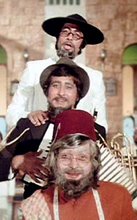
Yeah man, championing Hind, even if it means fantasizing a rule over Nepali-Tibetan glaciers: Parbat woh sab se uncha hamsaya aasmaan ka, woh santari hamara, woh pasban hamara.

England 2009

There exists the exciting possibility that sometime in the future (2008 onwards), we will see an England cricket team go into a test match with three specialist spin bowlers, representing each of the three main disciplines of spin bowling (the fourth, left arm chinamen, are extremly uncommon).

Even more amazing, all three of them could be desis.

The potential line up:
Adil Rashid - leg spin
Saqlain Mushtaq - off spin
Monty Panesar - left arm orthodox.

Monty Panesar has already secured his place in the England team. Adil Rashid is an 18 year old doing phenomenally well in county cricket and has already been identified as a future star by a number of experts. Saqlain Mushtaq previously played for Pakistan with great success at international level, but disappeared from the scene due to injury. He now holds a British Passport and becomes eligible to play for England in 2008. He also took his first 5 wicket haul on return from injury yesterday, in the process out bowling Mushtaq Ahmed, the leading spin bowler in English County Cricket.

Monday, August 06, 2007

Once upon a time in India (cont'd)

Amar and Akbar arrive in a large covered market. They walk through the myriad of stores selling clothes, jewellery, furniture and household items to arrive in front of a tailors’.

The sign reads PIPALINAGAR TAILORS’. There is an elderly man in one corner reading a vernacular newspaper. A man is haggling over the price of a suit. A schoolboy is having his uniform measured.

Amar walks up to the counter and asks: Me and my brother here were wondering if you had a pair of Japanese shoes?

It’s a tailors’, not a shoe shop. The man in the counter replies. But we do have a number of fine English trousers.

No thank you. But I would be interested in a red Russian hat. Amar responds.

The elderly man leaves his newspaper and steps in: Ah we have just the thing for you, please come this way.

Sunday, August 05, 2007


An experiment with camera settings in Birmingham

Thursday, August 02, 2007

A-A have a deep discussion

Brothers A-A-A are children of hegira. Parts of our families moved from one part of Desh to another when different parts fell apart during the tumultuous 1970s, and before that, the 1940s. Our parents left Desh for work. And now, the time has come for one of them to make a choice: return to Desh in search of a home that they may not recognise, or stay in a land that they do not recognise as home.

Reflecting this, Amar noted: Strange is the life of the exile and the emigrant.

From this, the following conversation ensued.

Anthony: Ah, but it is the sedentary life that is an aberration when you consider the history of humanity. We are a roaming species.

Amar: We were a roaming species. And when we stopped roaming, that was when we progressed spectacularly, that was when civilisation was born. The years of roaming were lost years.

Anthony: We stopped roaming, developed agriculture and formed a civilisation which was the exploitation of many by a few. Sedentary peoples were less healthy than their pastoral nomadic neighbours. Agricultural civilizations produced priests and royal classes that built pyramids and monuments on the back of hardworking and hungry peasant, who was was worse off than his hunter-gatherer cousin. Real spectacular progress came in the more recent times, when we started roaming again. It started when a new civilization, based on the elegant faith of a nomadic people, allowed migration from one end of the known world to the other, trading ideas and commodities. It gathered pace when their rivals ventured to the unknowns beyond the oceans. The prosperity of today's cities on the hill, promised lands and new Jerusalems are all built by the roaming folks, the exile and the immigrant. This is true in Queens, New York and Southall, London, and it is true in the slums of Mumbai and Nairobi. It is the years of cultivating rice in swamps that were lost years!

Amar: A new civilisation based on the elegant faith of a nomadic people? You overlook that a recurring consequence of people venturing away from home in last five hundred years has been wars, imperialism, colonialism, vicious exploitation of others. Two world wars in the last century were also the result of people wanting to move to new places.

Anthony: Wars and invasion of others' territory didn't exactly begin in the last 500 years. Troops of chimpanzees and baboons fight wars of attrition, remember that scene in 2001: A Space Odyssey? Folks in PNG highland have a higher probability of meeting a violent death in the hands of a stranger than anywhere else in the world. And as for exploitation, well vicious exploitation of others begun with agriculture. Slavery, serfdom, caste system – that's exploitation. Yes people moving around causes problem. But for the millions exploited in the farms around the world, migration is the only root to salvation.

Amar: And when they find salvation, don't they settle down?

Anthony: I wouldn’t know, as I still haven’t found what I’m looking for.