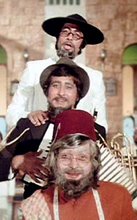
What's with Hollywood? We saw Next yesterday, terrorists planning to nuke LA in what would be almost certainly a suicide action, and instead of being Jihadis, they are young blond French, German and Russian men and women who show no sign of being Muslim, and have no discernable agenda whatsoever.
Amar asked this the other day. And the question got me thinking.
We discussed Jihad International at length last year. We argued that, contra Syriana, Jihadis don’t seem to be motivated by material poverty. We also discussed Islamofascism and Islamosocialism, but didn’t draw any link between Jihad and anarchy.
Perhaps we should have. The idea is not new. This Economist article, from August 2005, draws parallels between the Jihadi violence and the anarchist ones that terrorised Europe in the late 19th century.
What did the anarchists want? Pierre-Joseph Proudhon, their first great intellectual and the scribbler of the graffiti ‘property is theft’, wanted to replace states with a society based on voluntary contracts. This appears to be the antithesis of what modern Jihadis want — Mullah Omar never seemed like a libertarian to me! The Economist notes this too, but argues that scratch the surface, and there are many similarities, not the least between the means used by the two groups. Both, for example, rely on spectacular acts of violence to highlight their ideas — hence this ditty: It will come, it will come,every bourgeois will have his bomb.
This is not a very elegant ditty. A much better one, quoted by Bertrand Russell to describe the rise of Western revolutionary ideologies, is this.
Ah Love! could thou and I with Fate conspire
To grasp this sorry Scheme of Things entire,
Would not we shatter it to bits--and then
Re-mould it nearer to the Heart's Desire!
Anarchists, fascists, Bolsheviks, Jihadis — revolutionaries of left and right are bound by this common thread, this urge to grasp, shatter and re-mould. Of course each heart desires very different things, but that’s another matter.
The legend has it that the old man of the mountain was a close friend of the poet‑mathematician who scribed this ditty. While Hassan and Omar may not have been friends, and Hassan may not have given us the word assassin, it is probably true that he wanted to shatter the state of things in his day, and led a series of asymmetric wars to achieve that end.
The world will watch in terror as the greatest city falls. Anarchy and chaos will spread...
Another message from Bin Laden or Zawahiri, both last seen alive in a mountain? No sir, this is R’as Al Ghul in Batman begins. Ghul wants to destroy Gotham …so that mankind will ravage itself, the species will be culled and the balance of nature restored. The planet will be saved for all species.
In the movie, Ghul is a white man whose sanctuary appears to be somewhere in the Himalayas. Of course the aficionados know that in the graphic novels, Ghul comes from North Africa. Perhaps an apocalyptic figure from that part of the world was too much for Hollywood to stomach.
Perhaps. But you should be relieved to know that the spooks are onto this:
Anti-US and anti-globalization sentiment is on the rise and fuelling other radical ideologies. This could prompt some leftist, nationalist, or separatist groups to adopt terrorist methods to attack US interests. The radicalization process is occurring more quickly, more widely, and more anonymously in the Internet age, raising the likelihood of surprise attacks by unknown groups whose members and supporters may be difficult to pinpoint.
Hat tip Daniel Drezner, who asks: Will the anarchists of the 21st century unite?
So, the anarchists who planned to nuke LA in the movie Amar saw were motivated by some radical ideology? Well, perhaps it was the lack of an ideology, the absence of a great cause, that motivated them? I haven’t actually seen the movie, so can’t comment. But wasn’t this the case for Tyler Durden? Didn’t he want ‘Project Mayhem’ to be the Great Depression and World War II of his generation?
Capitalism breeds alienation, argued Marx. And from alienation comes anger and violence — thus argued a Dutch philosophy teacher on board Eurostar from Paris to Amsterdam earlier this year. Thanks to my best friend and companion’s surname and religion, I’m often drawn into conversations about these matters. Most such conversations were worse than excruciating. Not this one — though a subsequent one involving the philosopher’s Fortuyn-admiring wife and a British linguist employed by the International Criminal Court on Saddam Hussein’s trial was.
Anyway, I digress. Does one need an ideology to be angry enough to blow up the outside world? Perhaps Amar should ask Amaninder.
Saturday, June 30, 2007


Sunday, June 24, 2007
Had there been a battle at Plassey
Saturday was the 250th anniversary of the Battle of Plassey. To mark the event, we present our thoughts on what could have happened if the John Company had lost on 23 June 1757.
Of course, as every school child in Desh knows, no battle actually was fought at Plassey on that day because cliques led by his vizier betrayed the Nawab. Had there been actual fighting, sheer numerical superiority probably would have handed the Nawab victory.
What would have happened if the Nawab had won?
His army would almost certainly have burnt Calcutta to the ground. The Company would have lost all its privileges in Bengal. But would it have survived in the South? The Madras presidency was a separate entity, and there is no reason why it would have folded if Calcutta was lost. But would the Company have been so weakened that it would have ceased its rivalry with the French? And if the English Company was sufficiently weakened, would the Dutch Company have returned to the game in Desh?
By the 1750s, the Mughal Empire was in the process of disintegrating. There were principalities — Hindus and Muslims, large and small; Bengal, Hyderabad and Awadh, all Muslim, being the three large ones — that accorded the Mughal throne de jure allegiance while maintaining de facto independence. These post-Mughal states weren’t always friendly to each other. And then there was the Maratha confederacy, the first Hindu power to seek mastery of the entire Desh in many centuries.
The European companies operated in this world. In ‘the famous 200 days’, Clive gained mastery of Bengal and put the English Company way ahead of its French rival (the Dutch had conceded the contest earlier). Had Plassey gone the other way, the French perhaps would have come out ahead.
Or perhaps not.
We know that Hyder Ali and Tipu Sultan of Mysore were no anglophiles (see how Tipu's tiger mauls a sahib).

Bengal and Mysore probably would have become French allies, but perhaps the English would have formed an alliance with the Marathas. Perhaps in the course of the next few decades, a stand off would have ensued, with two alliances — French backed Bengal-Mysore entente and the English-allied Marathas — facing each other across the remnants of the Mughal Empire.
Which way would Hyderabad, Awadh and various Rajput and Afghan princes have gone?
There is no reason to think that the developments in Desh would have significantly affected the American and French revolutions. But Napoleon’s defeat would almost certainly have weakened the French Company. While this would have meant a Maratha ascendancy across Desh by the 1810s, a Maratha supremacy would by no means have been a certainty. By the 1820s, Ranjit Singh would have seated on this throne, overseeing his Sikh kingdom, adding one more power in the game.

Fearful of the expansionist power to the north beyond Hindu Kush and the Oxus, the Sikh king would surely seek alliance with some other European power, but who would that power have been?
By the 1840s and the 1850s, Desh would have become the setting of a great game of intrigue and high politics involving home grown and foreign players. How would the game end? Would there have been one massive war? Or would there have been a cold war? Who would have come out on top in that Great Game?
Of course, as every school child in Desh knows, no battle actually was fought at Plassey on that day because cliques led by his vizier betrayed the Nawab. Had there been actual fighting, sheer numerical superiority probably would have handed the Nawab victory.
What would have happened if the Nawab had won?
His army would almost certainly have burnt Calcutta to the ground. The Company would have lost all its privileges in Bengal. But would it have survived in the South? The Madras presidency was a separate entity, and there is no reason why it would have folded if Calcutta was lost. But would the Company have been so weakened that it would have ceased its rivalry with the French? And if the English Company was sufficiently weakened, would the Dutch Company have returned to the game in Desh?
By the 1750s, the Mughal Empire was in the process of disintegrating. There were principalities — Hindus and Muslims, large and small; Bengal, Hyderabad and Awadh, all Muslim, being the three large ones — that accorded the Mughal throne de jure allegiance while maintaining de facto independence. These post-Mughal states weren’t always friendly to each other. And then there was the Maratha confederacy, the first Hindu power to seek mastery of the entire Desh in many centuries.
The European companies operated in this world. In ‘the famous 200 days’, Clive gained mastery of Bengal and put the English Company way ahead of its French rival (the Dutch had conceded the contest earlier). Had Plassey gone the other way, the French perhaps would have come out ahead.
Or perhaps not.
We know that Hyder Ali and Tipu Sultan of Mysore were no anglophiles (see how Tipu's tiger mauls a sahib).

Bengal and Mysore probably would have become French allies, but perhaps the English would have formed an alliance with the Marathas. Perhaps in the course of the next few decades, a stand off would have ensued, with two alliances — French backed Bengal-Mysore entente and the English-allied Marathas — facing each other across the remnants of the Mughal Empire.
Which way would Hyderabad, Awadh and various Rajput and Afghan princes have gone?
There is no reason to think that the developments in Desh would have significantly affected the American and French revolutions. But Napoleon’s defeat would almost certainly have weakened the French Company. While this would have meant a Maratha ascendancy across Desh by the 1810s, a Maratha supremacy would by no means have been a certainty. By the 1820s, Ranjit Singh would have seated on this throne, overseeing his Sikh kingdom, adding one more power in the game.

Fearful of the expansionist power to the north beyond Hindu Kush and the Oxus, the Sikh king would surely seek alliance with some other European power, but who would that power have been?
By the 1840s and the 1850s, Desh would have become the setting of a great game of intrigue and high politics involving home grown and foreign players. How would the game end? Would there have been one massive war? Or would there have been a cold war? Who would have come out on top in that Great Game?


Monday, June 18, 2007
Changing names
[T]here are the same streets and shops and dishes and hotels, the same Star and Zee TV channels, the same moustachioed men in motorbikes and brisk women working behind the bank counters, the same juxtapositions of colonial and modern architecture, the same squalid streets with boys carrying planks on their heads, and the same wealthy babes schooled on satellited repeats of The Bold and the Beautiful who hang around outside pasta restaurants saying: ‘It’s so boring here, Tina. Let’s go to Maxi’s, yaaah?’
That’s how Patrick French describes the similarities between Lahore and Delhi in his 1997 masterpiece Liberty or Death. Lahore and Delhi, and also quite easily Karachi, Mumbai, Kolkata and Dhaka — the above para could easily describe all major Desi cities. French also described the major difference between Lahore and Delhi — Jinnah is everywhere in the former and nowhere in the latter.
Jinnah is not the only historical personality present in parts of Desh and absent elsewhere. Streets and localities are named after various politicians, poets and sundry once-famous people across Desh. Sometimes, streets and localities are renamed to reflect political changes.
For example, in Dhaka, many streets and buildings built during the Pakistan days were renamed when the association with Pakistan was severed. Jinnah Avenue became Bangabandhu Avenue and Jinnah Hall became Surjya Sen Hall. Similarly, Ayub Gate became Assad Gate and Ayub Nagar became Sher-e-Bangla Nagar. Iqbal Hall became Sgt Zahurul Huq Hall, and of course Pak Motors became Bangla Motors.
As the last link notes, while names associated with Pakistan changed, those associated with the British — Minto Road and Curzon Hall — have survived in Dhaka. This is not the case in Kolkata. Also, while Dhaka’s renames mark Bangladesh’s freedom struggle, Kolkata is more internationalist. Thus, Dharamtala is now Lenin Sarani, Harrington Street is Ho Chi Minh Sarani and Theatre Road has become Shakespeare Sarani. Iqbal has been erased from Dhaka, but Ekbalpur Road has now become Kabi Mohammed Iqbal Road, and Free School Street is now Mirza Ghalib Street. This is not to say that traditional Indian national icons are ignored — that’s why Chowringhee was renamed Jawaharlal Nehru and Red Road became Indira Gandhi Road. And there are many places named after Tagore.
Of course Desh is not the only place this kind of renaming occurs. For example, they are changing names in South Africa these days, with Durban's Point Road (reputed to house many houses of ill-repute) being renamed after Mahatma Gandhi.
That’s how Patrick French describes the similarities between Lahore and Delhi in his 1997 masterpiece Liberty or Death. Lahore and Delhi, and also quite easily Karachi, Mumbai, Kolkata and Dhaka — the above para could easily describe all major Desi cities. French also described the major difference between Lahore and Delhi — Jinnah is everywhere in the former and nowhere in the latter.
Jinnah is not the only historical personality present in parts of Desh and absent elsewhere. Streets and localities are named after various politicians, poets and sundry once-famous people across Desh. Sometimes, streets and localities are renamed to reflect political changes.
For example, in Dhaka, many streets and buildings built during the Pakistan days were renamed when the association with Pakistan was severed. Jinnah Avenue became Bangabandhu Avenue and Jinnah Hall became Surjya Sen Hall. Similarly, Ayub Gate became Assad Gate and Ayub Nagar became Sher-e-Bangla Nagar. Iqbal Hall became Sgt Zahurul Huq Hall, and of course Pak Motors became Bangla Motors.
As the last link notes, while names associated with Pakistan changed, those associated with the British — Minto Road and Curzon Hall — have survived in Dhaka. This is not the case in Kolkata. Also, while Dhaka’s renames mark Bangladesh’s freedom struggle, Kolkata is more internationalist. Thus, Dharamtala is now Lenin Sarani, Harrington Street is Ho Chi Minh Sarani and Theatre Road has become Shakespeare Sarani. Iqbal has been erased from Dhaka, but Ekbalpur Road has now become Kabi Mohammed Iqbal Road, and Free School Street is now Mirza Ghalib Street. This is not to say that traditional Indian national icons are ignored — that’s why Chowringhee was renamed Jawaharlal Nehru and Red Road became Indira Gandhi Road. And there are many places named after Tagore.
Of course Desh is not the only place this kind of renaming occurs. For example, they are changing names in South Africa these days, with Durban's Point Road (reputed to house many houses of ill-repute) being renamed after Mahatma Gandhi.
Saturday, June 16, 2007
More writing
One of us has recently become involved with a writers’ collective that focuses on politics, economy, human rights, international affairs and issues of current development discourse. You can read their writing here.
Wednesday, June 13, 2007
Italy washed in gold
 At first life's colours were bright and harsh, but then wine washed over everything with its golden glow.


Monday, June 11, 2007

Sunday, June 10, 2007
Once upon a time in Hind
As the side bar attests, Wo hu cang long (aka Crouching tiger, hidden dragon) is one of our favourite movies. Quite a few great historical epics like this have come out of East Asia in recent years. And Hollywood has a rich tradition of historical epics (everyone has seen Charleton Heston trying to play a Hebrew in a couple of movies, but the real aficionados won’t settle for anything other than the silent version). Bollywood, in contrast, seems to have lagged behind. Yes there is the Grand Mughal, but that was in 1960. More recently, Bollywood has given us turkeys like this.
Brothers A-A-A often wondered about a Desi period epic, set some time in the post-Islam era to give all three of us a chance to appear. The Mughal Empire is a natural candidate for the setting. Brothers and sisters over at the adda also had similar ideas.
So what would our movie include?
1. A fortress would change hands, and someone would escape with their life.
2. Dushmans would chase someone across Desh.
3. A royal scandal would involve a famous diamond.
4. Complicated amorous entanglements would test the characters.
5. A Sufi saint would lead his followers in search of a golden land beyond the rivers.
6. Ideas would be tested in philosophical debates and battles involving imperial forces promising order and stability, free people resisting the empire and villains.
7. There would be nautch girls, elephants, snakes, jadu-tona, tantriks and tigers.
8. Someone would be switched at birth.
9. There would be a murder mystery.
10. It would be over three hours long.
Dear reader, watch these pages for more details (as they develop) about this grandest epic of them all.

Wednesday, June 06, 2007
Desh: an alternative history
Couple of weeks ago, we asked what if Gandhi had not called off the non-cooperation movement?
One possibility was that the movement would have degenerated into something much more violent than the Chauri Chaura incident, and yet at the end of violence, an un‑mottled dawn would have broken. This is an intriguing possibility that Amar has urged me explore further. Here is an attempt.
----
After a year of satyagraha and hartals sweeping the land, Gandhi's promise of swaraj within a year looked imminently achievable in the early 1920s. But alas it wasn't to be. The uprising turned violent in 1921, and British reprisal became harsher. A mortified Gandhi retired to his ashram, but this had little effect in many of Desh's towns and cities. Communists and other radicals, inspired by events in Russia and elsewhere, escalated violent attacks on police stations and government buildings. British reprisal was more brutal than at any time since 1857. By 1923, freedom looked further than ever.
But the restoration of the Raj carried huge costs — both financially and in politically. Raj lost its legitimacy to the Desi elite, whose collaboration was necessary for the British presence. A more ominous portent was the refusal of Desi troops to open fire on civilians in several places. The spectre of a second mutiny haunted the corridors of power in Delhi and London, and the government was looking for an opening for a political dialogue.
But who would the government converse with? Congress was officially outlawed, and Gandhi, the unquestioned leader of the uprising when it begun, and the only leader who could speak on behalf of Desis in their multitude, was in a self-imposed isolation in his ashram. None of the other Congress leaders carried enough weight, but CR Das of Calcutta and Motilal Nehru of Allahabad had support of Desi businesses and other urban elites in British India (the uprising had little effect on the native states, which carried on as before). While the Desi elite had lost faith on the Raj, they didn't trust the radical tone of the uprising either. They privately urged Das and Nehru to call off the uprising. But, neither Das nor Nehru wanted to be seen as sell-outs.
Gandhi's death in 1926, election of a labour-liberal coalition in Britain, and Stalin's rise to power in Soviet Union changed the political equation. Secret negotiations commenced between the British and Motilal Nehru, who assumed the role of de facto Congress supremo. The government announced an amnesty in 1927 and lifted the ban on Congress. Congress postponed the movement for 3 years. With Stalin cutting off aid to the radicals and communists, violence subsided.
Fearing a Nehruvian takeover of the party, Das invited the self-exiled MA Jinnah to rejoin politics. By 1928, Jinnah assumed the role of key negotiator with the British, with Nehru being the party's interface with business, and Das controlling the party machine. In 1929 the British-appointed Simon Commission reported that India should become free by the end of the 1930s.
On 26 January 1930, in Lahore, Congress adopted a resolution that outlined an Azad Desh. The British parliament passed the Government of India Act later that year. The Act called for an independent Indian Commonwealth, along the lines suggested by the Lahore Resolution by the end of the decade.
---
So, what would this Commonwealth be like? When would it have come about?
One possibility was that the movement would have degenerated into something much more violent than the Chauri Chaura incident, and yet at the end of violence, an un‑mottled dawn would have broken. This is an intriguing possibility that Amar has urged me explore further. Here is an attempt.
----
After a year of satyagraha and hartals sweeping the land, Gandhi's promise of swaraj within a year looked imminently achievable in the early 1920s. But alas it wasn't to be. The uprising turned violent in 1921, and British reprisal became harsher. A mortified Gandhi retired to his ashram, but this had little effect in many of Desh's towns and cities. Communists and other radicals, inspired by events in Russia and elsewhere, escalated violent attacks on police stations and government buildings. British reprisal was more brutal than at any time since 1857. By 1923, freedom looked further than ever.
But the restoration of the Raj carried huge costs — both financially and in politically. Raj lost its legitimacy to the Desi elite, whose collaboration was necessary for the British presence. A more ominous portent was the refusal of Desi troops to open fire on civilians in several places. The spectre of a second mutiny haunted the corridors of power in Delhi and London, and the government was looking for an opening for a political dialogue.
But who would the government converse with? Congress was officially outlawed, and Gandhi, the unquestioned leader of the uprising when it begun, and the only leader who could speak on behalf of Desis in their multitude, was in a self-imposed isolation in his ashram. None of the other Congress leaders carried enough weight, but CR Das of Calcutta and Motilal Nehru of Allahabad had support of Desi businesses and other urban elites in British India (the uprising had little effect on the native states, which carried on as before). While the Desi elite had lost faith on the Raj, they didn't trust the radical tone of the uprising either. They privately urged Das and Nehru to call off the uprising. But, neither Das nor Nehru wanted to be seen as sell-outs.
Gandhi's death in 1926, election of a labour-liberal coalition in Britain, and Stalin's rise to power in Soviet Union changed the political equation. Secret negotiations commenced between the British and Motilal Nehru, who assumed the role of de facto Congress supremo. The government announced an amnesty in 1927 and lifted the ban on Congress. Congress postponed the movement for 3 years. With Stalin cutting off aid to the radicals and communists, violence subsided.
Fearing a Nehruvian takeover of the party, Das invited the self-exiled MA Jinnah to rejoin politics. By 1928, Jinnah assumed the role of key negotiator with the British, with Nehru being the party's interface with business, and Das controlling the party machine. In 1929 the British-appointed Simon Commission reported that India should become free by the end of the 1930s.
On 26 January 1930, in Lahore, Congress adopted a resolution that outlined an Azad Desh. The British parliament passed the Government of India Act later that year. The Act called for an independent Indian Commonwealth, along the lines suggested by the Lahore Resolution by the end of the decade.
---
So, what would this Commonwealth be like? When would it have come about?
Sunday, May 27, 2007
The Great Pictographic Competition: Blood 2 !!
......Where you are still the judge (sadly)!!!

Khawateen-wa-Hazarat (Ladies and more ladies!) Amar ka parnam, Akbar ka salam, aur Anthony hai sab ka Bhagwan!
We are back with misfit moments, Ibn Batutish imagery of the world (Italy actually!!) - though this time the competition is between Pagal Bandar (previosuly known as Mad Monkey) and Mota Billa (Fat Cat - as the new entrant who fit into the competition with great difficutly).
Below are a collection of 36 pictures -20 for Pagal Bandar and 16 for Mota Billa. Once again, a butt scratching argument ensued over who is the better photographer.
Crazy Cat won the competition last time against Pagal Bandar, who was left scratching his head and counting his monkey nuts in wonder. FYI, CC has been travelling the world promoting the Cannon brand of camera which helped her win the competition.
We are back with misfit moments, Ibn Batutish imagery of the world (Italy actually!!) - though this time the competition is between Pagal Bandar (previosuly known as Mad Monkey) and Mota Billa (Fat Cat - as the new entrant who fit into the competition with great difficutly).
Below are a collection of 36 pictures -20 for Pagal Bandar and 16 for Mota Billa. Once again, a butt scratching argument ensued over who is the better photographer.
Crazy Cat won the competition last time against Pagal Bandar, who was left scratching his head and counting his monkey nuts in wonder. FYI, CC has been travelling the world promoting the Cannon brand of camera which helped her win the competition.
We again call on our reader, fans, hatemailers and all kinds of creature (see picture above) to decide whose vacation was better? -Bandar OR Billa?
Vote for the one
whose pics you so love
if not,
then vote for the one you hate less!
XXX
PB & MB

PAGAL BANDAR
PRESENTS HIS
MARVELLOUS ITALIAN HOLIDAY:
A Monkey Foreword: I just wanted to explain how my photos were selected. Rather than focus only on the beautiful, or on 'clever' photography, many of the photos are about places, sights, experiences that I wanted to share with you - the talking statues of Rome, the worn stairs of Pisa, and so on. Some of the photos are thus very ordinary, but their subject matter is, I think, quite interesting. Enjoy.
 We fly over the higher peaks of the Italian Alps, snow-capped even in May.
 The Infamous Leaning Tower of Pisa.
 Inside the Leaning Tower, a narrow spiral stair case goes up to the top.
 The foot-steps of centuries of travellers have worn down the stairs inside the Tower, and they are significantly and visibly sunken in the middle. They are also quite slippery, as a result of all that friction and wear, and need to be climbed carefully.
 The twin brothers Remus and Romulus, nursed by a wolf, are the mythological founders of Rome.
 An Orange and Lemon shop at Pompeii the south of Italy, on the slopes of Mount Vesuvius.
 The city of Pompeii, along with its residents, was buried under volcanic ash and rock when Mount Vesuvius erupted in 79 C.E. The living themselves turned to ash and dust, but modern archaelogists found that by pouring plaster into the cavities left behind, they could create moulds of Pompeii's victims in the very position they died. In great contrast to the terror visible on many of the re-created faces, this man appear to have died while sleeping peacefully. Nearly two thousand years later, his face and posture still exudes a sense of calm and serenity, in contrast to all the noise and activity around him.


These two photos are plays on a single theme - The Effect of Woman on Man. I have written more about the first photo elsewhere on the blog. The second photo, I leave to you to interpret as you wish.

 It was late night, and we were somewhat lost when we came across this road. We didn't know where it led, and there was not a person in sight. But it was so intensely atmospheric, full of mystery and a promise of surprise revelations around the corner that we felt compelled to follow the road, wherever it might lead us.

 These two photos are of the ceiling of Chiesa Sant Ignazio, or the Church of Saint Ignatius, in Rome. The ceiling is fascinating, painted by Andrea Pozzo and full of visual tricks to fool the eye into thinking the church ceiling is much higher than it actually is. For example, look at the two arches on the left, on top of one another. Only the one at the bottom is real - the one on top is actually painted on the ceiling.

The dormant volcano of Mount Vesuvius, top left, erupts periodically, with a major eruption approximately every two thousand years. The next major eruption is in fact expected sometime this century. As you can see in the photo above, the area around the volcano has a high urban concentration, and millions of people live in the volcano's shadow. It would take nearly a week to evacuate everybody in case of an emergency, assuming of course, that the Volcano provides a week's warning.

Say hello to Pasquino! Pasquino is a talking statue, and he is known for his love of satire, gossip, and lampooning the authorities and other important people! He's been standing in his corner passing rude comments on all that goes on in Rome and the rest of the world for five hundred years now. One of the Popes even wanted him thrown into the river for his impudence! There is a word in the English language - Pasquinade (a work of satire/lampooning posted in public) - which has its origins in Pasquino's name. Pasquino is famous!
While Pasquino is Rome's most famous talking statue, he is not the only one. There are a number of them, including Madame Lucrezia, Baboon (!), all of them together known as the Congress of the Wits. But Pasquino has always been the leader, and he is a hero for all who love free speech.
It would be nice to have our own Pasquinos in Desh.


Illegal street vendors running away with their wares (in this case, art posters) when they see the police coming. Once the police are gone, they will return. This game of cat and mouse is played out on a daily basis. Most of the vendors tend to be from Bangladesh or West Africa. Florence, Italy.


ps - PAGAL BANDAR'S HOLIDAY FINANCED BY LOCAL MAFIA.
HIS FABOULOUS
ITALIAN GETAWAY:

On YOUR doorstep has this mad man arrived


Miss Cellulite 2007!
 Life between a rock and a hard place.

Reflection of Beauty


Tanhai
 When the shadow has abondoned.


The path we wander, the path we astray.
Subscribe to:
Posts (Atom)