Some time ago, Amar talked about the Giant Rat of Sumatra, er New Guinea. Well, islands are conducive for things like Giant Rats, and other odd-sized animals. Islands typically don’t have large carnivores — not enough food supply for their survival. So, in the absence of large carnivores, smaller carnivores and herbivores grow bigger than their mainland counterparts. And at the same time, large herbivores tend to shrink over time. That’s why islands could have Dwarf Elephants. These phenomena are called island gigantism and insular dwarfism respectively.
Could something like this have happened in Skul Island? The wiki link says that the island has an unstable ecosystem. What does that mean? Those dinosaurs have survived 65 million years in the island, how unstable could the ecosystem really be then? And how the hell did those insect grow so big?
And what about Kong himself? How did his kind get to grow so big? The wiki says it was the last of its species. How did it get to the island?
And what about the human inhabitants? I thought the scene where they came to get Ann was genuinely cool. Obviously their religion is a cult of Kong. But what is Kong meant to do with Ann? Gorillas don’t eat meat (they eat insects if occasionally). Does Kong eat meat?
I watched King Kong in the plane few weeks ago, and started wondering these. You see, one really can’t enjoy the grandeur of King Kong in the tiny screen that one gets in the economy class in a Boeing 777. This is one big screen movie.
I watched I am Legend in the big screen. I was looking forward to it eagerly. Will Smith is cool. The idea of the original novel seemed cool. A deserted New York City could have been cool. And I happened to be there when they were shooting it. How could it go wrong?
Well, it did go wrong. Neville, Smith’s character, was hunting the mutants. But the mutants were also hunting Neville. They were watching him. They laid traps for him. I’m sure New York’s concrete jungle could have been exploited for some really spine tingling cat and mouse spooky scenes. Shame nothing like that happened.
And since it wasn’t thrilling enough, I started wondering about the mutants’ biology. So the virus that was supposed cure cancer had terrible side effects — it killed most of the humanity, and resulted in rabies, hair loss, loss of resistance to the UV ray and extreme aggression among most of the survivors. Only a very small number of people were resistant to the mutated virus.
Okay, so far so good. But why the hell do all the mutants look similar? Surely CGI doesn’t have to mean that. These creatures only come out at night because of their problem with the UV ray. But does a problem with the UV ray give them night vision? Does the virus affect their optic nerves? And how did the creatures get to be so powerful? And how did they develop spiderman-like climbing abilities?
You see, if you start thinking about this stuff, the movie is obviously not going so well for you. But I’m still curious enough about the book to read it. Perhaps I’ll write about it some other time. Meanwhile, if you want more such stuff (physics, not biology), check this out.
Showing posts with label science. Show all posts
Showing posts with label science. Show all posts
Wednesday, March 12, 2008
Friday, May 12, 2006
Golar or prizzly?
What would you call a cross between a grizzly and a polar bear? Well, whatever you call it, a Canadian hunter killed it, and people are unhappy. The photo is below. The facts are available here, and google will tell you how horrible a crime against nature killing this rare animal is.
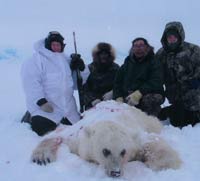 But is it a horrible crime against nature?
Two animals are of the same species if their offspring is fertile. The dead animal is a result of cross-species mating. Probably its dad got lost, had too much berry, some of it a bit fermented, felt a bit horny and humped anything that barely resembled a bear, or beared a bearish resemble, or… Okay, enough with bad jokes. The point is, the dead animal was infertile, so there’s no loss to the nature by its killing.
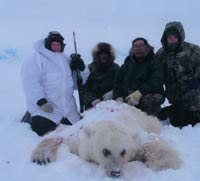 But is it a horrible crime against nature?
Two animals are of the same species if their offspring is fertile. The dead animal is a result of cross-species mating. Probably its dad got lost, had too much berry, some of it a bit fermented, felt a bit horny and humped anything that barely resembled a bear, or beared a bearish resemble, or… Okay, enough with bad jokes. The point is, the dead animal was infertile, so there’s no loss to the nature by its killing.


Tuesday, February 14, 2006
On the moon
The Moon is a pretty unusual satellite.
Firstly, it's very big – the Moon-Earth size ratio is much higher than say the Phobos-Mars size ratio. Only Pluto’s satellite has a relatively larger size, but some people don’t even recognise Pluto as a real planet.
Secondly, this means that the general theory about satellites – that these were pieces of rocks captured by the planet – doesn’t hold for the Moon: it’s simply too big to have been captured by the Earth’s gravity.
Thirdly, the Moon rotates around itself in exactly the same amount of time as its revolution around the earth. This means that we can only see only one side of the Moon – hence the saying the far side of the Moon. Scientists are not sure why this is so – the dominant theory is that there is an assymmetry in its density. But this just raises the question why this should be so.
Could we resort to the anthropocentric principle? Maybe if the moon were not the way it is, the course of evolution would have been affected such that we wouldn’t have been here to ponder why the Moon is the way it is? But the anthropocentric principle always seemed like a fudge to me. Hmmm, more research is required.
Tuesday, January 17, 2006
On probability
You are a contestant in a game show. You choose from three closed boxes. One contains the keys to a car and the other two a picture of a goat. You make a choice. The host opens one of the other doors to reveal – a goat. He taunts you to change the decision. Should you switch to the other closed box?
This is the Monty Hall problem. When the problem was first published in an American magazine in the 1970s, thousands of readers — including professors of statistics — alleged an error.
Consider another problem. One person in a 1,000 suffers from a rare disease. You have been tested randomly for this illness and tested positive. The test gives a correct diagnosis in 99 per cent of cases. How likely is it that you have the disease? If you’re much stressed then don’t be. It’s not very likely that you have the disease. In random groups of 1,000 people an average of 10 would display false positives and only one would be correctly diagnosed with the disease.
Suppose that two editors, Amar and Akbar, independently check your manuscript. Amar finds 3 mistakes and Akbar finds 4, and 2 of the mistakes are commonly found. Can you see that we would expect only one unfound error remaining?
These are just some examples of probability problems I found hard. But then, as Stephen Jay Gould said: The human mind did not evolve to deal with probabilities.
And if you’re still scratching your head, the answer to the Monty Hall problem is, yes you should switch.
Subscribe to:
Posts (Atom)