Showing posts with label detection. Show all posts

Sunday, October 29, 2006

Now I am become death, the destroyer of worlds

The atom bomb has been in the news again recently, with North Korea successfully testing a device earlier this month, the Iranian nuclear programme under scrutiny and suspicion all year, and our very own Anthony lecturing us on Nukes.

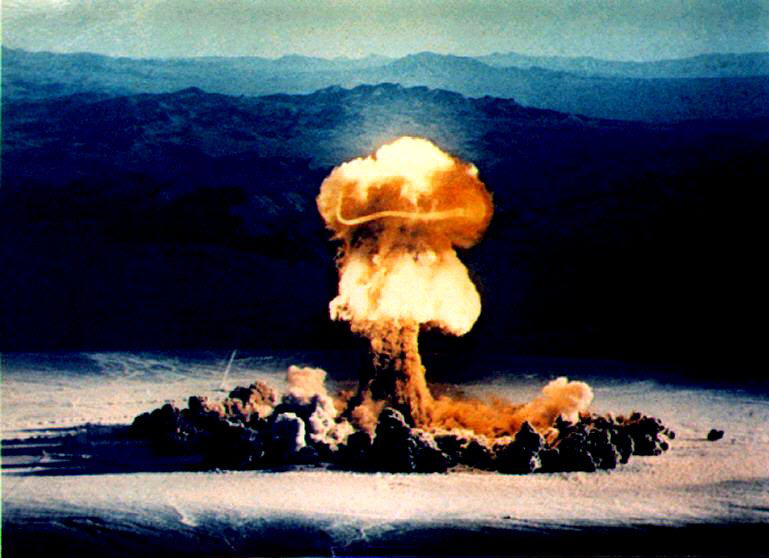
There's a famous (and true: see video) story about the moment the first atom bomb was tested, in the deserts of the American West. As Robert Oppenheimer, the scientist dubbed the father of the bomb, watched the first mushroom cloud appear on the horizon, the full horror of his own accomplishments struck him, and he was moved to recite the words of Krishna from the Bhagavad Gita:

I am become death, the destroyer of worlds.

***

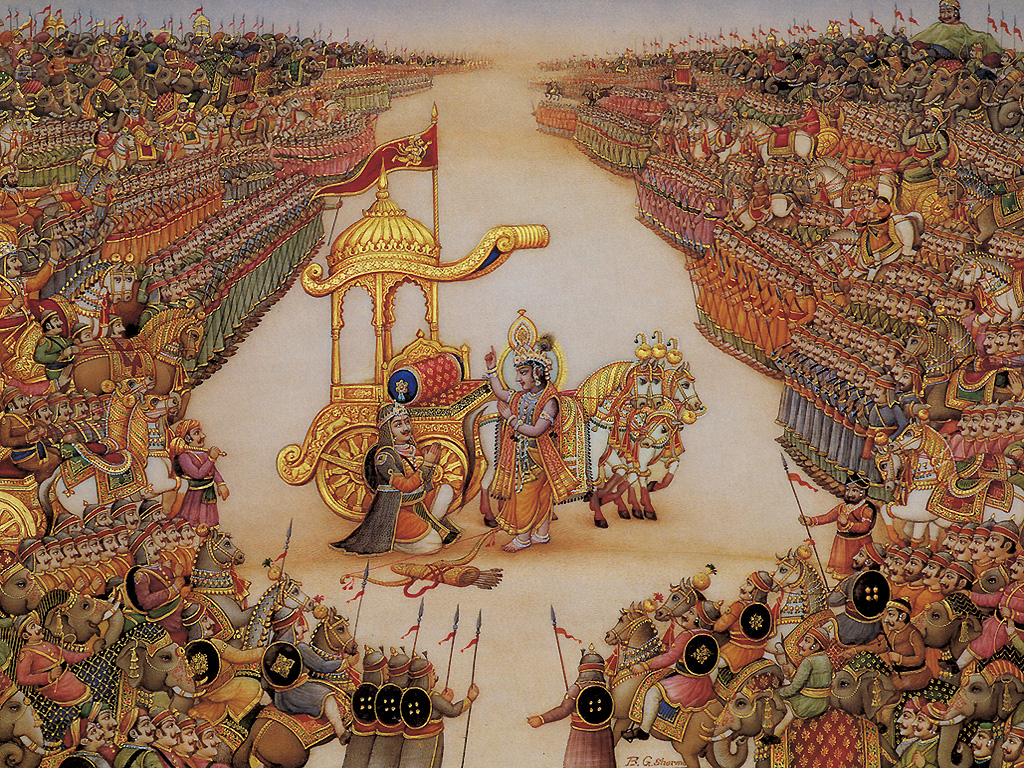
I remembered this as I was reading the Bhagavad Gita recently, because I couldn't find these words in my translation. The verse Oppenheimer had in mind was 11:32, which Juan Mascaro (The Bhagavad Gita, transl. Juan Mascaro, Penguin Books, 1962 1st edition) gave instead as follows:

I am all-powerful Time which destroys all things.

***

I was annoyed by two things about the translation Oppenheimer used.

Firstly, and the minor detail, was the grammar. There appears to be no reason to use the grammatically incorrect 'I am become', when the correct wording would have been 'I am' or 'I have become', and which could have been used. It appeared to be a case of translating something incorrectly to make it sound more exotic and foreign - as Edward Said may have noted in Orientalism (I can't remember where I read it, and I can't think where else it might have been. Rushdie?), there seemed a touch of suggestion that here was something so strange and foreign and absurd, that it could not even be translated correctly and sensibly.

Secondly, and the major issue, was the very fundamental one of what the original verse said. To say One is Death has far more sinister overtones than saying One is Time, and certainly while Time is in a way Death - as a character in Fight Club says, On a long enough time line, the survival rate for everyone drops to zero - there is a huge difference in idea, intent, and meaning. Was Krishna simply saying he was Time, and Oppenheimer misinterpreting it to Death? Was the most popular quote from the Gita in the western world actually a mistranslation?

I decided to look into this further.

***

The relevant line in the original sanskrit is as follows:

kalo 'smi loka-ksaya-krt
(source:http://www.asitis.com/11/32.html)

As I had no issue with 'the destroyer of worlds' = 'which destroys all things', I was only concerned with the first half of the line: kalo'smi. This could be translated as I am 'Kalo'. So what did 'Kalo' in this context refer to? Death or Time?

I decided to see if others had considered this matter. They had indeed, and in some detail. There was a paper called 'The Gita of J. Robert Oppenheimer' by James Hijiya, Professor of History at the University of Massachusetts, which explained that Oppenheimer was significantly influenced by Arthur Ryder (a Sanskrit scholar who had taught Oppenheimer), whose translation of the Gita used Death instead of Time. I have reproduced footnote 50 of his paper in full:

"Ryder’s translation here is a little peculiar but defensible. Ever since the first rendering of the Sanskrit text into English in 1785, most experts have translated this word not as Death but as Time. Cf. Charles Wilkens, The Bhagvat-Geeta (London: C. Nourse, 1785; Gainesville, Fla.: Scholars’ Facsimiles & Reprints, 1959), 93; Besant, Bhagavad-Gita, 116; Prabhavananda and Isherwood, Bhagavad-Gita, 123; S. Radhakrishnan, The Bhagavadgita (New York: Harper & Brothers, 1948), 279; Eknath Easwaran, The Bhagavad Gita (Petaluma, Calif.: Nilgiri Press, 1985), 154; Barbara Stoler Miller, The Bhagavad-Gita (New York: Columbia University, 1986), 103; Dominic Goodall, Hindu Scriptures (Berkeley: University of California, 1996), 260.
There are, however, exceptions. Franklin Edgerton, The Bhagavad Gita (Cambridge: Harvard University, 1944), 58, renders the word as “Time (Death).” Miller, Bhagavad-Gita, 103, translates the word in question and a following phrase as “time grown old”; Radhakrishnan, Bhagavadgita, 279, as “time . . . grown mature.” The passage of a vast expanse of time implies death, thus making “Death” a legitimate translation. In his rendering of the passage, Oppenheimer followed his teacher, Ryder. This variant was especially appropriate for describing a nuclear explosion, which could bring a great deal of Death in very little Time."


***

The footnote answered most of my questions, but I would like to note the following:

The reasons for the difficulty are obvious for the Hindustani speaker just by looking at words in contemporary usage with the K-L consonant sounds. There are words like Kal, Kaal, Kala, which we associate with concepts of time, but there is also the goddess associated with death, Kali.


***

But one can in this instance also look within the Gita to see other instances where concepts of Time or Death are mentioned, and consider the vocabulary employed for them. I am more familiar with Adhyayas (Cantos) 1 and 2, where in 1:1, Sama is used for Time, and where in 2:37, Hato is used for Death. Unhelpfully, Kal is used for neither situation. It is used elsewhere in the book, including Adhyaya 11, but I did not have, well, the time(!) for a thorough review, and decided against an incomplete one.

***

In summary, we wondered whether Oppenheimer wasn't misquoting the Gita. We laid out the reason for our wondering thus, and then found that someone had already done a lot of research on the topic, which revealed that most translators thought so, but there was a minority in support. Since we are libertarians and see no harm in minorities taking divergent opinions where there is no harm to others, I will not be criticizing Mr Oppenheimer's choice of translation, though I do not think I agree with it.

Tuesday, May 09, 2006

you may already know classical sanskrit

While aware of the shared ancestry of the Sanskrit and English languages as members of the Indo-European languages family, I must confess to still feeling a sense of amazement whenever I come across an unanticipated or unexpected reminder of this.

Last week, I was listening to the Sanskrit recitation of the Bhagavad Gita while reading the English translation. And when the text mentioned brothers, the sanskrit word for it was bhratren, to all intents identical to the english brethren.

The online etymology dictionary threw up this interesting item:

BROTHER
O.E. broþor, from P.Gmc. *brothar, from PIE base *bhrater (cf. Gk. phratér, L. frater, O.Ir. brathir, Skt. bhrátár-, O.Pers. brata, Goth. bróþar, O.Prus. brati, O.C.S. bratru "brother"). As a familiar term of address from one man to another, it is attested from 1912 in U.S. slang; the specific use among blacks is recorded from 1973. Alternate pl. brethren was predominant c.1200-1600s, but survived only in religious usage. Colloquial shortening bro is attested from 1666. Brotherhood is M.E. broiþerhede (c.1300). In Arabic, Urdu, Swahili, etc., brother-in-law, when addressed to a male who is not a brother-in-law, is an extreme insult, with implications of "I slept with your sister."

I rather like the brother-in-law comment too :-]

Anyway, that was last week. This week, still slowly reading the Bhagavad Gita, I came across this Sanskrit passage:

tataḥ śvetair hayair yukte
mahati syandane sthitau

One Bhagavad Gita website translates this as: stationed on a great chariot drawn by white horses

Now place each sanskrit word next to its approximate english definition:

tatah/thereforẹ śvetair/white hayair/horses yukte/yoked
mahati/mighty syandane/chariot sthitau/situated


Isn't that amazing? With just a little assistance, someone who knows only English is able to almost fully read and understand a classical Sanskrit verse composed over two millenia ago. Maybe you are still sharp enough to learn a new language or two after all.

Sunday, February 05, 2006

An assassination in Lebanon

On 12 October 2004, a Mitsubishi Canter Van was stolen in Sagamihara City, Japan. Three months later, on 21 January 2005, the same Mitsubish Canter crossed into Lebanon from its border with Syria. On 14 February 2005, as former Lebanese Prime-Minister Rafiq Hariri's motorcade drove through downtown Beirut, a remote-controlled bomb detonated resulting in a massive blast that killed Hariri and 22 others. It was later established that the source of the blast was a Mitsubishi Canter Van carrying one thousand kilos of explosives.

Not all thrillers are fiction. You can read the full UN report into the assassination of Rafiq Hariri here.

Wednesday, September 28, 2005

the curious incident of the non-existent patatar

In Desh, the tomato is known as tamatar, so why isn't the potato called patatar? Why is it instead called aaloo? Didn't tomato and potato both originally come from South America? How then did the tomato manage to keep its original name, and how did the potato lose its? Why did people start calling the potato aaloo, did the word refer to something else once upon a time? If so, what? How and when did tomatoes and potatoes first arrive in the subcontinent, and how did they subsequently become so wide-spread? And what was our food like before their arrival, how was it different from what we eat today?

* * *

The potato (fancy name: solanum tuberosum) and the tomato (solanum lycopersicum) go back together a long way. In fact, I don't think I will be able to have fries with ketchup again without thinking of old friends, and missing them all terribly. For that is what the two are.

Look at the similarity for classification purposes: the two fall within the same kingdom, division, class, order, family and genus. They must have once had a common ancestor - the legendary and exotic potamato. And being from the same family, they share the same first name too.

Then there's the shared history and culture. Both were originally native to South and Central America, living happy indigeneous lifestyles. Then towards the end of the 15th century, the Spanish arrived. Clearly more impressed with tomatoes and potatoes than with the local population, they were soon exporting the plants back to the motherland as well as to other colonies around the world.

There is a suggestion that their spread in Asia was via the Philippines, a Spanish colony from the late 16th century onwards. Maybe they came to Desh via Spain's European neighbour Portugal. After all, the Portuguese had a permanent settlement in India by early 16th century, and they were also quick to follow the Spanish into South America (in breach of the inter caetera ). Some say it was the British. Maybe there were multiple introductions, by different people at different times and places. We do not know for certain.

The tomato and potato had probably reached Desh by the middle or late 16th century - when Desh was ruled by Akbar the Great. They may have subsequently changed our cuisine and our diet, but noone seems to have noticed their arrival. We have records of Portuguese missionaries, Persian artists and judges, Bilayati traders and merchants, but the humble tomato and potato seems to have entered Desh unrecorded.

***

The word tamatar comes from tomato. The Online Etymology Dictionary notes:

TOMATO: 1753, earlier tomate (1604), from Sp. tomate (1554) from Nahuatl tomatl "a tomato," lit. "the swelling fruit," from tomana "to swell." Spelling probably influenced by potato (1565). A member of the nightshade family, which all contain poisonous alkaloids.

Again the parallel history of the two plants is seen, with the idea that our spelling for tomato came from that of the potato. So how did we get to potato?

POTATO: 1565, from Sp. patata, from Carib (Haiti) batata "sweet potato." Sweet potatoes were first to be introduced to Europe; in cultivation in Spain by mid-16c.; in Virginia by 1648. Early 16c. Port. traders carried the crop to all their shipping ports and the sweet potato was quickly adopted from Africa to India and Java. The name later (1597) was extended to the common white potato, from Peru, which was at first (mistakenly) called Virginia potato, or, because at first it was of minor importance compared to the sweet potato, bastard potato.

Poisons and bastard potatos! Suitably impressed, we arrive at the modern words potato and tomato. The question I want to proceed to is the transformation of a potato into an aaloo. Why are the potatoes of Desh called Aaloo? I consulted the wonderful Hobson-Jobson:

ALOO (p. 16) , s. Skt. -- H. ālū. This word is now used in Hindustani and other dialects for the 'potato.' The original Skt. is said to mean the esculent root Arum campanulatum.

So aaloo comes from sanskrit then. A quick confirmation at the Monier-Williams Sanskrit dictionary :

ola
ola or olla mfn. wet, damp L.
• (am), n. Arum Campanulatum L.


Ola to Aaloo? Maybe. But what's Arum Campanulatum anyhow?

An illegitmate name is what, according to the international code of botanical nomenclature. How strange and mysterious. But this is a matter for another day, and I ignore this mystery of illegitimacy and continue ploughing.

A paper on the plant names of Nepal talks about the edible bulb of the Arum lily, or Arum campanulatum. This is apparently eaten as a paste in times of hardship. So we seem to have an edible flower from Desh, which would wrap things up nicely, except isn't a bulb not a root! Sigh.

Hindunet's Saraswati Sindhu Civlization (?!) page has a dictionary which seems to say it is a kind of yam:

2063.Arum campanulatum: ce_n-ai amorphophallus campanulatus (Ta.); ce_na yam, arum campanulatum (Ma.); ke_ne tahiti arrowroot, an itchy root (Ka.); ke_n a kind of yam, arum campanulatum [amorphophallus campanutalus = arum campanulatum](DEDR 2022). Amorphophallus campanulatus: arsaghna (Skt.); jungli suran (M.); ol (B.); zaminkand (H.); karnaikilangu (Ta.); kanda (Te.); chena (Ma.); tuber: stomachic, tonic, restorative, carminative, in piles and dysentery, when fresh acts as an acrid stimulant and expectorant and much used in acute rheumatism (GIMP, p.16).


However, there is not much other information to be found, the reason seeming to be that arum was a 19th century misclassification and whatever it referred to is now going under a different name. So we are trying to work out what aaloo used to be, and all we know is it was arum so we must return to the mystery I was trying to avoid, and find out what arum campanulatum is and what has became of it.

arum campanulatum turns up on a plant database page about a somewhat dirty sounding group of plants - the "amorphophallus". We hit the jackpot right away:

Amorphophallus paeoniifolius (Dennst.) Nicolson var. campanulatus (Decne.) Sivad.

SYNONYM(S) : Amorphophallus campanulatus Blume, Amorphophallus campanulatus Decne., Amorphophallus campanulatus Roxb., Amorphophallus rex Prain, Arum campanulatum Roxb., nom. illeg.

ENGLISH : Elephant-yam, Leopard palm, Stanley's washtub, Telinga-potato, White-spotted giant arum.

NEPALESE : Ole (as A. campanulatus).


And here, at last, is the answer we have been looking for all along. The original aaloo of Desh was in fact the elephant yam. Native to the sub-continent, the elephant yam is still known as Ole in Nepal. When the potato first arrived in Desh, its appearance reminded locals of the elephant yam they were familiar with, and they started calling the potato aaloo. Cue to the present, where the potato has become so popular with us that we have long forgotten the original aaloo, its very name and identity lost to the parvenu from the Americas.

***

Aaloo: A Hindutva Perspective?

What horror. Foreign vegetables have arrived and taken the names and identitity of our native vegetables! Further, the potatoes are reproducing so heavily that they have taken over as the most populous vegetable, while elephant yams have become a minority in their own country. And did we mention the native vegetables had the name aaloo first! Historical injustices must be corrected, the potato must give up its claim on the name aaloo if it wants to stay in Desh!


***

Fortunately, in real life the hindu loony brigade are still unaware of the potato's controversial history. The same seems to be the case for their muslim counterparts:

Ubedullah Khan Azmi, a member of Parliament, and secretary of the Muslim Personal Law Conference, said: "It was the believers in the Qur'an who taught you the graces of life, taught you how to eat and drink. All you had before us were tomatoes and potatoes. What did you have? We brought jasmine, we brought frangipani. We gave the Taj Mahal, we gave the Red Fort. India was made India by us."


Arrival of Islam in subcontinent? Early 8th century. Arrival of tomatoes and potatoes? Late 16th century. Tsk tsk, these sophisticated rhetoricians intoxicated by the exuberance of their own verbosity! He should have instead said "what did they have before us? Zero!" It would have pleased him equally and he would have also been technically correct. And we could then have saluted the Desi ancients who thought up this remarkable metaphysical concept, which also describes so well Mr Azmi's knowledge of history. Zero.

***

Monday, September 26, 2005

The mystery of paradise on earth


In the popular history of Desh, Kashmir is paradise lost. Talk about Kashmir to any Desi with literary pretensions, and invariably a time will come in the conversation when moist-eyed and overcome with emotion, he will unleash this persian couplet from his literary armoury:

Agar firdaus bar roo-e zameen ast,
Hameen ast-o hameen ast-o hameen ast.

If there is a paradise on earth,
this is it, this is it, this is it!

Unhappy school essays, newspaper articles, bombastic speeches, hyperbolic tourism brochures and advertising, this is the standard quotation to invoke for any piece of rubbish writing to do with Kashmir.

I have become very tired of this quote! Further, I have dark suspicions that it had originally nothing to do with Kashmir at all, that the poet meant someplace else, and that it was only adopted in the context of Kashmir much later. I would usually have let the matter rest with suspecting lazily without checking, but in recent times, there has been an epidemic of people correcting me when I suggested that the quote may have associations with Delhi, telling me I was quite mistaken and that it refers to Kashmir.

Irritated at being "corrected" (by people who I think are wrong), I have decided to uncover the truth, find out what this quote actually referred to, and trace the origin of its association with Kashmir.

Here goes:

The couplet was composed by the poet Amir Khusrau (1253-1325 ad). He was born in what is now UP, but came to Delhi at an early age. It appears he lived in Delhi all his life, serving in the royal courts in the days of the Delhi Sultanate. There does not seem to be any evidence he ever went to Kashmir, nor any reason to think he was talking of Kashmir in his couplet. Instead, the obvious inference would be either Delhi, the city he lived in, or Desh, the nation he belonged to and much of which was ruled by his royal masters.

Some people seem to think the couplet was written by a poet called "Firdaus". To clarify, there was a very famous Iranian poet Firdausi (who wrote Shahnama), but he has no relation to Khusrau. In urdu poetry, there is a tradition of the poet inserting their name into the last couplet of a poem, and some people may be getting confused when they see "firdaus" in the couplet. Firdaus as used in the poem has nothing to do with authoriship, it simply means Paradise ("the gardens of paradise"). [As an aside, the eytmology here is interesting, the english word paradise actually derives from persian, and if you look at the two words 'firdaus' and 'paradise' carefully, you can appreciate just how similar they are]

Now to go ahead in time to the age of the Mughals and to Delhi's Lal-Qila, the Red Fort, built in the 17th century by Shah Jahan. Within we find the magnificent Diwan-e-Khaas, the hall of special audience, and upon whose walls were inscribed the couplet in question. Again, it could be inferred to be a reference to the city, or more likely a reference to the kingdom of Desh, ruled by the man who sat on the throne in the Diwan-e-Khaas. Kashmir would appear to not only be non-appropos in this context, it can also be inferred that at the time there was certainly no exclusive association , if any, of the phrase with Kashmir.

So where the Kashmir link?

Google suggests various permutations.

1. Some people suggest outright that Khusrau or "Firdaus" was talking about Kashmir in saying these words.

2. Some suggest that it was in fact a Mughal who uttered these words when moved by the beauty of Kashmir. Some say it was Jahangir, others say it was Shah Jahan, someone even says it was "Shah Jahan' s Prime Minister".

Jahangir seems the most popular choice. Now there is a logic to this, for the Mughals were indeed known to be fond of Kashmir, heading up to the mountains during summer to escape the heat of the plains. And in his memoirs, the Tuzuk-i-Jahangiri, he certainly writes at length about Kashmir, praising its many charms and generally expressing his affection for the place. But does he quote Khusrau's popular line, is it referenced there? Alas, I do not know, I find no evidence one way or the other from the sources at hand, I have no access to the primary text, and yet I suspect it is so!

My theory then, is that Jahangir may have indeed remembered Khusrau's words and said them about Kashmir at a particularly awe-struck moment. I also take this to mean he was a man of learning and knew his poetry, rather than that it was an attempt by him to plagiarize Khusrau!

But for the moment, there is no evidence, and the connection of the verse with Kashmir remains unseen. And yet, there is some progress. Next time I hear a Desi starting to versofy in a discussion on Kashmir, I shall shake him by his collar until I have forced out either an admission of ignorance or gained a full and referenced explanation.

Satyamev Jayate.

Monday, September 12, 2005

Bacha-i-Lada?

M.Athar Ali in his essay Perception of India (from: Akbar and His India, Ed. Irfan Habib) says that Akbar "in 1563 confronting Adham Khan...used a hindi word of abuse still living with us." The source would appear to be Bayazid Bayat's Tazkira-i-Humayun Wa Akbar, which I have no recourse to.

That sounds pretty cool. But did he really say the B word? As per the Akbar-Nama , the official biography of Akbar, in 1562 Akbar calls Adham "bacha-i-lada", which the linked translation gives as son of a fool/bitch.

Issue 1: Has anyone heard of bacha-i-lada before? I have heard ullu-ka-bacha, but not this phrase. However, would be thrilled to learn if the phrase is indeed living and being used by people somewhere. Any ideas?

Issue 2: Adham Khan was killed by Akbar in 1562 (as per Akbar-Nama, and confirmed by other sources), so M.Athar Ali seems to have made at least one mistake in claiming the year as 1563. (Is the matter of its current usage another?)

Issue 3: Did Bayazid Bayat indeed record another different term of abuse used by Akbar for Adham? He may have, but it seems unlikely given the paucity of records generally that two different people were busy recording abuse that Akbar used in reference to specific individuals! And 1563 is clearly wrong - but is the mistake by Bayat, or Athar Ali?

Now given what I know so far, the best scenario I can hazard seems to be that in 1562, Akbar abused Adham thus: Bacha-i-Lada.

But what does Lada mean, what is this term of abuse? Athar Ali says it was abuse, the translation we have gives it as son of a fool/bitch.

Now Bacha means child. Son of is not problematic. But Lada?

Platt's Urdu Dictionary gives lada as:

lada (p. 0945)

H lADA lada [lad, q.v.+S. kH], adj. & s.m. (f. -i), Beloved, pet, darling; tenderly nurtured; -- a beloved object, a pet; a favourite; a lover, sweetheart; a bridegroom; -- a character in a play; -- raw indigo-plant (as it comes into the factory): -- ladi-ladi, Lover and beloved, lovers; bridegroom and bride.

Shakespear doesn't contain it at all.

So short of correction or verification from another source, lada seems to literally translate as beloved or pet or even lover! Son of a pet? Son of a lover? How does under this translation bacha-i-lada become a term of abuse? And one that is still alive?

The questions then are these. What does lada mean, and what does bacha-i-lada mean? Is it a term of abuse? Is that what Bayazid Bayat's book says? If not, what does it say? And is this really a living phrase?

Personally I am disappointed Akbar didn't (probably) call him behenchod. It seemed so appropriate that one of the greatest kings of Desh should favour the same term of abuse hundreds of years ago that remains most popular with the people of Desh today.

ps: Could there be a typo, could this be the word?:

lalā

s.m. A boy; dear boy, darling; -- a dolt, blockhead, fool (=S. laṭa); -- adj. (f. -ī), Impotent: -- Badā'ūṅ-kā lalā, A Badā'uṅ fool; a great dolt or blockhead (cf. the Eng. `Essex calf').

If so, Shakespear unfortunately again fails to offer confirmation.

pps: Could lala in fact be ladla? That would make sense as being a term still in use, and also as being perhaps the correct spelling of 'lada' (a case of a missed letter). But the big problem: is ladla then a term of abuse?