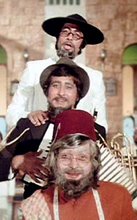
The valleys of northwest are ruled by madmen who care more about the length of one's beard than anything else. In the delta of the east, paramilitary revolts and kills the commander and wife. In the vast democratic experiment in the middle doesn't exist in the huge swatch of territory ruled by Naxalites.
Meanwhile, a singer passes away. A singer who wanted to see the promised day:
Jab zulm-o-sitam ke kohe-garaan rui ki tarah ud jaayenge,
Hum mahkoomon ke pau tale, jab dharti dhar dhar dharkegi…
Sab taaj uchale jaenge
Sab takht girae jaenge…
Uthega An-al-Huq ka nara jo mai bhi hoon aur tum bhi ho…
Radicals of left and right are trying to realise their utopian vision in Desh. History warns us against grand experiments, but the status quo is not sustainable either.
Iqbal Bano didn't see the promised day. Is it too late for us too?
Showing posts with label politics. Show all posts
Showing posts with label politics. Show all posts
Saturday, April 25, 2009
Friday, October 24, 2008
A-A-A bets on the US election
The brothers are all barracking for Sen Obama, but both Amar and Akbar have bet on Sen McCain against Anthony. This post records the bets.
Back in May, Anthony said: Well, Obama has won the nomination. And markets are giving him a 60% chance of beating McCain. I'm happy to give anyone a 3 to 1 odd that Obama will win.
Amar accepted: Alright, I accept your offer of 3 books vs 1 book. Suggested limits on cost of books -up to 25 pounds or A$ equivalent as price of each book (ie 75 / 25 pounds maximum stakes). I fully expect to lose the bet, but the odds you offer are better than the market's.
Akbar had an alternative offer: If Obama wins, I will take you Khalil Jibran restaurant in Sydney red light area. If McCain wins, you will stop supporting democracy and become pro-dictatorship in Bangladesh (evidenced by public declaration of this in atleast one article agaisnt democracy).
Anthony's counteroffer: I can go to a Sydney restaurant whenever I want, so you've to offer something more. Here is what I suggest - if Obama is the next president, you'll drape yourself in the Indian flag, dance bhangra and shout democracy zindabad (it will have to be witnessed by someone credible, or videotaped or something). If Obama is not the next president, I'll give you an anti-democracy article.
Akbar: Man - it's cheaper for me to fly and dine you in the most expensive restaurant than to get my mother to stitch the indian flag! Let's make it more painful for u as well - in the event of McCain winning, you will drape your head and body in a Pakistani flag, and make a video speach against democracy and praise Gen Musharraf and Gen Moeen and post it in A-A-A and other political blogs and facebook. I agree to your Indian flag demand only if you agree to the above.
Anthony: Done.
Here is how the Intrade odd of an Obama presidency has evolved since May.


Wednesday, August 20, 2008
Tuesday, November 06, 2007
Whisker check

We noted last year that no clean-shaved general has successfully saved Bangladesh and Pakistan. Since then, Moeen U Ahmed has been saving Bangladesh from suicidal inaction in the face of corruption and failed politics. And now, Pakistan also needs saving. If the very moustachoid Musharraf can't do it, will Lt Gen Ashfaq Kiani step in? Will he be successful? He is, after all, also clean-shaved.
Sunday, November 04, 2007
Musharraf's Bitch
Emergency or not
what difference does it make?
Even a four legged animal knows
Musharraf was here and
will stay!!
Why a two legged politician not fathom
this?
Musharraf's bitch is surprised to say!
Know they not this;
Power and love are always in a haste
Even Muhammed rushed to Medina
to save his chair of the day.
Are bengalis so foolish
to accept democracy their only fate?
Even Hasina's Sari
unwraps her body for the Lathi of the day
and BB's salwar
catches the martial color
to remain in place!!
Only a bald man in Makkah knows
Promises are broken to be made.
what difference does it make?
Even a four legged animal knows
Musharraf was here and
will stay!!
Why a two legged politician not fathom
this?
Musharraf's bitch is surprised to say!
Know they not this;
Power and love are always in a haste
Even Muhammed rushed to Medina
to save his chair of the day.
Are bengalis so foolish
to accept democracy their only fate?
Even Hasina's Sari
unwraps her body for the Lathi of the day
and BB's salwar
catches the martial color
to remain in place!!
Only a bald man in Makkah knows
Promises are broken to be made.
Tuesday, October 23, 2007
A letter for Arif
Dear Readers,
It is more than a month since Arifur Rahman’s arrest. 30 days is a long time. Mohammad Arifur Rahman, the Prothom Alo cartoonist, has spent the better part of Ramadan in prison and has spent Eid away from his family. Anyone away from the loved ones can empathise and draw comparisons to their own experiences - but to be right in the centre of the Green Delta and not to be with one’s family on the Eid day? Even among his critics, surely that should elicit some sympathy.
In the past month, Arif’s culpability has been debated many times. The purpose of this post is not to re-visit that old debate. Even if we think of this man as guilty, we should ask ourselves: is his incarceration what the Prophet would have prescribed given his sense of generosity, forgiveness and - most importantly - justice?
We understand that Arif is being held at Dhaka Central Jail. We sincerely urge all of his well-wishers to write to him expressing solidarity at the address given below.
Mohammad Arifur Rahman,
Son of Mohammad Matiur Rahman,
re CR Case No. 2298/07,
Dhaka Central Jail,
Nazimuddin Road,
Dhaka.
We also urge those offended by the cartoon to write to him, for compassion towards one’s adversaries is a fast-vanishing Islamic value in today’s world.
Salam
It is more than a month since Arifur Rahman’s arrest. 30 days is a long time. Mohammad Arifur Rahman, the Prothom Alo cartoonist, has spent the better part of Ramadan in prison and has spent Eid away from his family. Anyone away from the loved ones can empathise and draw comparisons to their own experiences - but to be right in the centre of the Green Delta and not to be with one’s family on the Eid day? Even among his critics, surely that should elicit some sympathy.
In the past month, Arif’s culpability has been debated many times. The purpose of this post is not to re-visit that old debate. Even if we think of this man as guilty, we should ask ourselves: is his incarceration what the Prophet would have prescribed given his sense of generosity, forgiveness and - most importantly - justice?
We understand that Arif is being held at Dhaka Central Jail. We sincerely urge all of his well-wishers to write to him expressing solidarity at the address given below.
Mohammad Arifur Rahman,
Son of Mohammad Matiur Rahman,
re CR Case No. 2298/07,
Dhaka Central Jail,
Nazimuddin Road,
Dhaka.
We also urge those offended by the cartoon to write to him, for compassion towards one’s adversaries is a fast-vanishing Islamic value in today’s world.
Salam
Monday, October 01, 2007

Monday, August 27, 2007
Inquilaab Zindabad
Down with the dictatorships in Bangladesh and Pakistan.

Maha bidrohi rana klanto,
Ami sheidin hobo shanto,
Jobe utpiriter krondon roll akashe batashe dhonibe na,
Ottacharir kharga kripan bheem rana bhume ranibe na...
(The battle-fatigued rebel
I will only rest,
When the cries of the oppressed no longer reach the sky,
When the sound of the oppressor's scimitar no longer rings in the battlefield...)
- Kazi Nazrul Islam (25 May 1899 - 29 August 1976).

Maha bidrohi rana klanto,
Ami sheidin hobo shanto,
Jobe utpiriter krondon roll akashe batashe dhonibe na,
Ottacharir kharga kripan bheem rana bhume ranibe na...
(The battle-fatigued rebel
I will only rest,
When the cries of the oppressed no longer reach the sky,
When the sound of the oppressor's scimitar no longer rings in the battlefield...)
- Kazi Nazrul Islam (25 May 1899 - 29 August 1976).
Monday, July 30, 2007
Nor does the Australian Government !
According to the BBC news website, the Australian Prime Minister John Howard said that Australia will not be apologising to Dr Haneef. He added:
Dr Haneef was not victimised
Australia's international reputation has not been harmed by this 'mis-start' to its new anti-terrorism laws.
In George Orwell's 1984, the three slogans of the Party were:
WAR IS PEACE
FREEDOM IS SLAVERY
IGNORANCE IS STRENGTH
Well, Australia has supported a war on Iraq for peace. It has robbed Dr Haneef and other people of their freedom to protect freedom. And the people who vote for such a Government may quite possiby find their strength in ignorance.
There is however still some hope for the people of Australia. I understand that instead of letting Big Brother watch over everyone, Australians prefer to watch Big Brother instead. Mr Howard does not approve.
WAR IS PEACE
FREEDOM IS SLAVERY
IGNORANCE IS STRENGTH
Well, Australia has supported a war on Iraq for peace. It has robbed Dr Haneef and other people of their freedom to protect freedom. And the people who vote for such a Government may quite possiby find their strength in ignorance.
There is however still some hope for the people of Australia. I understand that instead of letting Big Brother watch over everyone, Australians prefer to watch Big Brother instead. Mr Howard does not approve.
Friday, July 20, 2007
A-A-A want democracy and test cricket
Amar: If this deal between BCCI and Zee TV is cancelled, it will be good for all. Stupid BCCI is trying to find another broadcaster. Let's get rid of all the one-dayers, and have a bloody extra practice game in Australia. And maybe an extra test in England instead of 7 one dayers!
Anthony: I presume the idea is to 'improve' irish cricket. Irish cricket would be better served if India played a three or four-dayer against Ireland. This would also give the Indian team good conditioning practice.
Amar: Oh no. Nothing to do with Irish cricket. The idea was to honour the 200 million plus deal done with Zee TV for playing offshore one-dayers in non-test centres (if played in test country, the local cricket board has the TV rights apparently — don't know how). Thus the 3 one-ayers with South Africa. I think the one match with Ireland was just a sop — they are also playing Pakistan in Scotland, without playing Scotland.
Anthony: What do you think will end first — this obsession with one day cricket, or military rules in Pakistan and Bangladesh?
Akbar: This obsession with one-day cricket shows that the people of Pak-Bangla lack the genius for democracy. Only when the people are ready for test cricket can democracy succeed!
Anthony: I presume the idea is to 'improve' irish cricket. Irish cricket would be better served if India played a three or four-dayer against Ireland. This would also give the Indian team good conditioning practice.
Amar: Oh no. Nothing to do with Irish cricket. The idea was to honour the 200 million plus deal done with Zee TV for playing offshore one-dayers in non-test centres (if played in test country, the local cricket board has the TV rights apparently — don't know how). Thus the 3 one-ayers with South Africa. I think the one match with Ireland was just a sop — they are also playing Pakistan in Scotland, without playing Scotland.
Anthony: What do you think will end first — this obsession with one day cricket, or military rules in Pakistan and Bangladesh?
Akbar: This obsession with one-day cricket shows that the people of Pak-Bangla lack the genius for democracy. Only when the people are ready for test cricket can democracy succeed!
Wednesday, July 11, 2007
Dictator 1 - Mullahs 0
Maulana Abdul Aziz of Lal Masjid had previously been extremely vocal about the willingness of his followers to become martyrs for the cause. But when the time came, the Mullah himself proved a little less eager, preferring to try and sneak away pretending to be a woman, dressed in a burqa and carrying a handbag.
As the Mullah turned from a figure of awe into an object of ridicule, the Dictator's Government took the opportunity to humiliate their opponents further, parading this firebrand Jihadi leader on PTV wearing a burqa, a symbolic castration of this self appointed warrior of the faith.
Meanwhile, Al-Qaeda's No.2 man Ayman Al-Zawahari is pretty pissed off to see this humiliation of his Pakistani allies. He had some nasty things to say about General Musharraf in his latest video, including the following rant:
I talk to you today on the occasion of the criminal aggression carried out by Musharraf, his army and his security organs - the Crusaders' hunting dogs - against Lal Masjid in Islamabad, and on the occasion of the dirty, despicable crime committed by Pakistani military intelligence - at the orders of Musharraf - against Maulana Abdul Aziz Ghazi when it showed him on television in women's dress.
(...) Musharraf and his hunting dogs have rubbed your honor in the dirt in the service of the Crusaders and the Jews, and if you don't retaliate for your honor, Musharraf won't spare any of you, and won't stop until he eradicates Islam from Pakistan. Lowly Musharraf, who has sold his honor and religion to the Crusaders and Jews, is arrogant with you in the extreme and regards you with the utmost contempt, and treats you like animals and dogs, and only is satisfied by portraying you in the lowliest and most despicable light.
(...) Musharraf and his hunting dogs have rubbed your honor in the dirt in the service of the Crusaders and the Jews, and if you don't retaliate for your honor, Musharraf won't spare any of you, and won't stop until he eradicates Islam from Pakistan. Lowly Musharraf, who has sold his honor and religion to the Crusaders and Jews, is arrogant with you in the extreme and regards you with the utmost contempt, and treats you like animals and dogs, and only is satisfied by portraying you in the lowliest and most despicable light.
Monday, July 09, 2007
Political Graffiti

This funny piece of political graffiti was spotted in Rome.
The Tricolour Flame, based on the Italian flag, is the symbol of the Movimento Sociale Fiamma Tricolore, a right-wing Italian political party with neo-fascist leanings.
This is how their logo usually looks:

Saturday, June 30, 2007
Anarchy in the ...
What's with Hollywood? We saw Next yesterday, terrorists planning to nuke LA in what would be almost certainly a suicide action, and instead of being Jihadis, they are young blond French, German and Russian men and women who show no sign of being Muslim, and have no discernable agenda whatsoever.
Amar asked this the other day. And the question got me thinking.
We discussed Jihad International at length last year. We argued that, contra Syriana, Jihadis don’t seem to be motivated by material poverty. We also discussed Islamofascism and Islamosocialism, but didn’t draw any link between Jihad and anarchy.
Perhaps we should have. The idea is not new. This Economist article, from August 2005, draws parallels between the Jihadi violence and the anarchist ones that terrorised Europe in the late 19th century.
What did the anarchists want? Pierre-Joseph Proudhon, their first great intellectual and the scribbler of the graffiti ‘property is theft’, wanted to replace states with a society based on voluntary contracts. This appears to be the antithesis of what modern Jihadis want — Mullah Omar never seemed like a libertarian to me! The Economist notes this too, but argues that scratch the surface, and there are many similarities, not the least between the means used by the two groups. Both, for example, rely on spectacular acts of violence to highlight their ideas — hence this ditty: It will come, it will come,every bourgeois will have his bomb.
This is not a very elegant ditty. A much better one, quoted by Bertrand Russell to describe the rise of Western revolutionary ideologies, is this.
Ah Love! could thou and I with Fate conspire
To grasp this sorry Scheme of Things entire,
Would not we shatter it to bits--and then
Re-mould it nearer to the Heart's Desire!
Anarchists, fascists, Bolsheviks, Jihadis — revolutionaries of left and right are bound by this common thread, this urge to grasp, shatter and re-mould. Of course each heart desires very different things, but that’s another matter.
The legend has it that the old man of the mountain was a close friend of the poet‑mathematician who scribed this ditty. While Hassan and Omar may not have been friends, and Hassan may not have given us the word assassin, it is probably true that he wanted to shatter the state of things in his day, and led a series of asymmetric wars to achieve that end.
The world will watch in terror as the greatest city falls. Anarchy and chaos will spread...
Another message from Bin Laden or Zawahiri, both last seen alive in a mountain? No sir, this is R’as Al Ghul in Batman begins. Ghul wants to destroy Gotham …so that mankind will ravage itself, the species will be culled and the balance of nature restored. The planet will be saved for all species.
In the movie, Ghul is a white man whose sanctuary appears to be somewhere in the Himalayas. Of course the aficionados know that in the graphic novels, Ghul comes from North Africa. Perhaps an apocalyptic figure from that part of the world was too much for Hollywood to stomach.
Perhaps. But you should be relieved to know that the spooks are onto this:
Anti-US and anti-globalization sentiment is on the rise and fuelling other radical ideologies. This could prompt some leftist, nationalist, or separatist groups to adopt terrorist methods to attack US interests. The radicalization process is occurring more quickly, more widely, and more anonymously in the Internet age, raising the likelihood of surprise attacks by unknown groups whose members and supporters may be difficult to pinpoint.
Hat tip Daniel Drezner, who asks: Will the anarchists of the 21st century unite?
So, the anarchists who planned to nuke LA in the movie Amar saw were motivated by some radical ideology? Well, perhaps it was the lack of an ideology, the absence of a great cause, that motivated them? I haven’t actually seen the movie, so can’t comment. But wasn’t this the case for Tyler Durden? Didn’t he want ‘Project Mayhem’ to be the Great Depression and World War II of his generation?
Capitalism breeds alienation, argued Marx. And from alienation comes anger and violence — thus argued a Dutch philosophy teacher on board Eurostar from Paris to Amsterdam earlier this year. Thanks to my best friend and companion’s surname and religion, I’m often drawn into conversations about these matters. Most such conversations were worse than excruciating. Not this one — though a subsequent one involving the philosopher’s Fortuyn-admiring wife and a British linguist employed by the International Criminal Court on Saddam Hussein’s trial was.
Anyway, I digress. Does one need an ideology to be angry enough to blow up the outside world? Perhaps Amar should ask Amaninder.
Amar asked this the other day. And the question got me thinking.
We discussed Jihad International at length last year. We argued that, contra Syriana, Jihadis don’t seem to be motivated by material poverty. We also discussed Islamofascism and Islamosocialism, but didn’t draw any link between Jihad and anarchy.
Perhaps we should have. The idea is not new. This Economist article, from August 2005, draws parallels between the Jihadi violence and the anarchist ones that terrorised Europe in the late 19th century.
What did the anarchists want? Pierre-Joseph Proudhon, their first great intellectual and the scribbler of the graffiti ‘property is theft’, wanted to replace states with a society based on voluntary contracts. This appears to be the antithesis of what modern Jihadis want — Mullah Omar never seemed like a libertarian to me! The Economist notes this too, but argues that scratch the surface, and there are many similarities, not the least between the means used by the two groups. Both, for example, rely on spectacular acts of violence to highlight their ideas — hence this ditty: It will come, it will come,every bourgeois will have his bomb.
This is not a very elegant ditty. A much better one, quoted by Bertrand Russell to describe the rise of Western revolutionary ideologies, is this.
Ah Love! could thou and I with Fate conspire
To grasp this sorry Scheme of Things entire,
Would not we shatter it to bits--and then
Re-mould it nearer to the Heart's Desire!
Anarchists, fascists, Bolsheviks, Jihadis — revolutionaries of left and right are bound by this common thread, this urge to grasp, shatter and re-mould. Of course each heart desires very different things, but that’s another matter.
The legend has it that the old man of the mountain was a close friend of the poet‑mathematician who scribed this ditty. While Hassan and Omar may not have been friends, and Hassan may not have given us the word assassin, it is probably true that he wanted to shatter the state of things in his day, and led a series of asymmetric wars to achieve that end.
The world will watch in terror as the greatest city falls. Anarchy and chaos will spread...
Another message from Bin Laden or Zawahiri, both last seen alive in a mountain? No sir, this is R’as Al Ghul in Batman begins. Ghul wants to destroy Gotham …so that mankind will ravage itself, the species will be culled and the balance of nature restored. The planet will be saved for all species.
In the movie, Ghul is a white man whose sanctuary appears to be somewhere in the Himalayas. Of course the aficionados know that in the graphic novels, Ghul comes from North Africa. Perhaps an apocalyptic figure from that part of the world was too much for Hollywood to stomach.
Perhaps. But you should be relieved to know that the spooks are onto this:
Anti-US and anti-globalization sentiment is on the rise and fuelling other radical ideologies. This could prompt some leftist, nationalist, or separatist groups to adopt terrorist methods to attack US interests. The radicalization process is occurring more quickly, more widely, and more anonymously in the Internet age, raising the likelihood of surprise attacks by unknown groups whose members and supporters may be difficult to pinpoint.
Hat tip Daniel Drezner, who asks: Will the anarchists of the 21st century unite?
So, the anarchists who planned to nuke LA in the movie Amar saw were motivated by some radical ideology? Well, perhaps it was the lack of an ideology, the absence of a great cause, that motivated them? I haven’t actually seen the movie, so can’t comment. But wasn’t this the case for Tyler Durden? Didn’t he want ‘Project Mayhem’ to be the Great Depression and World War II of his generation?
Capitalism breeds alienation, argued Marx. And from alienation comes anger and violence — thus argued a Dutch philosophy teacher on board Eurostar from Paris to Amsterdam earlier this year. Thanks to my best friend and companion’s surname and religion, I’m often drawn into conversations about these matters. Most such conversations were worse than excruciating. Not this one — though a subsequent one involving the philosopher’s Fortuyn-admiring wife and a British linguist employed by the International Criminal Court on Saddam Hussein’s trial was.
Anyway, I digress. Does one need an ideology to be angry enough to blow up the outside world? Perhaps Amar should ask Amaninder.
Saturday, June 16, 2007
More writing
One of us has recently become involved with a writers’ collective that focuses on politics, economy, human rights, international affairs and issues of current development discourse. You can read their writing here.
Saturday, May 26, 2007
An old conversation
Nearly a year ago, brothers A-A talked about the most effective way of fighting terrorists. This follow-up conversation was not posted then.
Amar: Don't jump the gun just yet about the terrorist attacks — last month (July 2006) 250 policemen [!] raided a Desi home in London because of an imminent chemical terrorist attack. It was headlines in every newspaper and TV channel. A week later they were released without charges.
Anthony: I definitely don't think cops need extra powers or we need draconian laws like the Patriot Act or anything like that. However, to the extent that more budgets are likely to lead to smaller number of mistakes, the marginal anti-terrorism dollar is better spent on cops than armies.
Amar: But wait, the tip off (to a planned terrorist attack) really seems to have come from Pakistan originally. So may be the dollar is even better spent on cultivating good relationships with the bad guys — ISI, Iran, whatever — who hang out with the worse guys?
Amar is absolutely right. At the very least, we don’t lose anything by talking.
Amar: Don't jump the gun just yet about the terrorist attacks — last month (July 2006) 250 policemen [!] raided a Desi home in London because of an imminent chemical terrorist attack. It was headlines in every newspaper and TV channel. A week later they were released without charges.
Anthony: I definitely don't think cops need extra powers or we need draconian laws like the Patriot Act or anything like that. However, to the extent that more budgets are likely to lead to smaller number of mistakes, the marginal anti-terrorism dollar is better spent on cops than armies.
Amar: But wait, the tip off (to a planned terrorist attack) really seems to have come from Pakistan originally. So may be the dollar is even better spent on cultivating good relationships with the bad guys — ISI, Iran, whatever — who hang out with the worse guys?
Amar is absolutely right. At the very least, we don’t lose anything by talking.
Tuesday, May 22, 2007
A revolutionary what if?
You say you want a revolution, well you know, we all want to change the world — sang Lennon. But do revolutions really change the world? Or do they run out of steam, spiral and turn? Lennon wanted to be counted out when you’re talking about destruction. And much like an omelette can’t be made without breaking an egg, so with revolutions without violence and destruction.
When do you support a revolution? This is not a rhetorical question in Pakistan. But if a revolution sweeps away Musharraf, will that cure Pakistan’s ailment? I don’t worry that Musharraf will be replaced by mad mullahs or the ISI. Mad mullahs and ISI are already in power. A revolution will probably replace Musharraf with another general, much like how Yahya replaced Ayub in 1969. What will a revolution achieve then? Is it perhaps not better to cut a deal that allows Musharraf an exit strategy? Similar debates are raging in Bangladesh?
What is a revolution anyway? When the existing order collapses, and rival factions fight it out until the most organised/cruellest/luckiest one comes to power — isn’t that what the fellow travellers romanticise as a revolution? Isn’t that what happened in Russia in 1917 or Iran in 1979?
Lennon probably thought about revolutions this way. Gandhi definitely wasn’t a believer in this kind of revolution. His was all for internal revolution: the truth force and moral regeneration, and a good dump in the morning. This is why, when it turned violent in February 1922, Gandhi didn’t hesitate to call off the non-cooperation movement.
What would have happened if he had not? Would there have been a revolution, as defined above?
Probably not. The movement probably would have run out of steam. Gandhi’s promise of Swaraj in one year was already stale when the Chauri Chaura incident happened. It’s possible that had the movement continued, it would have just gradually degenerated. But what would have replaced it? Intifada in Palestine has been replaced by asymmetric war in the form of suicide bombing. Would we have witnessed something similar in Desh?
If that happened, how would the British have reacted? Perhaps they would have sought out an exit strategy. Perhaps they would have cut a deal with moderate leaders like Jinnah, Motilal Nehru and CR Das. Perhaps these leaders would have founded a genuine federal republic.
Perhaps it would have been so, or perhaps not.
Perhaps the asymmetric war would have been met by violent repression. Perhaps the British would have matched, the Japanese empire in terms of oppression. Perhaps the British and the Japanese would have become allies in Asia. Perhaps the counter-insurgency violence in Desh would have warmed the British to Hitler. Perhaps there would have been a London-Berlin Axis.
Perhaps it’s in such a bleak world brother A-A-A would have lived?
Friday, May 11, 2007
Free Tasneem
We heard earlier today that Tasneem Khalil, a young Bangladeshi journalist and a fellow blogger (Tasneem's blog), was picked up by the army in the early hours of the morning from his home in Dhaka. What is his crime? Why has he been arrested?
Bangladesh's unelected regime says it wants to curb corruption and institute reforms. But sacrificing liberty to get better governance will result in a loss of both. And in any case, it is hard to imagine how a young journalist can be involved in corruption that the regime says it is uprooting. We suspect that the arrest has a lot more to do with his reporting of extra-judicial killings carried out by various state agencies.
This gross violation of a fundamental right has been reported around the world. Fellow bloggers have initiated a campaign to free him (examples: Unheard Voices, Shahidul and Mash). Our thoughts are with his family. We hope that with strong international pressure and, more likely, through appropriate back channel negotiations, Tasneem will be free soon.
But there are many others currently under detention who don’t have friends in western capitals to call the CNN or the nation’s top officials. What will happen to them?
We don’t want to see another Faujistan in Desh. Let's stop the creeping dictatorship now so that we don't have to face a bitter generation-long conflict later.
Update: Anonymous comments have been posted at a number of blogs claiming that Tasneem has 'confessed' to sending 'seditious SMS'. How dumb do the army intelligence think people are?
Update 2: He has been freed.
Bangladesh's unelected regime says it wants to curb corruption and institute reforms. But sacrificing liberty to get better governance will result in a loss of both. And in any case, it is hard to imagine how a young journalist can be involved in corruption that the regime says it is uprooting. We suspect that the arrest has a lot more to do with his reporting of extra-judicial killings carried out by various state agencies.
This gross violation of a fundamental right has been reported around the world. Fellow bloggers have initiated a campaign to free him (examples: Unheard Voices, Shahidul and Mash). Our thoughts are with his family. We hope that with strong international pressure and, more likely, through appropriate back channel negotiations, Tasneem will be free soon.
But there are many others currently under detention who don’t have friends in western capitals to call the CNN or the nation’s top officials. What will happen to them?
We don’t want to see another Faujistan in Desh. Let's stop the creeping dictatorship now so that we don't have to face a bitter generation-long conflict later.
Update: Anonymous comments have been posted at a number of blogs claiming that Tasneem has 'confessed' to sending 'seditious SMS'. How dumb do the army intelligence think people are?
Update 2: He has been freed.
Saturday, May 05, 2007
On the hijab, in Desh and Phoren
Anyone returning to the major European (and some American or Australian) cities after a decade or so would notice that there are many more women with the hijab in the streets. This is partly because of migration. Thousands of Muslims from the Middle East and Africa as well Desh enter these cities every year, and there are many more Muslims today than a decade earlier. If the proportion of the hijab-wearing women remained same, then there would still be many more hijabs in the streets. Plus, the proportion of the hijab‑wearing women in these cities probably has actually risen in the past five years so.
Part of the reason for the rise in this proportion is that there are relatively more practising Muslim women among the immigrants. This might be because of a rise in the share of older women — mothers of the younger men who had arrived years earlier and have acquired citizenship recently. But there is another reason for the rise in the proportion. Many younger women are wearing the hijab too. Many of these younger women have grown up in these cities, and some of them are not all that religious either.
For many, the hijab is a badge of identity, and wearing it is a sort of a political fashion statement. Say it up, say it loud, I am a sister from name-the-country and I am proud, f… you I won’t do what you tell me, I’ll wear the hijab and kick your white arse to hell — you get the point. Now identity is important, and in the human jungles of the phoren cities, beleaguered by the majoritarian pressures and cultural clashes with the older generation, the hijab can be an important political symbol for many. I see where the sisters are coming from, and I used to applaud their choice to express themselves.
I used to, but I don’t any more. A trip to Desh and a Salman Rushdie interview have changed my mind.
Because of family reasons, I visited a small town a hundred mile or so north of Dhaka in January. This was my first visit in about five years. I saw a lot of women wearing the hijab/burqa in the streets of this town. But then again, there were many more women in the street. In a small town in a conservative Muslim society, if there are more women in the street then there would be more hijabs too. That there were more women in the street is the thing to applaud.
But then, what about choice? Did all those women wear the hijab because they wanted to? No one in my immediate family wears the hijab. My long deceased grandmother used to wear a burqa. She was a religious woman. But when I asked around I found that for many in the small town as well as the big city Desh, the hijab has little to do with the choice to express one’s faith or identity and a lot to do with avoiding unwelcome male attention or good-old social pressure.
Then I saw an interview of Rushdie on television. Asked about the identity politics of wearing a hijab in phoren, he noted the lack of choice for many women in Desh.
I agree with Rushdie. I have nothing to say to the sisters who wear the hijab because of their faith. But those of you who are making a political statement against cultural imperialism, please think about your sisters back in Desh who don’t have the choice that you have.
Part of the reason for the rise in this proportion is that there are relatively more practising Muslim women among the immigrants. This might be because of a rise in the share of older women — mothers of the younger men who had arrived years earlier and have acquired citizenship recently. But there is another reason for the rise in the proportion. Many younger women are wearing the hijab too. Many of these younger women have grown up in these cities, and some of them are not all that religious either.
For many, the hijab is a badge of identity, and wearing it is a sort of a political fashion statement. Say it up, say it loud, I am a sister from name-the-country and I am proud, f… you I won’t do what you tell me, I’ll wear the hijab and kick your white arse to hell — you get the point. Now identity is important, and in the human jungles of the phoren cities, beleaguered by the majoritarian pressures and cultural clashes with the older generation, the hijab can be an important political symbol for many. I see where the sisters are coming from, and I used to applaud their choice to express themselves.
I used to, but I don’t any more. A trip to Desh and a Salman Rushdie interview have changed my mind.
Because of family reasons, I visited a small town a hundred mile or so north of Dhaka in January. This was my first visit in about five years. I saw a lot of women wearing the hijab/burqa in the streets of this town. But then again, there were many more women in the street. In a small town in a conservative Muslim society, if there are more women in the street then there would be more hijabs too. That there were more women in the street is the thing to applaud.
But then, what about choice? Did all those women wear the hijab because they wanted to? No one in my immediate family wears the hijab. My long deceased grandmother used to wear a burqa. She was a religious woman. But when I asked around I found that for many in the small town as well as the big city Desh, the hijab has little to do with the choice to express one’s faith or identity and a lot to do with avoiding unwelcome male attention or good-old social pressure.
Then I saw an interview of Rushdie on television. Asked about the identity politics of wearing a hijab in phoren, he noted the lack of choice for many women in Desh.
I agree with Rushdie. I have nothing to say to the sisters who wear the hijab because of their faith. But those of you who are making a political statement against cultural imperialism, please think about your sisters back in Desh who don’t have the choice that you have.
Wednesday, February 21, 2007
Of Maududi and Munir
Most readers of these scribbles would know that a global bestseller has Jesus escaping Judea and settling in France. This book has caused many in Firangi lands to wonder about their religion. It has also caused commotion in Desh — in its great secular tradition, India found the idea objectionable enough to censor the movie version. This is odd, because the idea that Jesus escaped from the Roman punishment field alive and in flesh to settle elsewhere is not new in Desh. Why, there is even a tomb of the man in Kashmir.
Yes, that’s right. There is a tomb, called Roza Bal, in Srinagar where buried is a man alleged to be the son of Mariam of Nazareth, a false messiah to the Jews, part of the Divine Trinity to the Christians and a prophet to the Muslims.
So how come in a continent of one and a quarter billion people and one-third of a billion gods/demi‑gods/god-men this place does not attract thousands of devotees everyday? Perhaps this particular tomb had no sponsor to market it as a shrine. Perhaps Jesus, after escaping from the Levant, had no chela to peddle his divine connection to Desis. But that can’t be right, because there is a sect that actively sells the idea of Jesus dying in the Paradise on Earth instead of ascending to Heaven. I am talking about Ahmadiyas/Qadianis.
Ahmadiyas get their name from the founder of their cult — one Mirza Ghulam Ahmad of Qadian (hence Qadiani), Indian Punjab. These guys believe that Mirza Ahmad is the promised Messiah of the three Abrahamaic faiths. While there is a dispute among his followers about whether Mirza Sahib was a prophet or a mere learned reformer, there is no doubt among them that Jesus had indeed died in Kashmir in the early 2nd century CE.
Mirza Ahmad started his god-man career in the 1890s. He preached that the British Raj was the Anti‑Christ/Dajjal. He talked about overthrowing the empire and freeing his people. Punjab has the most productive farm sector in Desh today, but in the 1890s it experienced droughts, a famine and a depression. One would have thought that in that time of desperation, Ahmad’s messianic message would massively move the mass imagination. This, however, did not happen. Ahmadiyas are not a major religious group even in Punjab, let alone elsewhere in Desh.
And this, perhaps, is a greater puzzle than why the Roza Bal is not better known?
It’s not as if strange people who heard voices had a difficulty finding followers in Punjab, or indeed elsewhere in Desh. After all, those railing against another empire a few centuries earlier found many followers, enough to have their own shrine in Amritsar affecting Desi history in the 1980s. And elsewhere in Desh and beyond, god-men from Prince Siddhartha to Bhagwan Rajnish had flourished. So why did Ahmad flop?
Perhaps because Ahmad marketed his cult to the wrong audience. You see, Muslims are not all that receptive to new ideas when it comes to religion — at least that’s the orientalist line many in the Firangi land run these days. But we know that in Desh that’s mostly rubbish. Desi Muslims have their fair share of god-men, pirs, Sufi mystics, other crackpots who seek a carnal relationship with their maker (in the words of a nocturne). Why, then, could Ahmad not whip up a following to match those of the Qalandars of Sind, Shah Jalal of Sylhet, and Khawajas and Chishtis of Delhi and Ajmer?
I am no expert, so I’ll give the authoritative commentary of the completely unqualified. I think where Ahmad is different from other assorted god-sellers/lovers is that he challenged the merchant of Mecca monopoly on the last direct line to the Lord. You see, none of the other mystics claimed to have received any message (verbal or written) from you know who. Ahmad claimed to have done exactly that. It seems that anything to do with the Prophet and you’re in trouble, and Ahmad claimed he was at the least a semi-prophet.
I think this is why Ahmad’s cult flopped. There are reasons to think that this conjecture is plausible. The first intra-Muslim sectarian violence in Pakistan was against the Ahmadiyas in the early 1950s. Maulana Maududi, writer of semi-intelligent rant passing as the interpretation of the Quran and founder of Jamaat-e-Islami, issued a fatwa that Ahmadiyas are the enemy of Islam because of their heretical views on the last prophet, and mob burnt down their houses and mosques in Lahore. Order was restored by the Army (this was the first time that gallant institution saved our hacked off lands). More recently, Bangladesh’s supposedly secular politicians entertained passing a law that would, in effect, brand Ahmadiyas as non-Muslims. In Pakistan, Ahmadiyas are officially disqualified as Muslims.
In a perfect world, this law would be as significant as the conference that deliberated on how one bows to Mecca while in space. But in Pakistan (though fortunately not in Bangladesh), non-Muslims are denied the same rights as Muslims, so the distinction matters — on the other hand, since in Pakistan no one has any right to speak of, maybe the distinction doesn’t matter. Either way, let me tell you what Justice Munir found five decades ago on the definition of a Muslim.
In 1953, after Maududi’s followers did their worst and the Army its best, two judges were appointed to write a report on what the government should do about defining a Muslim. The judges, Munir and Kiyani, interviewed all the leading Islamic scholars of Desh and beyond. The result was a 350 page report that contains these words.
The result…, however has been anything but satisfactory and if considerable confusion exists in the minds of our ulama on such a simple matter, one can easily imagine what the differences on more complicated matters will be…. Keeping view the several different definitions given by the ulama, need we make any comment except that no two learned divines are agreed on this fundamental. If we attempt our own definition as each learned divine has done and that definition differs from that given by all others, we unanimously go out of the fold of Islam. And if we adopt the definition given by any one of the Ulama, we remain Muslims according to the view of that alim, but kafirs according to the definitions of everyone else.
The report is one of the most cogent argument against an Islamic Rpeublic I've ever read. Oh how one wishes that Munir triumphed over Maududi.
Yes, that’s right. There is a tomb, called Roza Bal, in Srinagar where buried is a man alleged to be the son of Mariam of Nazareth, a false messiah to the Jews, part of the Divine Trinity to the Christians and a prophet to the Muslims.
So how come in a continent of one and a quarter billion people and one-third of a billion gods/demi‑gods/god-men this place does not attract thousands of devotees everyday? Perhaps this particular tomb had no sponsor to market it as a shrine. Perhaps Jesus, after escaping from the Levant, had no chela to peddle his divine connection to Desis. But that can’t be right, because there is a sect that actively sells the idea of Jesus dying in the Paradise on Earth instead of ascending to Heaven. I am talking about Ahmadiyas/Qadianis.
Ahmadiyas get their name from the founder of their cult — one Mirza Ghulam Ahmad of Qadian (hence Qadiani), Indian Punjab. These guys believe that Mirza Ahmad is the promised Messiah of the three Abrahamaic faiths. While there is a dispute among his followers about whether Mirza Sahib was a prophet or a mere learned reformer, there is no doubt among them that Jesus had indeed died in Kashmir in the early 2nd century CE.
Mirza Ahmad started his god-man career in the 1890s. He preached that the British Raj was the Anti‑Christ/Dajjal. He talked about overthrowing the empire and freeing his people. Punjab has the most productive farm sector in Desh today, but in the 1890s it experienced droughts, a famine and a depression. One would have thought that in that time of desperation, Ahmad’s messianic message would massively move the mass imagination. This, however, did not happen. Ahmadiyas are not a major religious group even in Punjab, let alone elsewhere in Desh.
And this, perhaps, is a greater puzzle than why the Roza Bal is not better known?
It’s not as if strange people who heard voices had a difficulty finding followers in Punjab, or indeed elsewhere in Desh. After all, those railing against another empire a few centuries earlier found many followers, enough to have their own shrine in Amritsar affecting Desi history in the 1980s. And elsewhere in Desh and beyond, god-men from Prince Siddhartha to Bhagwan Rajnish had flourished. So why did Ahmad flop?
Perhaps because Ahmad marketed his cult to the wrong audience. You see, Muslims are not all that receptive to new ideas when it comes to religion — at least that’s the orientalist line many in the Firangi land run these days. But we know that in Desh that’s mostly rubbish. Desi Muslims have their fair share of god-men, pirs, Sufi mystics, other crackpots who seek a carnal relationship with their maker (in the words of a nocturne). Why, then, could Ahmad not whip up a following to match those of the Qalandars of Sind, Shah Jalal of Sylhet, and Khawajas and Chishtis of Delhi and Ajmer?
I am no expert, so I’ll give the authoritative commentary of the completely unqualified. I think where Ahmad is different from other assorted god-sellers/lovers is that he challenged the merchant of Mecca monopoly on the last direct line to the Lord. You see, none of the other mystics claimed to have received any message (verbal or written) from you know who. Ahmad claimed to have done exactly that. It seems that anything to do with the Prophet and you’re in trouble, and Ahmad claimed he was at the least a semi-prophet.
I think this is why Ahmad’s cult flopped. There are reasons to think that this conjecture is plausible. The first intra-Muslim sectarian violence in Pakistan was against the Ahmadiyas in the early 1950s. Maulana Maududi, writer of semi-intelligent rant passing as the interpretation of the Quran and founder of Jamaat-e-Islami, issued a fatwa that Ahmadiyas are the enemy of Islam because of their heretical views on the last prophet, and mob burnt down their houses and mosques in Lahore. Order was restored by the Army (this was the first time that gallant institution saved our hacked off lands). More recently, Bangladesh’s supposedly secular politicians entertained passing a law that would, in effect, brand Ahmadiyas as non-Muslims. In Pakistan, Ahmadiyas are officially disqualified as Muslims.
In a perfect world, this law would be as significant as the conference that deliberated on how one bows to Mecca while in space. But in Pakistan (though fortunately not in Bangladesh), non-Muslims are denied the same rights as Muslims, so the distinction matters — on the other hand, since in Pakistan no one has any right to speak of, maybe the distinction doesn’t matter. Either way, let me tell you what Justice Munir found five decades ago on the definition of a Muslim.
In 1953, after Maududi’s followers did their worst and the Army its best, two judges were appointed to write a report on what the government should do about defining a Muslim. The judges, Munir and Kiyani, interviewed all the leading Islamic scholars of Desh and beyond. The result was a 350 page report that contains these words.
The result…, however has been anything but satisfactory and if considerable confusion exists in the minds of our ulama on such a simple matter, one can easily imagine what the differences on more complicated matters will be…. Keeping view the several different definitions given by the ulama, need we make any comment except that no two learned divines are agreed on this fundamental. If we attempt our own definition as each learned divine has done and that definition differs from that given by all others, we unanimously go out of the fold of Islam. And if we adopt the definition given by any one of the Ulama, we remain Muslims according to the view of that alim, but kafirs according to the definitions of everyone else.
The report is one of the most cogent argument against an Islamic Rpeublic I've ever read. Oh how one wishes that Munir triumphed over Maududi.
Wednesday, February 07, 2007
Hollywood and the White Man's Burden
I watched four films about Africa in the last week.
The Last King of Scotland: A white man in Uganda becomes ring-side spectator to the excesses of the psychopathic dictator Idi Amin.
Blood Diamond: A white man in Sierra Leone searches for a precious diamond as the horrors of a mad war (financed by diamonds) unfold around him.
Lord of War: A white man sells guns to mad African dictators and warlords (among others).
Hotel Rwanda: A black hotel manager tries to protect refguees in his hotel as genocide rages outside. All the white people have to be evacuated, see.
Subscribe to:
Posts (Atom)