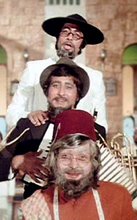
Irfan Khan plays Billu, a poor barber who lives an uneventful life with his wife and two children in some north Indian village until Bollywood superstar Sahir Khan --- Shahrukh Khan --- comes to the village to shoot a film. Billu had mentioned to his family that he knows Sahir. When his children talk about their father's friendship with the star, word spreads throughout the village. Virtually overnight, Billu becomes the center of attention, and everyone wants him to introduce them to Sahir. While Billu refuses and downplays the friendship, the villagers persist, until they accuse him of lying about his friendship. Even his family begin to doubt his character and integrity, but Billu remains quiet about the nature of his friendship with Sahir.
So, how does this pickle end?
If this was Satyajit Ray classic, the truth would have become known in such a fashion that only Billu's family would have found out about it. And their reaction to the truth would have been noted in a few glances, with hardly a word uttered.
If this was a great Bollywood movie, the movie would have ended with Sahir Khan's speech at the local school, when the truth is revealed. The last scene would have been Billu leaving the school, with the villagers' reactions left to the audience's imagination.
If this was a good Bollywood movie, it would have ended with Billu's children apologising to the father.
But this otherwise interesting movie had a typically terrible Bollywood ending where Sahir and Billu are reunited.
Showing posts with label watching. Show all posts
Showing posts with label watching. Show all posts
Saturday, December 12, 2009
Saturday, July 25, 2009
Dark Side of the Moon
Earlier this week, Moonlanding anniversary was everywhere. Now, I was born many years after the event that made Ray Bradbury suggest be the beginning of a new global calendar. So I have nothing to say when old people talk about ‘oh I remember….’ But I do remember 1 April 2003, when I first watched the Dark Side of the Moon — not the Pink Floyd album, but the French mockumentary.
Titled Operation Lune in French, the premise is that Moonlanding was a hoax, and what the world saw on 23 Jul 1969 was shot in the set of the Stanley Kubrick’s 1968 classic 2001: A Space Odyssey, and for this, Uncle Sam gave Kubrick some fancy camera, but when CIA operatives associated with the project started dying mysteriously in places like South America, Kubrick got spooked, and that’s why he only made two movies in his last two decades, and all the big guns in Nixon-Ford administration, Kissinger, Alex Haig, Rumsfeld, they were all in on it.
On that evening, I got home from work and switched on the TV. Muhammad Saeed al-Sahaf was telling us that the foreign invaders were drowing in their own blood. I flicked it to CNN — but how would I know if they were telling the truth? I flicked the channel again. Something was in French. Ah, the French would tell us the truth, I thought (I was young, and naive). What was this, I wondered! Kissinger and Rumsfeld admitting to deception? Whoa! This is cooler than the other side of the pillow!
I highly recommend it.
I also remember the last time I watched 2001 in a theatre. It was the Summer of 2001. We went to a midnight screening. During the scene where the hominid tribes scream at each other over the water hole, my friend yelled out — Jews and Palestinians. Everybody had a good laugh. I highly recommend that movie too. If you find it hard to follow the birth of the star child, a kolki full of mari jane will help. If that proves too hard, penadol with red bull can give you a solid bender.


Tuesday, March 31, 2009
Out of Pakistan
I'd really like to watch these Pakistani classics.
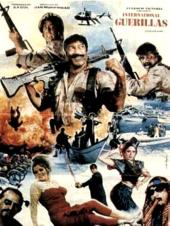 International Gorillay. A criminal mastermind sets out to destroy Islam by luring Pakistanis into gambling, dancing, and all manner of sundry sins. He tortures his prisoners by reading to them aloud from his blasphemous novel. The brave mujahedin out to stop him are disguised in Batsuits; and in the end, a quartet of levitating Qurans shoot laser beams into the nefarious villain's head, causing him to explode. Oh, the villain is named Salman Rushdie.
Zinda Laash. A black and white thriller from 1967, sort of Dr Jekyll and Mr Dracula. The first and only Pakistani film to earn the label "For Adults Only," after the board of censors accused the film of being "corruptive and evil."
Aurat Raj. A group of women discover a bomb that switches gender roles and seize power by setting it off. In this brave new world, women wield machine guns and flick their cigarettes with an easy flair, while men twirl in slow motion and swing their hips coquettishly.
Zibahkhana. Five teenagers set out to watch a concert, but find their van break down and get set upon by flesh eating zombies, a ghoulish hitchhiker, and a blood-soaked, burqa-wearing killer. The writer-director's next project is apparently a genre-busting women-in-prison meets porn-factory meets monster-spectacular named Jhabarjhilla.
----
More here.
----
Akbar isn't impressed.
Sick piece of movie. About zombies wearing salwar kameez and a senseless plot with amateur acting. The acting/story line is so bad- its hilarious. Not even worth blogging.
International Gorillay. A criminal mastermind sets out to destroy Islam by luring Pakistanis into gambling, dancing, and all manner of sundry sins. He tortures his prisoners by reading to them aloud from his blasphemous novel. The brave mujahedin out to stop him are disguised in Batsuits; and in the end, a quartet of levitating Qurans shoot laser beams into the nefarious villain's head, causing him to explode. Oh, the villain is named Salman Rushdie.Zinda Laash. A black and white thriller from 1967, sort of Dr Jekyll and Mr Dracula. The first and only Pakistani film to earn the label "For Adults Only," after the board of censors accused the film of being "corruptive and evil."
Aurat Raj. A group of women discover a bomb that switches gender roles and seize power by setting it off. In this brave new world, women wield machine guns and flick their cigarettes with an easy flair, while men twirl in slow motion and swing their hips coquettishly.
Zibahkhana. Five teenagers set out to watch a concert, but find their van break down and get set upon by flesh eating zombies, a ghoulish hitchhiker, and a blood-soaked, burqa-wearing killer. The writer-director's next project is apparently a genre-busting women-in-prison meets porn-factory meets monster-spectacular named Jhabarjhilla.
----
More here.
----
Akbar isn't impressed.
Sick piece of movie. About zombies wearing salwar kameez and a senseless plot with amateur acting. The acting/story line is so bad- its hilarious. Not even worth blogging.
Monday, February 23, 2009
How often does the best picture win?
So the Academy Awards, Oscar, is done. Slumdog Millionaire won. But was that the best movie of the year? How often does the year's best picture actually win the Oscar? Put differently, how does posteriority treat an Oscar winner? And what's the metric of 'best' anyway?
These questions come up every year. You see, Oscar, like the Nobel for subjects other than natural sciences, or the Man Booker or Pultizer, involves a lot of politicking and lobbying and broader socio-cultural trends. With the 'emergence of India' being a favourite talking point of the global cognoscenti, it may not be all that surprising that Slumdog won, just as it may not have been surprising to see Arvind Adiga's White Tiger win last year's Booker. More about the book some other time, but was Slumdog the best movie of 2008? Let's be more specific, was it the best movie available to the general filmgoing public in the Anglophone world in 2008?
These questions come up every year. You see, Oscar, like the Nobel for subjects other than natural sciences, or the Man Booker or Pultizer, involves a lot of politicking and lobbying and broader socio-cultural trends. With the 'emergence of India' being a favourite talking point of the global cognoscenti, it may not be all that surprising that Slumdog won, just as it may not have been surprising to see Arvind Adiga's White Tiger win last year's Booker. More about the book some other time, but was Slumdog the best movie of 2008? Let's be more specific, was it the best movie available to the general filmgoing public in the Anglophone world in 2008?
Monday, July 28, 2008
On Jodhaa Akbar
Just in case you are not familiar with the world of Hindi movies, Jodhaa Akbar is one of the most expensive movies ever made in India. Set in the 16th century, it is based on Emperor Akbar's relationship with his Rajput wife Jodhaa Bai. This is my take on the movie. Short version: it lacks direction. Long version, read on.
Let's begin with the things that I liked. I liked the language. I had to use the subtitle to understand many of the Farsi words. But I did get the feeling that this is how the elite of North India might have conversed in the Sultani era and beyond. Also, listening to the Rajput’s Sanskritised Hindi and the chaste Urdu of akbar, one appreciates just how syncretic Bollywood is. And that’s a good thing. Bollywood for a peaceful Desh!
I also liked the costumes and sets. Again, I got the feeling that this is what people in 1550s India (not just the rich, but also the men in bazaar) wore, and this is what the place might have looked like.
And at 200 minutes, the movie didn’t really sag. The set, costume and dialogue kept it going. But the core of it — the love story between the Emperor and his wife — was at most 100 minutes. So the makers of this movie had two options they wasted: they could have done more with the love story, or they could show more battles and politics.
Amar or I would have liked the second option. As it were, the movie didn't have much of politics. It didn’t show any of Akbar’s reign. And I think that was good. The historical basis of the events covered in the movie are 6 months of akbar’s 62 years of life. I’m glad that the movie didn’t explicitly say that Akbar was a great king because of his marriage to a Rajput princess.
In fact, it almost certainly got the history wrong. For one thing, the 6 feet plus Roshan is a very improbable Akbar - according to the historical record, Akbar was a rather short fellow. But the movie doesn't claim to get the history right. It is billed as ‘one narrative of what happened’ in those months.
I was rather disappointed about the battle scenes though. I wasn’t expecting Lord of the Rings, sure. But Bollywood probably has reached a stage where we can expect something like Gladiator (the battle between the Romans and Goths). And I don’t think the problem was money or technology. I think the issue was more with direction. Even the one-on-one combats were not anywhere near as awe-inspiring as they could have been.
In any case, packing in more politics and battles probably would have made it a very different movie from what they set out to make. But there is really no reason why they couldn’t have taken the first option.
I think they could have done a much better job with the love story.
Now, romances are hard to do. A love story with a happy ending is even harder — to paraphrase Tolstoy, all happy endings are alike and so on. But even then, one can think of a number of possible avenues not pursued (or not pursued enough).
For example, Jodhaa could have had feelings for someone else, but she’d come to love Akbar: she was engaged, she could have had developed feelings for his fiance — Rai’s debut movie was based on the theme of love and marriage, and that was a great love story.
And if the romance didn't have a third person, then it needed other enemies and obstacles. They could have had lot more court intrigue. Indeed, there was a bit of it, with tensions leading up to the intermission, but then it all fell through.
They could have shown a lot more verbal jousting and battles of wit. Think of Katharine Hepburn and Cary Grant in The Philadelphia Story. In fact, Bollywood and Urdu literature have a rich tradition of this. One wonders, why wasn’t more made of that heritage?
I should also note couple of other things.
I was extremely disappointed with the Khawaja song. It's meant to be a Sufi devotional number. The idea is that the song should lead to the listener transcend into some ‘deeper meaning’ and dance away in a haze (I think ganjah helps). I love the genre, whether in Urdu, Punjabi or Bangla (in Bangla they mix Radha-Krishna/Ali/Rasul/pirs/tigers the whole lot — talk about a confused syncretic bunch). This particular song was just boring though.
I liked some of the lesser characters. The guy playing the renegade Rajput prince looks like Amitabh Bachchan circa 1975. Him and the guy playing akbar’s brother-in-law were both impressive. Maham Anaga was also really cool. But the evil mullah could have been a lot more evil.
Finally, having seen Taare Zameen Par, and noting Gowarikar and Farhan Akhter's recent outputs, one must wonder how much of Lagaan and Dil Chahta Hai were Aamir Khan.
Monday, June 30, 2008
A-A-A talk Fatherland
Akbar: I am reading Fatherland. In so many ways the Nazi Germany is similar to Saudi Arabia. For example Saudis require all nationals to get pre-marital medical check up, which is also mentioned in Fatherland.
Anthony: I’d have thought most totalitarian regimes have that kind of behaviour in common. Anyhow, what do you think of the story?
Akbar: It’s good. Better than the movie. But the ending was, well, hmm.. shrug.
Anthony: Yes, the ending was thoroughly disappointing.
Amar: Yeah, it's a total copout. If I remember correctly, it is that they succeed in giving the information to the Americans, who are stunned by the horror of what happened and stop becoming friends with the Germans. A better novel, more chilling and probably more believable, would have been to give the information to the Americans, then realise the Americans have known it all along, and that they don't really care — it makes sense to be friends with the Germans, and raking up past just gets in the way.
Or have I got the ending wrong?
If I have it right, I think it was probably the Publishers who made him change the ending to appeal to Americans — I can't believe such a good writer would pick such a crappy ending.
Akbar: The book leaves it ambiguous as to what happens — it implies without saying the information gets across — it doesn't deal with what happens afterwards.
It's the movie which shows the information reaching the Americans at the last moment, and stopping the American rapprochement with the Germans.
Amar: I still think the better ending would be the throwing of cold water on the fire of hope.
Wednesday, March 12, 2008
Incredible movie biology
Some time ago, Amar talked about the Giant Rat of Sumatra, er New Guinea. Well, islands are conducive for things like Giant Rats, and other odd-sized animals. Islands typically don’t have large carnivores — not enough food supply for their survival. So, in the absence of large carnivores, smaller carnivores and herbivores grow bigger than their mainland counterparts. And at the same time, large herbivores tend to shrink over time. That’s why islands could have Dwarf Elephants. These phenomena are called island gigantism and insular dwarfism respectively.
Could something like this have happened in Skul Island? The wiki link says that the island has an unstable ecosystem. What does that mean? Those dinosaurs have survived 65 million years in the island, how unstable could the ecosystem really be then? And how the hell did those insect grow so big?
And what about Kong himself? How did his kind get to grow so big? The wiki says it was the last of its species. How did it get to the island?
And what about the human inhabitants? I thought the scene where they came to get Ann was genuinely cool. Obviously their religion is a cult of Kong. But what is Kong meant to do with Ann? Gorillas don’t eat meat (they eat insects if occasionally). Does Kong eat meat?
I watched King Kong in the plane few weeks ago, and started wondering these. You see, one really can’t enjoy the grandeur of King Kong in the tiny screen that one gets in the economy class in a Boeing 777. This is one big screen movie.
I watched I am Legend in the big screen. I was looking forward to it eagerly. Will Smith is cool. The idea of the original novel seemed cool. A deserted New York City could have been cool. And I happened to be there when they were shooting it. How could it go wrong?
Well, it did go wrong. Neville, Smith’s character, was hunting the mutants. But the mutants were also hunting Neville. They were watching him. They laid traps for him. I’m sure New York’s concrete jungle could have been exploited for some really spine tingling cat and mouse spooky scenes. Shame nothing like that happened.
And since it wasn’t thrilling enough, I started wondering about the mutants’ biology. So the virus that was supposed cure cancer had terrible side effects — it killed most of the humanity, and resulted in rabies, hair loss, loss of resistance to the UV ray and extreme aggression among most of the survivors. Only a very small number of people were resistant to the mutated virus.
Okay, so far so good. But why the hell do all the mutants look similar? Surely CGI doesn’t have to mean that. These creatures only come out at night because of their problem with the UV ray. But does a problem with the UV ray give them night vision? Does the virus affect their optic nerves? And how did the creatures get to be so powerful? And how did they develop spiderman-like climbing abilities?
You see, if you start thinking about this stuff, the movie is obviously not going so well for you. But I’m still curious enough about the book to read it. Perhaps I’ll write about it some other time. Meanwhile, if you want more such stuff (physics, not biology), check this out.
Wednesday, January 16, 2008
Losers
When I was young, I did not care for Losers. I had not then realised that these were my brethren, that I was one of them, that in their pain, in the emptiness and misery of their existence I would find kinship, that sense of belonging, that feeling of understanding and being understood. The Losers, I now realise, are my people. And Loss is my intimate companion.
I came across this marvellous loser earlier this week:
How wonderfully and ridiculously tragic our fellow loser is! His song is miserable and self-pitying enough. He says some people's fate is wine, for others it's thirst. We know which one he is. He is singing about his loss, because having lost everything he cared for, the loss itself is all he has now.I came across this marvellous loser earlier this week:
But to return to the action on scene. It is clear that not only is our loser tragic and sad, he is also literally blind. Thus he does not see his lost beloved walk through the door. She hears his every word, our loser oblivious to her presence in the room (though not of her presence in the world). At the end of his song, she walks up to him. And slaps him! She accuses him of having seen her earlier, thus inadvertently revealing to us that he has lost his sight since their parting, she tells him she hates him, and storms out the door.
Our loser is left standing, hurt, lost, alone, and also despised. We sigh in pleasure at the exquisiteness of his pain, as it connects to the solitary pain of our own hearts. We can rejoice that our own suffering is so unworthy compared to his. Truly, this man is a badshah among losers, and to him we raise our literal glass of wine, because metaphorically of course ours are all empty as well.
Salut!
Saturday, June 30, 2007
Anarchy in the ...
What's with Hollywood? We saw Next yesterday, terrorists planning to nuke LA in what would be almost certainly a suicide action, and instead of being Jihadis, they are young blond French, German and Russian men and women who show no sign of being Muslim, and have no discernable agenda whatsoever.
Amar asked this the other day. And the question got me thinking.
We discussed Jihad International at length last year. We argued that, contra Syriana, Jihadis don’t seem to be motivated by material poverty. We also discussed Islamofascism and Islamosocialism, but didn’t draw any link between Jihad and anarchy.
Perhaps we should have. The idea is not new. This Economist article, from August 2005, draws parallels between the Jihadi violence and the anarchist ones that terrorised Europe in the late 19th century.
What did the anarchists want? Pierre-Joseph Proudhon, their first great intellectual and the scribbler of the graffiti ‘property is theft’, wanted to replace states with a society based on voluntary contracts. This appears to be the antithesis of what modern Jihadis want — Mullah Omar never seemed like a libertarian to me! The Economist notes this too, but argues that scratch the surface, and there are many similarities, not the least between the means used by the two groups. Both, for example, rely on spectacular acts of violence to highlight their ideas — hence this ditty: It will come, it will come,every bourgeois will have his bomb.
This is not a very elegant ditty. A much better one, quoted by Bertrand Russell to describe the rise of Western revolutionary ideologies, is this.
Ah Love! could thou and I with Fate conspire
To grasp this sorry Scheme of Things entire,
Would not we shatter it to bits--and then
Re-mould it nearer to the Heart's Desire!
Anarchists, fascists, Bolsheviks, Jihadis — revolutionaries of left and right are bound by this common thread, this urge to grasp, shatter and re-mould. Of course each heart desires very different things, but that’s another matter.
The legend has it that the old man of the mountain was a close friend of the poet‑mathematician who scribed this ditty. While Hassan and Omar may not have been friends, and Hassan may not have given us the word assassin, it is probably true that he wanted to shatter the state of things in his day, and led a series of asymmetric wars to achieve that end.
The world will watch in terror as the greatest city falls. Anarchy and chaos will spread...
Another message from Bin Laden or Zawahiri, both last seen alive in a mountain? No sir, this is R’as Al Ghul in Batman begins. Ghul wants to destroy Gotham …so that mankind will ravage itself, the species will be culled and the balance of nature restored. The planet will be saved for all species.
In the movie, Ghul is a white man whose sanctuary appears to be somewhere in the Himalayas. Of course the aficionados know that in the graphic novels, Ghul comes from North Africa. Perhaps an apocalyptic figure from that part of the world was too much for Hollywood to stomach.
Perhaps. But you should be relieved to know that the spooks are onto this:
Anti-US and anti-globalization sentiment is on the rise and fuelling other radical ideologies. This could prompt some leftist, nationalist, or separatist groups to adopt terrorist methods to attack US interests. The radicalization process is occurring more quickly, more widely, and more anonymously in the Internet age, raising the likelihood of surprise attacks by unknown groups whose members and supporters may be difficult to pinpoint.
Hat tip Daniel Drezner, who asks: Will the anarchists of the 21st century unite?
So, the anarchists who planned to nuke LA in the movie Amar saw were motivated by some radical ideology? Well, perhaps it was the lack of an ideology, the absence of a great cause, that motivated them? I haven’t actually seen the movie, so can’t comment. But wasn’t this the case for Tyler Durden? Didn’t he want ‘Project Mayhem’ to be the Great Depression and World War II of his generation?
Capitalism breeds alienation, argued Marx. And from alienation comes anger and violence — thus argued a Dutch philosophy teacher on board Eurostar from Paris to Amsterdam earlier this year. Thanks to my best friend and companion’s surname and religion, I’m often drawn into conversations about these matters. Most such conversations were worse than excruciating. Not this one — though a subsequent one involving the philosopher’s Fortuyn-admiring wife and a British linguist employed by the International Criminal Court on Saddam Hussein’s trial was.
Anyway, I digress. Does one need an ideology to be angry enough to blow up the outside world? Perhaps Amar should ask Amaninder.
Sunday, March 25, 2007
Two bad bio-pics
You know a bio-pic is bad when you become more interested in a supporting character instead of caring about the protagonist. This happened to me twice recently. I watched Ali, and found myself wondering about Malcolm X, and I watched The Rising: ballad of Mangal Pandey and wanted to know what happens to Kaptan Gordon.
We know what happened to Malcolm X: they murdered X and tried to blame it on Islam. There’s even a bio-pic by Spike Lee, though I’d recommend reading the Autobiography.
But what about Kaptan Gordon? Was there ever a real Captain William Gordon? Hmmm… Amar, any idea?
We know what happened to Malcolm X: they murdered X and tried to blame it on Islam. There’s even a bio-pic by Spike Lee, though I’d recommend reading the Autobiography.
But what about Kaptan Gordon? Was there ever a real Captain William Gordon? Hmmm… Amar, any idea?
Saturday, February 24, 2007
Oscar predictions
Best motion picture of the year
Amar: Babel
Anthony: The Departed
Achievement in directing
Anthony: Clint Eastwood, Letters from Iwo Jima
Performance by an actor in a leading role
Amar: Forest Whitaker, The Last King of Scotland
Anthony: Leonardo DiCaprio, Blood Diamond
Performance by an actor in a supporting role
Amar: Djimon Hounsou, Blood Diamond
Anthony: Alan Arkin, Little Miss Sunshine
Performance by an actress in a leading role
Amar: Helen Mirren, The Queen
Anthony: Judi Dench, Notes on a Scandal
Performance by an actress in a supporting role
Anthony: Jennifer Hudson, Dreamgirls
Best documentary feature
Anthony: An Inconvenient Truth
Best adapted screenplay
Amar: Children of Men
Wednesday, February 21, 2007
Titanic: The curse of Allah
This is the real ishtorey of Titanic – the ship, the philm and the fornicating occupants including Jack (ass) and Rose (the hoe).
By the Will and Grace (not that lesbian/gay friendship sitcom) of Allah, the Titanic truth behind Titanic will be revealed unto all within the space permitted by this post and through the infidel support of Amar and Anthony.
In the name of Allah the most Gracious and Merciful.
We start with the ship. It is a huge ass mofo ship brothers and sistas. It is meant to be a means of transport but used like a five star hotel by these western infidels, where casino, drinking and fornication are permitted with privacy not available on land during those times!
Such privacy and such distance! Ideal for the Satan - the enemy of Allah. Why should he be left out of all the fun!
As the American expression goes ‘to cut to the chase’, while ass and hoe (oops!. I mean Jack and Rose) make out in the back seat of a Cadillac probably(?)…the fat ass captain was slurping tea down in his cabin.
What happens to a unpiloted cruise ship without headlights in the middle of Atlantic ocean? It crashes into an ice berg… that’s what happens brotha and sistas.
But wait my friends. This crash was meant to be. For Allah had sealed the eyes and hearts of the infidel despite the excellent indoor five star chandelier lighting within the ship. For they were not meant to see the ice berg as it was Allah’s will.
Such is the price that the passengers had to pay for the sins of Jack and Rose. Such is the price Allah extracts from Rose for her beyond the limit ubarhti jawani (excessively overactive youth estrogen).
As the cruise ship tilted vertically, the Dajjal’s daughter managed to cling on to the railing…while all passengers just fell and fell into the dark waters of the Atlantic. Instead of submitting to Allah’s will the Dajjal strives to live through this challenge from Allah so as to seduce more future Jacks into asses and to carry the satanic generation forward in the form a seed planted by the gullible and seducible Jack.
On a side note, before the ships tilts, the musicians keep playing oblivious to the panic around them. They were NOT soul extracting Israfeels (death angels). They were waiting to be paid from the guy who hired them.
In the end, what happens my dear reader? history always repeats itself. Jack sinks and sinks to the bottom of the sea, trying to save that infidel seed carried by Rose. But was he not knowledgeable that the vile hoe intended to exchange his life for the precious gem given unto her by an ex-Fiance.
The cursed woman carried on with her life obtaining a nice flat on mortgage in Amerika and what’s more she also got a green card. Poor hard working Mexicans spend their lives trying to cross the border and obtain green card, while this daughter of Dajjal manages to get all this by doing nothing other than seducing Jack and cheating a rich man out his gems.
Finally, we see in the movie that old Rose throws the precious gem into the ocean. It is only a guise. The real gem is placed in a safety deposit box in Chase Manhattan Bank.
Such a fine actor this old Rose is? She shamelessly admits to lying naked on a cruise sofa, to have sketch made out by the gullible Jack.
Surely dear reader, with occupants like Jack and rose, this ship was to be cursed and meet its ill fate. May Allah have mercy on the soul of the many ignorant and innocent passengers. Amen.
Wednesday, February 07, 2007
Hollywood and the White Man's Burden
I watched four films about Africa in the last week.
The Last King of Scotland: A white man in Uganda becomes ring-side spectator to the excesses of the psychopathic dictator Idi Amin.
Blood Diamond: A white man in Sierra Leone searches for a precious diamond as the horrors of a mad war (financed by diamonds) unfold around him.
Lord of War: A white man sells guns to mad African dictators and warlords (among others).
Hotel Rwanda: A black hotel manager tries to protect refguees in his hotel as genocide rages outside. All the white people have to be evacuated, see.
Monday, January 29, 2007
Celebrity Big Brother
Something seems to have passed unnoticed in all the excitement of this year's Celebrity Big Brother. Yes, Britain has voted Shilpa Shetty as the winner, and yes, the media-circus has condemned and turned against the girls who bullied her. And yes, when Shilpa was nominated for eviction against the villain of the hour, her bully and tormentor, Jade Goody, 82% of the public votes cast were in favour of Shilpa. Everyone said the British people had spoken, that there was no cause for concern with the state of the nation.
Indeed. 18% of Britain voted for an ignorant obnoxious bigot.
Indeed. 18% of Britain voted for an ignorant obnoxious bigot.
Wednesday, November 22, 2006
A-A talk Nehru’s heirs
Amar: You know that West Wing episode with Nehru’s granddaughter as the Indian Prime Minister?
Anthony: Yeah.
Amar: Was she also white and called Mountbatten?
Anthony: She wasn’t shown, but I don’t follow.
Amar: Nehru had only one child, Indira. Whose children in turn were Sanjay and Rajiv. So, for there to be another grandchild, there would either need to be illegitimate offspring of Indira, or another illegitimate offspring for Nehru. Indira would be hard-pressed to conceal a pregnancy for months. Who else was Nehru's woman? Mountbatten. So any offspring would have been born to the Mountbatten family, and would then be partly white. So in the West Wing universe, India would have had a Mountbatten as Prime Minister.
Monday, November 13, 2006
A-A-A on Don
Amar
Excellent. A stylish, sexy and contemporary update of the convoluted, absurd, inane but ultimately cool bollywood thriller genre, revelling in its excesses and cliches. I expected no less from the director of our old favourite, Dil Chahta Hai. Some specific comparisons are listed below.
Shah Rukh Khan is a much better Don than Amitabh Bachchan. Bachchan is, however, a much better Vijay and Khan is a poor imitation.
The old Khaaike pan banaras wala song is great — it is more fun watching a bunch of village oddballs dancing than all those semi-naked gyrating chicks one gets these days.
Both Priyanka Chopra and Zeenat Aman are very good, but Aman is sexier.
The ending is the best bit of the new film. It rescues us from the clichéd happy-ending of the original and presents a more wicked and delightful possibility. I thoroughly enjoyed the twist.
Again, I think this is a great remake. What I missed most about the old Don are: Bachchan as Vijay, the fat pot-bellied Punditji dancing for the Banaras song, and Zeenat Aman in that sexy nurse costume.
Finally, I want to note how we are first introduced to the character of Vijay. This happens when he is seen singing and leading celebrations at the Hindu festival of Ganesh Chaturthi. In fine Bollywood secularism style, you will observe that immediately to Vijay's side are two Sikhs with patkas, and next to them, two Muslims with prayer caps, all singing and dancing together in communal harmony.
Akbar
Frankly, I didn’t find Don that good. Stylistically, it’s a rip off of Face/Off and the Bourne movies. Shah Rukh Khan acted better as Don when he did not open his mouth. I reckon he fared better as Vijay only with the street dancer scene.
Perhaps the experience in cinema would have given me more pleasure. Perhaps my point of view then would have been different. But all I have are pirate CDs, with many scenes deleted — result, the plot is lost when Khan stops to admire Priyanka Chopra bathing in the pool.
Also the Banaras wala song, well it was not convincing enough to have me believe that the character is actually don not Vijay. But wait, does that mean that Shah Rukh Khan was a convincing Vijay?
Observations from other regular Bollywood viewers: the new version is dull compared to the original; Khan over acts; and the ending, well it is not quite easy to understand what the ending means.
Anthony
In 1978, Vijay earned 11.75 rupee after singing the whole day. In 2006, he earns 3,000 rupee in three days — that’s 1,000 rupee a day. This is an 85-fold (or 8,411%) increase. According to the IMF data, prices have gone up by 7¼ to 8½ fold (or a maximum of 740%) depending on the measure. That is, the real wage of a busker has increased 10-fold in the past 28 years. Now, in the long run, real wage can only increase if there is an improvement in productivity, and it is hard to see exactly what revolutionary technological change could have occurred in the busking industry. But one can invoke the Balassa-Samuelson effect and argue that perhaps there has been a 10-fold productivity increase in the industries where Vijay could have worked had he not been busking. If this explanation is right, then according to the movie, the living standard in Bombay has increased 10-fold in these years, compared with a mere 3-fold increase in the country’s per capita income. Regardless of what Bhagwati says, that kind of rise in inequality is bound to cause trouble.
But enough about economics, let’s talk about the movie. I have to say, there is something rather fundamentally irrational about the plot (in both versions, but more stark in the new one) — why does Narang not kill Vijay/Don after the accident? Vardhan wants Vijay/Don to infiltrate Singhania’s gang, sure. Don wants to escape, right. Why does Narang keep him alive? What good is an amnesiac Don to the gang?
Okay, I’m still being rather tedious about what was actually a rather enjoyable movie. A few thoughts on what Amar and Akbar said. Perhaps it is intentional that Khan didn’t portray Vijay well — Khan was playing Don who was playing Vijay, perhaps the idea is to make Vijay non-convincing. I liked the idea of Desi diaspora in Malaysia replacing the oddball villagers in the Banaras wala song. As for the ending, well perhaps this leaves the door open for a sequel, or even a trilogy. The title of this movie is Don: the chase begins again. Perhaps the sequel will be the chase continues and the last one will be the chase ends. Perhaps we’ll see Priyanka Chopra kicking arse in the sequels. She’d need help — perhaps from other cool gangsters and rogue cops. Now that would be cool!
Sunday, October 22, 2006
On adapting the Bard
As the side bar suggests, The Rubaiyat of Omar Khayyam is something brothers A‑A-A love to read — why, I believe Amar even has it in his i-pod. We do not, of course, know Farsi, and the Rubaiyat we love are the 19th century translations by an Englishman named Edward Fitzgerald. Rushdie waxes lyrical in Shame about such translations being new creations — at the risk of a grossly inarticulate simplification, the point is: what we love should really be called The Rubaiyat of Omar Khayyam and Edward Fitzgerald.
We also love the Dollar trilogy, which owes a lot to Kurosawa, whose work we also love. And as any aficionado knows, Star Wars Episode IV was based on Kurosawa’s Hidden Fortress. Then there is Tarantino, who borrows profusely from Hong Kong. These are all examples of successful adaptations. Bollywood has always adapted from Hollywood. Some adaptations are more successful, and cooler, than others. Fifty years ago, Raj Kapoor and Nargis ‘sang’ 'Yeh raat bheegi bheegi’ in a successful adaptation of It happened one night. That was cool. The umpteenth 1980s copy of Death Wish was not cool.
Successful adaptations of Shakespeare are cool. What are some successful adaptations? Bazz Luhrman’s rendition of Romeo and Juliet is one. Setting Richard III in a Fascist Britain is another — A horse, a horse, my kingdom for a horse cries Richard when his jeep breaks down. Such successful adaptations are not common. Two consecutive successful screen adaptations of Shakespeare are extremely rare. And following Rushdie’s argument, credit for such successful adaptations would belong as much to the modern day director as to the Bard.
Two consecutive successful screen adaptations of the Bard — that is exactly what Vishal Bharadwaj has achieved. In 2003, he gave us Maqbool: Macbeth set in Mumbai underworld. This year, he has brought us Omkara: Othello set in small town Uttar Pradesh. Both movies are thoroughly recommended. Instead of giving reviews, let me just note some highlights.
Maqbool: the food — kheer and biriyani and kofta and korma, and people sitting on carpets, a great ode to the Indo-Muslim heritage that is bound to water anyone’s mouth; Pundit and Purohit — played by Naseeruddin Shah and Om Puri, these are two corrupt cops who replace the witches; and Tabu, whose performance as Nimmi (Lady Macbeth) is simply sublime — while all performances were superb, this is the central character, and anything short of what Tabu gave would have made it a lesser movie.
Omkara — again, all performances were excellent, but Saif Ali Khan as Langda Tyagi (Iago) was simply marvelous; ‘Beedi jalai ley’ — I am not sure of the exact meanings, but I gather they are rather suggestive, probably the best ‘item number’ since ‘Khallas’ (Company, 2002); and the rugged countryside — easily evokes scenes from Sholay.
Surely Bharadwaj will go for a hat trick. Surely he will do another Shakespeare tragedy. There is absolutely no point in doing Romeo and Juliet, cross-eyed lovers dying to unite feuding families, hasn’t that been done to death? What, then, should he adapt next?
Shakespeare’s historical dramas about English Kings and Roman generals could be adapted in modern Desi settings. But recent histories in Desh’s fauji republics might be too similar to any such adaptation for comfort. He could turn to happy endings. But who wants those? Multiple deaths pleased the crowd and critics in the Elizabethan England, and they do so in today’s Bollywood. And when it comes to that, what is better than Hamlet?
Surely Bharadwaj’s next venture will be Hamlet. Where will he set the Prince of Denmark? We suggest the world of the super rich, the world of Tatas and Birlas and Ambanis. The elder Bachchan will make the ideal wronged patriarch, while the younger could play the troubled heir to the fortunes of India’s richest family. The movie could begin with a flash back / dream sequence that would be identical to three thousand other movies about the extended family and tradition and all that stuff, but very soon the story will shift gear as the reality dawns. Who will play the conniving mother and the uncle? Polonius and his family can be adapted with ease. Some ingenious thinking is needed to transform the climactic duel into this setting, but I’m sure Bharadwaj will figure something out.
Damnit. I’m excited. Make this movie now Mr Bharadwaj!
Friday, October 20, 2006
Don
Excellent. A stylish, sexy and contemporary update of the convoluted, absurd, inane but ultimately cool bollywood thriller genre, revelling in its excesses and cliches.
I expected no less from the director of our old favourite, Dil Chahta Hai. I say "I", because Akbar and Anthony's thoughts are still awaited.
I expected no less from the director of our old favourite, Dil Chahta Hai. I say "I", because Akbar and Anthony's thoughts are still awaited.
Monday, October 02, 2006
The Heart Desires, in Sydney
It has been about five years since I first watched Dil Chahta Hai. The movie, its literal meaning is The heart desires, broke new grounds in storytelling, production techniques and the subject matter. There are hundreds of Bollywood movies on love, this is the first one on friendship — a very special person recommended the movie to me thus. Compare the way Aamir’s character introduces the song in the graduation party in this movie with the way it was done in his first hit — there are few better illustrations of how dramatically urban India has changed since the late 1980s.
And then there was the way the movie depicted phoren.
Years before he romanced a blind Kashmiri girl and a Gori filmmaker in Delhi, Aamir Khan explored Sydney with a Desi girl, discovering his own feelings along the way in this movie. And this wasn’t done by swinging to bhangra beats in ‘Indian night clubs’ or ‘college campuses’ where only Desi kids are seen. In fact, most of the Sydney scenes in the movie are very realistic — I speak from personal experience. And it really was shot in Sydney (unlike, say, the Aishwarya-starrer where Italian scenes are shot in Hungary). That this is about the best silver screen depiction of Sydney, a city I am immensely fond of, is just a bonus. I recently traced these Sydney scenes, and I describe them below.
We begin with Aakash’s (Khan’s character) apartment. This appears to be in North Sydney — the city skyline as shown in Tanhayee (the sad song) is only visible from somewhere north of the Harbor Bridge. His office is also in North Sydney. From the way the Bridge is shown, it seems that one needs to take a left-turn after crossing the bridge to get to the office. Alternatively, one could probably take the train to Milson’s Point or North Sydney.
Where is the theatre where our hero and his heroine watch the ‘serious movie’ that sets off the song Jaane kyun? It is very likely to be the Greater Union complex in Mosman.
The song itself shows a number of places. The first scene, by the lagoon with boats, is in The Spit Bridge on the way to Manly. Not too far from the Mosman cinemas, there’s a great seafood restaurant there, though this is not shown in the movie. From there, the couple takes the monorail — this is something only visitors to the city do, and all visitors, time-permitting, do it. From there, they walk down Hyde Park — a summer walk in the park, many Sydneysiders will relate to this scene. Most Sydneysiders will not have taken the helicopter ride, again something for the visitors. After their chopper ride, the couple is shown returning to North Sydney, on foot, over the Bridge. This is, perhaps, the only unlikely Sydney scene in the movie — The Harbour Bridge just is not a fun walk, not when a train noisily passes you. Our couple is in a North Sydney pier after crossing the bridge, and the song ends in a Mosman seashore.
Between the songs, the couple’s relationship advances through a trip to the Lunar Park. The couple gets separated in the Olympic Park rail station. Aakash discovers his feeling at an opera. They, however, do not watch the opera at the Opera House. After the show, things turn serious, and we move to Tanhayee, the sad song.
The song begins as Aakash says good bye to Shalini (Preity Zeinta). We are shown that he is in a cab in a tunnel. Assuming that Aakash is returning home, in North Sydney, it is reasonable to guess that Shalini’s uncle’s place is somewhere south of the bridge — eastern suburbs perhaps? After Shalini has left, Aakash is shown wandering around: in Martin Place, the financial heart of the city; Milson’s Point rail station; in the pedestrian tunnel under the Central Station; the Rocks (you can see the Bridge on his left); the Market Street Mall; the café in front of the Opera House (I have spent many a lonely afternoon myself in that place); the Waverly Cemetery (while a beautiful place, how would he know about it — may be he discovered it with Shalini?); the botanical garden; the eastern suburbs (he is shown jogging, why would he do it so far from his apartment though — maybe because it is close to Shalini’s uncle’s place?); and as the song ends, crossing the Bridge, alone.
Dear reader, you probably have guessed that I have watched the movie many times. If you haven’t, do so right away. You won’t regret it.
Thursday, August 17, 2006
On the legacy of the Raj
Once upon a time I used to watch The West Wing diligently. This was the post-Clinton era. Compared with the boring one and the dumb one, Jeb Bartlet looked a lot better. As one of those East Coast liberal rags said, the show captured the zeitgeist of the era. Then 9/11 happened. Soon after, Aaron Sorkin left the show. And by 2003, the real world became lot more interesting than anything on the show. These days, with actual politics becoming passé, I decided to watch old episodes about the Bartlet Administration. I am glad I did so. The first three seasons are great television, though you have to wonder why the characters walk around so much. But this post is not about The West Wing. Rather, it is about something I saw in one of the episodes.
In one of the episodes, the Indian Prime Minister visits the United States. She gives him a chess set, one used by her grandfather to play with Lord Mountbatten. In case there is any doubt, the President actually says: Jawaharlal Nehru, one of the greatest minds of the century, played this set while convincing Mountbatten of necessity of Indian independence. Right, Priyanka Gandhi, I thought. Wait, hang on, isn’t she the great-grand daughter?
Anyway, the President says he 'understands' the Indian stance over Kashmir. He tells the First Lady that the US foreign policy should tilt to India, that India is preferred to China because of democracy, the rule of law and the English language.
The rule of law, democracy manifest in a constitutional government, a free press and a professional civil service, and the English language that has been Indianized into the country’s own language — these are the legacies of the Raj that has ‘served the country well’, so said Prime Minister Singh (the actual one, not Rajiv Gandhi’s imagined sister) after receiving an honorary degree at Oxford last year.
Of course, the rule of law and democracy were not gifts of the British Raj. If the Raj was all one needed to sustain democracy then Pakistan would not be ruled by a uniformed man today. Rather, the rule of law and democracy were enshrined into the Indian constitution by the founding fathers. And there is more to it than just the constitution. Iraq and Afghanistan have fine words in their constitutions. The legacy of the Raj or not, the survival, no the thriving, of democracy in India has to be one of the biggest achievements of the last century.
While we could debate about democracy being a legacy of the Raj, there is really little doubt that we are writing this in English because John Company, and not the French, won in the 18th century. And while Mr Singh mentioned cricket only in passing, surely that has to be among the greatest legacies the Raj left behind.
Or are they? After all, more people learn English every year in China than anywhere else. And as for cricket, well as Bhubaan from Lagaan says, it is just daanda-gulli anyway.
One legacy of the Raj that is seldom mentioned is Desh’s borders. Everyone knows that the British decided the border in Punjab and Bengal. Most of Desh marked the setting of the Radcliff Line earlier this week. But Desh’s external borders — the Durand Line that separates Pakistan from Afghanistan and the McMahon Line between China and India — were also set by the Raj. Add to this the fact that Sri Lanka, Maldives, Nepal and Bhutan are independent countries because of arrangements made by imperial bureaucrats.
The borders set by the British, the external as well as the internal ones, have been honored by the Raj’s successors in both India and Pakistan. These countries have quarreled over Kashmir, where the Empire did not set the boundary. India fought China over land Indians did not even know they were granted by the British! Similarly, Pakistan has accepted its western borders as set by the Raj. Just think what if Kandahar was incorporated into the Frontier Province by the British.
Borders decide who is legally an Indian and who is not. Borders decide where Desh ends and Phoren begins. Desh’s borders must be the single most important legacy of the Raj.
Subscribe to:
Posts (Atom)