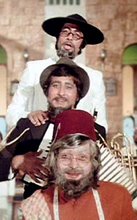
Some time ago, I posted this joke that, quite scarily, I found funny. In addition to the real business cycle — negative technological shocks — and Keynesian — fall in aggregate demand — stories of why recessions happen, there is also the ‘hangover theory’. The story of recessions in this theory goes like this: in the beginning, there is loose money that leads to bad investment, at some point the easy money runs out and the day of reckoning arrives, and the painful adjustment process is what we call recession.
A major proponent of this theory is Friedrich von Hayek, the doyen of Austrian school of economic thought. Listening to the school’s ideas in his iPod (yes, he is a very disturbed young man), Amar thought the Austrians were a cult who believed in the god of market called the invisible hand. Well, Paul Krugman compared Austrian macroeconomics with phlogiston theory of fire in the late 1990s. But as De Long notes here, Krugman had a sort of change of heart after the 2001 US recession.
Perhaps I should start a bit further back. Once upon a time, there was chairman of the Federal Reserve called Alan Greenspan. When the unemployment rate in the US fell to 6 per cent in the mid-1990s and everyone feared a break out of inflation, Greenspan held steady and didn’t raise rates. In the event, joblessness fell further, to 5 per cent and then to 4 per cent. And there was no inflation. What happened? It was the beginning of the new economy — the IT and globalisation inspired productivity pick up.
Stronger productivity growth led to rallying share prices, and before long, there was a full-blown bubble in the share market. Even though inflation was moderate, many crypto-Austrians, but not Krugman, thought there was too much money in the system, and Greenspan should prick the bubble. Greenspan did nothing. The bubble ran its course and burst in April 2000.
Then for the next 30 or so months, share prices fell steadily. By 2002, there were talks of a Japanese-style deflationary slump in the US. Bush administration cut taxes heavily and Greenspan slashed interest rates sharply. The economy was flooded with liquidity. Consumers borrowed, and spent, heavily. And the 2001 recession turned out to be one of the mildest on record. Greenspan became a legend.
Tax cuts and cheap money fend of a deflationary slump — sounds like textbook Keynesianism. And it seemed to have worked. Or did it? There were doubters, of the Austrian kind, but also a reformed Krugman, who thought that the tax cuts were poorly designed and money became too cheap. They argued that Greenspan merely replaced the bubble in the tech stock with one in the housing market. And sooner or later, that bubble would burst, leaving Greenspan’s successor to with a mess.
The housing bubble burst last year. It appears that there were a lot of bad loans to the sub prime mortgage market. Other financial institutions had link with these bad mortgage loans. And now it appears that the rabbit hole is much deeper than what anyone thought.
The general view it seems is that it’s Greenspan’s fault (here’s what Stiglitz says). It seems that we are all Austrians now.
Or are we? The first reaction of the central bankers seem to be to pump more money into the market, exactly the opposite of what the Austrians would suggest. Hmmm… stay tuned for what happens next.
And oh, if you have lost money in the last few days, oh well, remember, money can’t buy you love.
Showing posts with label dismalia. Show all posts
Showing posts with label dismalia. Show all posts
Friday, August 10, 2007
Wednesday, July 18, 2007
On the star economists
We discussed the greatest economists of all time last September, settling for, in chronological order: Adam Smith, David Ricardo, Karl Marx, Alfred Marshall, John Maynard Keynes, Ronald Coase, Paul Samuelson, Kenneth Arrow, Milton Friedman, and Garry Becker. Now, these guys are all old, really old, they all remember the Great Depression. Who are the greatest economists born after World War II?
That’s the question the Economist asked in an issue in the late 1980s. They settled for eight people. They are listed below, in alphabetical order, with brief notes on where they are now.
• Alberto Alesina: works on political economy and co-authors fascinating books such as the one discussed here.
• Sanford Grossman: a very wealthy fellow with his own hedge fund.
• Paul Krugman: easily the best known of the eight, as much for his widely partisan New York Times columns as for his work in international trade and finance; might win a Nobel, perhaps with Bhagwati.
• Gregory Mankiw: served the Bush administration, sold heaps of textbooks, and has his own blog.
• Jeffrey Sachs: after providing shock therapy to countries from Bolivia to Bulgaria, Sachs has been saving the world with U2’s Bono for the past few years.
• Andrei Shleifer: he advised ex-communists on how to get into capitalism before getting into legal wrangles with the US government, ironically as his research issue is corruption.
• Larry Summers: after serving as the Secretary of Treasury during the last years of the Clinton Administration, he ran Harvard for five years before quitting over women.
• Jean Tirole: the only one in the list to be based outside the United States, and the only one to have remained in the ivory tower, working on microeconomic theory.
A decade later, the magazine asked Où sont les Krugmans d’antan? They came up with a list of another eight bright and coming economists. They are listed below, in the order of their appearance in the Economist piece, with brief notes on their specialty and what they have been up to since then.
• Michael Kremer: then of MIT, now at Harvard, Kremer was chosen for his O-ring theory, and it seems a decade on, this is still his best known work.
• Edward Glaeser: of Harvard, chosen by the Economist for his work on why cities exist, he has been a prolific researcher exploring, among other things, Rove’s excite the base strategy, the need for state sanctioned holidays, co-authoring the abovementioned book with Alesina and much, much more.
• Casey Mulligan: he was chosen for the observation that social factors, such as parents’ work ethic, contribute far more to inequality than financial constraints do; he continues to be a prolific ivory tower economist at Chicago.
• Steve Levitt: he was chosen for innovative empirical works like the one that drew a link between the legalisation of abortion in the 1970s and the drop of crime rates in the 1990s; since then, he has won the John Bates Clark medal in 2003 and written Freakonomics.
• Caroline Hoxby: of Harvard, chosen for, and continues to work on, the economics of education.
• Glenn Ellison: of MIT, continues to work on microeconomic theory.
• Wolfgang Pesendorfer: of Princeton, works on game theory and political economy.
• Matthew Rabin: of Berkeley, works on behavioural economics, and won the John Bates Clark medal in 2001.
Two people not in the list have won the John Bates Clark medal, awarded to ‘that American economist under the age of forty who is adjudged to have made a significant contribution to economic thought and knowledge’ by the American Economic Association and is considered the best accolade in the profession, in recent years. They are: MIT’s Daron Acemoglu, co-author of a great read on democracy and dictatorship, and Harvard’s Susan Athey, who works on auction theory, proving that theory is not dead.
This then raises the obvious question, who are the brightest of today’s economists? I guess there will be an article in the 2008 Christmas edition.
That’s the question the Economist asked in an issue in the late 1980s. They settled for eight people. They are listed below, in alphabetical order, with brief notes on where they are now.
• Alberto Alesina: works on political economy and co-authors fascinating books such as the one discussed here.
• Sanford Grossman: a very wealthy fellow with his own hedge fund.
• Paul Krugman: easily the best known of the eight, as much for his widely partisan New York Times columns as for his work in international trade and finance; might win a Nobel, perhaps with Bhagwati.
• Gregory Mankiw: served the Bush administration, sold heaps of textbooks, and has his own blog.
• Jeffrey Sachs: after providing shock therapy to countries from Bolivia to Bulgaria, Sachs has been saving the world with U2’s Bono for the past few years.
• Andrei Shleifer: he advised ex-communists on how to get into capitalism before getting into legal wrangles with the US government, ironically as his research issue is corruption.
• Larry Summers: after serving as the Secretary of Treasury during the last years of the Clinton Administration, he ran Harvard for five years before quitting over women.
• Jean Tirole: the only one in the list to be based outside the United States, and the only one to have remained in the ivory tower, working on microeconomic theory.
A decade later, the magazine asked Où sont les Krugmans d’antan? They came up with a list of another eight bright and coming economists. They are listed below, in the order of their appearance in the Economist piece, with brief notes on their specialty and what they have been up to since then.
• Michael Kremer: then of MIT, now at Harvard, Kremer was chosen for his O-ring theory, and it seems a decade on, this is still his best known work.
• Edward Glaeser: of Harvard, chosen by the Economist for his work on why cities exist, he has been a prolific researcher exploring, among other things, Rove’s excite the base strategy, the need for state sanctioned holidays, co-authoring the abovementioned book with Alesina and much, much more.
• Casey Mulligan: he was chosen for the observation that social factors, such as parents’ work ethic, contribute far more to inequality than financial constraints do; he continues to be a prolific ivory tower economist at Chicago.
• Steve Levitt: he was chosen for innovative empirical works like the one that drew a link between the legalisation of abortion in the 1970s and the drop of crime rates in the 1990s; since then, he has won the John Bates Clark medal in 2003 and written Freakonomics.
• Caroline Hoxby: of Harvard, chosen for, and continues to work on, the economics of education.
• Glenn Ellison: of MIT, continues to work on microeconomic theory.
• Wolfgang Pesendorfer: of Princeton, works on game theory and political economy.
• Matthew Rabin: of Berkeley, works on behavioural economics, and won the John Bates Clark medal in 2001.
Two people not in the list have won the John Bates Clark medal, awarded to ‘that American economist under the age of forty who is adjudged to have made a significant contribution to economic thought and knowledge’ by the American Economic Association and is considered the best accolade in the profession, in recent years. They are: MIT’s Daron Acemoglu, co-author of a great read on democracy and dictatorship, and Harvard’s Susan Athey, who works on auction theory, proving that theory is not dead.
This then raises the obvious question, who are the brightest of today’s economists? I guess there will be an article in the 2008 Christmas edition.


Thursday, April 26, 2007
On the ANZAC Day
Every year, on 25 April, they observe the ANZAC Day in the Down Under. I have never really understood this holiday. What happened on 25 April that needs to be commemorated? On that day in 1915, troops of the Australia and New Zealand Armed Corp — the ANZACs — landed in the Gallipoli peninsula in Turkey to fight the Ottoman Empire. The battle went horribly for the ANZACs. The Turkish forces were stationed on hill tops, and hundreds of ANZACs died attempting to land. More details of the Battle of Gallipoli can be found in this font of all wisdoms. For us, it is suffice to note that the Aussies and Kiwis suffered terrible losses here.
So why commemorate these losses? When I asked around, I was told that it’s the spirit of fighting on, and not so much the loss, that is commemorated. Another argument I’ve heard is that this was the first time people of these shores shared a major historic event together — so the day has a place in these countries’ national identity. Finally, it is argued that this day marks the sacrifice of those who fell for their countries.
I don’t find the first two arguments all that convincing. Isn’t there anything other than a terrible loss of precious lives in a conflict thousands of miles away to mark these countries’ national identities or spirit of fighting on? As for honouring the sacrifices of dead soldiers, what were Australia and New Zealand doing fighting the Ottomans anyway? Actually, for that matter, what are Australians doing in Iraq anyway?
As it happens, there is another battle, much closer to Australia, that marks the spirit of fighting on, where those who died did die defending their country and that should have a place in the country’s national psyche. I’m talking about the Kokoda Track campaign.
I think there ought to be a national holiday to mark this campaign.
This holiday, sometime in July or August, would make a lot more sense than the ANZAC Day holiday. You see, there are already many holidays in the beginning of the year. Especially with the four day long Easter break that usually falls in April, there isn’t really all that much need for another day off in April. Between the Queen’s Birthday in June and the Labour Day in October, however, there aren’t any holidays. So bring on a Kokoda holiday in July I say. Or alternatively, there could be a Victory Day holiday in August marking the end of the World War II.
The libertarians would argue that why have state sanctioned holidays at all. Why not just allow people to trade their holidays? Why not indeed. Harvard’s Alberto Alesina and Ed Glaeser provide an argument for state sanctioned holidays. They argue that people get more out of their holidays when their friends and families are also on holiday. Left to a decentralised market, there is no guarantee that everyone could be on break at the same time. This co-ordination failure is avoided when the government makes everyone take a holiday on certain dates. You can read more here.
So why commemorate these losses? When I asked around, I was told that it’s the spirit of fighting on, and not so much the loss, that is commemorated. Another argument I’ve heard is that this was the first time people of these shores shared a major historic event together — so the day has a place in these countries’ national identity. Finally, it is argued that this day marks the sacrifice of those who fell for their countries.
I don’t find the first two arguments all that convincing. Isn’t there anything other than a terrible loss of precious lives in a conflict thousands of miles away to mark these countries’ national identities or spirit of fighting on? As for honouring the sacrifices of dead soldiers, what were Australia and New Zealand doing fighting the Ottomans anyway? Actually, for that matter, what are Australians doing in Iraq anyway?
As it happens, there is another battle, much closer to Australia, that marks the spirit of fighting on, where those who died did die defending their country and that should have a place in the country’s national psyche. I’m talking about the Kokoda Track campaign.
I think there ought to be a national holiday to mark this campaign.
This holiday, sometime in July or August, would make a lot more sense than the ANZAC Day holiday. You see, there are already many holidays in the beginning of the year. Especially with the four day long Easter break that usually falls in April, there isn’t really all that much need for another day off in April. Between the Queen’s Birthday in June and the Labour Day in October, however, there aren’t any holidays. So bring on a Kokoda holiday in July I say. Or alternatively, there could be a Victory Day holiday in August marking the end of the World War II.
The libertarians would argue that why have state sanctioned holidays at all. Why not just allow people to trade their holidays? Why not indeed. Harvard’s Alberto Alesina and Ed Glaeser provide an argument for state sanctioned holidays. They argue that people get more out of their holidays when their friends and families are also on holiday. Left to a decentralised market, there is no guarantee that everyone could be on break at the same time. This co-ordination failure is avoided when the government makes everyone take a holiday on certain dates. You can read more here.
Friday, April 20, 2007
Boffin talk
Boffin 1: I need a cool name for my blog.
Me: What will you blog on?
Boffin 1: Travel stuff.
Boffin 2: You should have something to do with econometrics.
Me: How about random walk?
Boffin 1: Random walk, yeah, but I think I have a drift.
Boffin 2: Random walk with a drift, yeah I like that.
Boffin 3: That’s too long for a name.
Boffin 2: How about co-integrated.
Me: Is there a co-blogger?
Boffin 1: No, just me.
Boffin 3: So it has to be spurious.
Me: That doesn’t make any sense.
Boffin 1: I like spurious.
Boffin 2: I think random walk with a drift describes me.
Boffin 3: I’m definitely non-stationary.
Me: I think I’m trend stationary.
Me: What will you blog on?
Boffin 1: Travel stuff.
Boffin 2: You should have something to do with econometrics.
Me: How about random walk?
Boffin 1: Random walk, yeah, but I think I have a drift.
Boffin 2: Random walk with a drift, yeah I like that.
Boffin 3: That’s too long for a name.
Boffin 2: How about co-integrated.
Me: Is there a co-blogger?
Boffin 1: No, just me.
Boffin 3: So it has to be spurious.
Me: That doesn’t make any sense.
Boffin 1: I like spurious.
Boffin 2: I think random walk with a drift describes me.
Boffin 3: I’m definitely non-stationary.
Me: I think I’m trend stationary.
Saturday, November 18, 2006
So long, Friedman
Most of you would know by now that Milton Friedman has passed away at 94. What can we say that has not already been said by Brad DeLong, Marginal Revolutionaries or Greg Mankiw?
I can note my personal thoughts.
Like many of their generation (born in the late 1940s, Baby Boomers in the West, Midnight’s Children in Desh), my parents thought socialism was the way of the future. They were involved in ‘people’s revolutions’ — but this was before I was born. By the time of my first memories, their revolutionary zeal had subsided, but socialist literature and Soviet books still abounded in our house. I learnt Russian folklore before Desi ones, and read Lenin for kids at seven.
Then, by the end of the 1980s, like many others of their generation, my parents underwent an ideological conversion. Faced with the failures of ‘socialism’ (or ‘social justice’ in the Kleptocratic Republic of Desh), they accepted the logic of the market. That was when I first heard of Milton Friedman. Or rather, I saw a signed photo of a Desi uncle with him — the photo was placed in a very prominent place in the lounge shelf, right next to (I think) the aunty’s wedding photo. I later discovered that Friedman’s writings played a large role in the intellectual conversion of many of that generation.
Galbraith, not Friedman, was the first economist I heard of. But it was Friedman whose ideas I found appealing. Free to choose was watched with a bunch of nerdy brothers at the same time as The Age of Uncertainty, and liberty was chosen almost unanimously (you can watch it here or here — the uninitiated might want to read this). Then I read Capitalism and Freedom, whose opening contains these electrifying words:
President Kennedy said, "Ask not what your country can do for you - ask what you can do for your country." Neither half of that statement expresses a relation between the citizen and his government that is worthy of the ideals of free men in a free society.
I can note what Friedman said about India half a century ago (hat tip: The Indian economy blog.
He was optimistic:
… [T]he fundamental problem for India is the improvement of the physical and technical quality of her people, the awakening of sense of hope, the weakening of rigid social and economic arrangements, the introduction of flexibility of institutions and mobility (of) people, the opening tip of the social and economic ladder (to) people of all kinds and classes. And what … makes one feel that India is on the move and will continue (to) move, is that so much is being done and such a good beginning has been made on this fundamental problem of creating the human and social basis for a dynamic and progressive economy.
But he was also pessimistic:
Favor and harassment are counterparts in the Indian economic scheme. There is no significant impairment of the willingness of Indian capitalists to invest in their industries, except in the specific industries where nationalization has been announced, but they are not always willing to invest and take the risks inherent in the free enterprise system. They want the Government to support their investment and when it refuses they back out and cry "Socialism".
Half a century on, both paragraphs are still relevant. And his fights for individual freedom also remain relevant. To spend is to tax — this is still relevant, in West as well as in Desh. Money matters — this is still relevant, ask Ben Bernanke. Flat taxes and school vouchers are still not reality in most countries, and futile wars on drugs and ‘vices’ are still waged. Friedman will be missed, but his work will remain important for a long time to come.
I can note my personal thoughts.
Like many of their generation (born in the late 1940s, Baby Boomers in the West, Midnight’s Children in Desh), my parents thought socialism was the way of the future. They were involved in ‘people’s revolutions’ — but this was before I was born. By the time of my first memories, their revolutionary zeal had subsided, but socialist literature and Soviet books still abounded in our house. I learnt Russian folklore before Desi ones, and read Lenin for kids at seven.
Then, by the end of the 1980s, like many others of their generation, my parents underwent an ideological conversion. Faced with the failures of ‘socialism’ (or ‘social justice’ in the Kleptocratic Republic of Desh), they accepted the logic of the market. That was when I first heard of Milton Friedman. Or rather, I saw a signed photo of a Desi uncle with him — the photo was placed in a very prominent place in the lounge shelf, right next to (I think) the aunty’s wedding photo. I later discovered that Friedman’s writings played a large role in the intellectual conversion of many of that generation.
Galbraith, not Friedman, was the first economist I heard of. But it was Friedman whose ideas I found appealing. Free to choose was watched with a bunch of nerdy brothers at the same time as The Age of Uncertainty, and liberty was chosen almost unanimously (you can watch it here or here — the uninitiated might want to read this). Then I read Capitalism and Freedom, whose opening contains these electrifying words:
President Kennedy said, "Ask not what your country can do for you - ask what you can do for your country." Neither half of that statement expresses a relation between the citizen and his government that is worthy of the ideals of free men in a free society.
I can note what Friedman said about India half a century ago (hat tip: The Indian economy blog.
He was optimistic:
… [T]he fundamental problem for India is the improvement of the physical and technical quality of her people, the awakening of sense of hope, the weakening of rigid social and economic arrangements, the introduction of flexibility of institutions and mobility (of) people, the opening tip of the social and economic ladder (to) people of all kinds and classes. And what … makes one feel that India is on the move and will continue (to) move, is that so much is being done and such a good beginning has been made on this fundamental problem of creating the human and social basis for a dynamic and progressive economy.
But he was also pessimistic:
Favor and harassment are counterparts in the Indian economic scheme. There is no significant impairment of the willingness of Indian capitalists to invest in their industries, except in the specific industries where nationalization has been announced, but they are not always willing to invest and take the risks inherent in the free enterprise system. They want the Government to support their investment and when it refuses they back out and cry "Socialism".
Half a century on, both paragraphs are still relevant. And his fights for individual freedom also remain relevant. To spend is to tax — this is still relevant, in West as well as in Desh. Money matters — this is still relevant, ask Ben Bernanke. Flat taxes and school vouchers are still not reality in most countries, and futile wars on drugs and ‘vices’ are still waged. Friedman will be missed, but his work will remain important for a long time to come.
Monday, November 13, 2006
A-A-A on Don
Amar
Excellent. A stylish, sexy and contemporary update of the convoluted, absurd, inane but ultimately cool bollywood thriller genre, revelling in its excesses and cliches. I expected no less from the director of our old favourite, Dil Chahta Hai. Some specific comparisons are listed below.
Shah Rukh Khan is a much better Don than Amitabh Bachchan. Bachchan is, however, a much better Vijay and Khan is a poor imitation.
The old Khaaike pan banaras wala song is great — it is more fun watching a bunch of village oddballs dancing than all those semi-naked gyrating chicks one gets these days.
Both Priyanka Chopra and Zeenat Aman are very good, but Aman is sexier.
The ending is the best bit of the new film. It rescues us from the clichéd happy-ending of the original and presents a more wicked and delightful possibility. I thoroughly enjoyed the twist.
Again, I think this is a great remake. What I missed most about the old Don are: Bachchan as Vijay, the fat pot-bellied Punditji dancing for the Banaras song, and Zeenat Aman in that sexy nurse costume.
Finally, I want to note how we are first introduced to the character of Vijay. This happens when he is seen singing and leading celebrations at the Hindu festival of Ganesh Chaturthi. In fine Bollywood secularism style, you will observe that immediately to Vijay's side are two Sikhs with patkas, and next to them, two Muslims with prayer caps, all singing and dancing together in communal harmony.
Akbar
Frankly, I didn’t find Don that good. Stylistically, it’s a rip off of Face/Off and the Bourne movies. Shah Rukh Khan acted better as Don when he did not open his mouth. I reckon he fared better as Vijay only with the street dancer scene.
Perhaps the experience in cinema would have given me more pleasure. Perhaps my point of view then would have been different. But all I have are pirate CDs, with many scenes deleted — result, the plot is lost when Khan stops to admire Priyanka Chopra bathing in the pool.
Also the Banaras wala song, well it was not convincing enough to have me believe that the character is actually don not Vijay. But wait, does that mean that Shah Rukh Khan was a convincing Vijay?
Observations from other regular Bollywood viewers: the new version is dull compared to the original; Khan over acts; and the ending, well it is not quite easy to understand what the ending means.
Anthony
In 1978, Vijay earned 11.75 rupee after singing the whole day. In 2006, he earns 3,000 rupee in three days — that’s 1,000 rupee a day. This is an 85-fold (or 8,411%) increase. According to the IMF data, prices have gone up by 7¼ to 8½ fold (or a maximum of 740%) depending on the measure. That is, the real wage of a busker has increased 10-fold in the past 28 years. Now, in the long run, real wage can only increase if there is an improvement in productivity, and it is hard to see exactly what revolutionary technological change could have occurred in the busking industry. But one can invoke the Balassa-Samuelson effect and argue that perhaps there has been a 10-fold productivity increase in the industries where Vijay could have worked had he not been busking. If this explanation is right, then according to the movie, the living standard in Bombay has increased 10-fold in these years, compared with a mere 3-fold increase in the country’s per capita income. Regardless of what Bhagwati says, that kind of rise in inequality is bound to cause trouble.
But enough about economics, let’s talk about the movie. I have to say, there is something rather fundamentally irrational about the plot (in both versions, but more stark in the new one) — why does Narang not kill Vijay/Don after the accident? Vardhan wants Vijay/Don to infiltrate Singhania’s gang, sure. Don wants to escape, right. Why does Narang keep him alive? What good is an amnesiac Don to the gang?
Okay, I’m still being rather tedious about what was actually a rather enjoyable movie. A few thoughts on what Amar and Akbar said. Perhaps it is intentional that Khan didn’t portray Vijay well — Khan was playing Don who was playing Vijay, perhaps the idea is to make Vijay non-convincing. I liked the idea of Desi diaspora in Malaysia replacing the oddball villagers in the Banaras wala song. As for the ending, well perhaps this leaves the door open for a sequel, or even a trilogy. The title of this movie is Don: the chase begins again. Perhaps the sequel will be the chase continues and the last one will be the chase ends. Perhaps we’ll see Priyanka Chopra kicking arse in the sequels. She’d need help — perhaps from other cool gangsters and rogue cops. Now that would be cool!
Excellent. A stylish, sexy and contemporary update of the convoluted, absurd, inane but ultimately cool bollywood thriller genre, revelling in its excesses and cliches. I expected no less from the director of our old favourite, Dil Chahta Hai. Some specific comparisons are listed below.
Shah Rukh Khan is a much better Don than Amitabh Bachchan. Bachchan is, however, a much better Vijay and Khan is a poor imitation.
The old Khaaike pan banaras wala song is great — it is more fun watching a bunch of village oddballs dancing than all those semi-naked gyrating chicks one gets these days.
Both Priyanka Chopra and Zeenat Aman are very good, but Aman is sexier.
The ending is the best bit of the new film. It rescues us from the clichéd happy-ending of the original and presents a more wicked and delightful possibility. I thoroughly enjoyed the twist.
Again, I think this is a great remake. What I missed most about the old Don are: Bachchan as Vijay, the fat pot-bellied Punditji dancing for the Banaras song, and Zeenat Aman in that sexy nurse costume.
Finally, I want to note how we are first introduced to the character of Vijay. This happens when he is seen singing and leading celebrations at the Hindu festival of Ganesh Chaturthi. In fine Bollywood secularism style, you will observe that immediately to Vijay's side are two Sikhs with patkas, and next to them, two Muslims with prayer caps, all singing and dancing together in communal harmony.
Akbar
Frankly, I didn’t find Don that good. Stylistically, it’s a rip off of Face/Off and the Bourne movies. Shah Rukh Khan acted better as Don when he did not open his mouth. I reckon he fared better as Vijay only with the street dancer scene.
Perhaps the experience in cinema would have given me more pleasure. Perhaps my point of view then would have been different. But all I have are pirate CDs, with many scenes deleted — result, the plot is lost when Khan stops to admire Priyanka Chopra bathing in the pool.
Also the Banaras wala song, well it was not convincing enough to have me believe that the character is actually don not Vijay. But wait, does that mean that Shah Rukh Khan was a convincing Vijay?
Observations from other regular Bollywood viewers: the new version is dull compared to the original; Khan over acts; and the ending, well it is not quite easy to understand what the ending means.
Anthony
In 1978, Vijay earned 11.75 rupee after singing the whole day. In 2006, he earns 3,000 rupee in three days — that’s 1,000 rupee a day. This is an 85-fold (or 8,411%) increase. According to the IMF data, prices have gone up by 7¼ to 8½ fold (or a maximum of 740%) depending on the measure. That is, the real wage of a busker has increased 10-fold in the past 28 years. Now, in the long run, real wage can only increase if there is an improvement in productivity, and it is hard to see exactly what revolutionary technological change could have occurred in the busking industry. But one can invoke the Balassa-Samuelson effect and argue that perhaps there has been a 10-fold productivity increase in the industries where Vijay could have worked had he not been busking. If this explanation is right, then according to the movie, the living standard in Bombay has increased 10-fold in these years, compared with a mere 3-fold increase in the country’s per capita income. Regardless of what Bhagwati says, that kind of rise in inequality is bound to cause trouble.
But enough about economics, let’s talk about the movie. I have to say, there is something rather fundamentally irrational about the plot (in both versions, but more stark in the new one) — why does Narang not kill Vijay/Don after the accident? Vardhan wants Vijay/Don to infiltrate Singhania’s gang, sure. Don wants to escape, right. Why does Narang keep him alive? What good is an amnesiac Don to the gang?
Okay, I’m still being rather tedious about what was actually a rather enjoyable movie. A few thoughts on what Amar and Akbar said. Perhaps it is intentional that Khan didn’t portray Vijay well — Khan was playing Don who was playing Vijay, perhaps the idea is to make Vijay non-convincing. I liked the idea of Desi diaspora in Malaysia replacing the oddball villagers in the Banaras wala song. As for the ending, well perhaps this leaves the door open for a sequel, or even a trilogy. The title of this movie is Don: the chase begins again. Perhaps the sequel will be the chase continues and the last one will be the chase ends. Perhaps we’ll see Priyanka Chopra kicking arse in the sequels. She’d need help — perhaps from other cool gangsters and rogue cops. Now that would be cool!
Tuesday, October 31, 2006
An evening with Bhagwati
I have given up on winning a Nobel — this is the title of a rather candid interview Jagdish Bhagwati gave to the Times of India last week. He said earlier that if he might become the second famous Gujerati to not win a Nobel. It is, indeed, a great surprise to most economists that Bhagwati hasn’t won the economics Nobel yet.
Pedants would of course say that economics isn’t a real Nobel. They are right. Technically it is The Bank of Sweden Prize — Alfred Nobel didn’t leave any money for economics you see. The good folks at the Swedish central bank only started handing these prizes out in the late 1960s. This is why a grandee like John Maynard Keynes didn’t win one. Now, there was already a big queue of eligible laureates in the late 1960s, and the back log has continued to the present day.
This is why cynics say that you have to be obsolete to win the prize. Perhaps that’s why Bhagwati hasn’t won one yet — even though he has been on people’s lists since the 1980s, his seminal contribution is far from obsolete. Trade barriers enacted to protect the poor (or the environment or the local culture or whatever) do nothing to protect the target but hurt everyone in the society, this is what Bhagwati showed in the 1960s, and this is one of the few things most economists unequivocally agree on.
You could read more about Bhagwati’s work here. In that piece, the IMF’s Arvind Subramaniam introduces Bhagwati this way: [B]oth theoretician and policy wonk, wielding a deft pen and moving easily between the ivory tower, op-ed pages, and corridors of influence…. a man who tries to score a point on the merits of free trade by invoking a Balzac novella.
I would have added an acerbic wit with that. I was present at a conversation on the Indian economy recently, where Bhagwati made the following quips.
Corruption is like pornography. The hard-core is straightforward, but where do you draw the line with the soft stuff?
Arguing with communists in India is like killing cockroaches in New York — there’s no end to it, and still it has to be done.
For the record, I agree with him on both counts. I also agree with more serious things he said.
He strongly stressed that inequality is a red herring, whether in Desh, Africa or the West. Rather, the problem is poverty. Economic growth through liberalization, privatization and deregulation is the best way to alleviate poverty. He was very critical of the World Bank for wasting resources on the inequality project.
He did, however, agree that it is important to compensate the (temporary) losers from open markets during the transition process. He also noted that it is irresponsible to sell globalization as a panacea to all problems. He was particularly scathing about Tom Friedman: Palestinians should forget about their olive grove and build Lexus, and people read that crap!
To be sure, Bhagwati may have been a tad bit jealous. His really good book has been outsold by Friedman’s lame attempt. I think he has every right to be peeved. But he is also right in saying that Tom Friedman is completely illiterate where economics is concerned (Ed Leamer makes the case here).
Turning to what is happening in India, Bhagwati said that Congress is totally dominated by unreformed socialists and communists. In the characteristically blunt way, he said that voters expect continued growth, and when populist socialism will fail, Congress will again find itself in the political wilderness. Here I simply don’t know enough to have an opinion. But I did ask him why he thought Congress kept winning during the Hindu rates of growth. Those were the days of chalta hai expectation: this was the answer. Incidentally, Bhagwati stressed a number of times that had Nehru been presented with strong pro‑market evidence, socialism would have been abandoned much earlier.
Maybe, we would never know. But let me finish with this joke he cracked.
In the very old days, to show your wife that you’re on her side in the battle against the saas, you’d have move out to your own place. Then came the days when you’d acquire a green card. These days, you’d get her an NGO.
Pedants would of course say that economics isn’t a real Nobel. They are right. Technically it is The Bank of Sweden Prize — Alfred Nobel didn’t leave any money for economics you see. The good folks at the Swedish central bank only started handing these prizes out in the late 1960s. This is why a grandee like John Maynard Keynes didn’t win one. Now, there was already a big queue of eligible laureates in the late 1960s, and the back log has continued to the present day.
This is why cynics say that you have to be obsolete to win the prize. Perhaps that’s why Bhagwati hasn’t won one yet — even though he has been on people’s lists since the 1980s, his seminal contribution is far from obsolete. Trade barriers enacted to protect the poor (or the environment or the local culture or whatever) do nothing to protect the target but hurt everyone in the society, this is what Bhagwati showed in the 1960s, and this is one of the few things most economists unequivocally agree on.
You could read more about Bhagwati’s work here. In that piece, the IMF’s Arvind Subramaniam introduces Bhagwati this way: [B]oth theoretician and policy wonk, wielding a deft pen and moving easily between the ivory tower, op-ed pages, and corridors of influence…. a man who tries to score a point on the merits of free trade by invoking a Balzac novella.
I would have added an acerbic wit with that. I was present at a conversation on the Indian economy recently, where Bhagwati made the following quips.
Corruption is like pornography. The hard-core is straightforward, but where do you draw the line with the soft stuff?
Arguing with communists in India is like killing cockroaches in New York — there’s no end to it, and still it has to be done.
For the record, I agree with him on both counts. I also agree with more serious things he said.
He strongly stressed that inequality is a red herring, whether in Desh, Africa or the West. Rather, the problem is poverty. Economic growth through liberalization, privatization and deregulation is the best way to alleviate poverty. He was very critical of the World Bank for wasting resources on the inequality project.
He did, however, agree that it is important to compensate the (temporary) losers from open markets during the transition process. He also noted that it is irresponsible to sell globalization as a panacea to all problems. He was particularly scathing about Tom Friedman: Palestinians should forget about their olive grove and build Lexus, and people read that crap!
To be sure, Bhagwati may have been a tad bit jealous. His really good book has been outsold by Friedman’s lame attempt. I think he has every right to be peeved. But he is also right in saying that Tom Friedman is completely illiterate where economics is concerned (Ed Leamer makes the case here).
Turning to what is happening in India, Bhagwati said that Congress is totally dominated by unreformed socialists and communists. In the characteristically blunt way, he said that voters expect continued growth, and when populist socialism will fail, Congress will again find itself in the political wilderness. Here I simply don’t know enough to have an opinion. But I did ask him why he thought Congress kept winning during the Hindu rates of growth. Those were the days of chalta hai expectation: this was the answer. Incidentally, Bhagwati stressed a number of times that had Nehru been presented with strong pro‑market evidence, socialism would have been abandoned much earlier.
Maybe, we would never know. But let me finish with this joke he cracked.
In the very old days, to show your wife that you’re on her side in the battle against the saas, you’d have move out to your own place. Then came the days when you’d acquire a green card. These days, you’d get her an NGO.
Friday, October 13, 2006
A Nobel for the poor
We would be glad if Shashi Tharoor got the top UN job — after all, we both have playfully appropriated recent history of Desh, albeit his is a lot better known than ours. Tharoor didn't get the job.
We would be glad if Jagdish Bhagwati won the economics Nobel. We nominated him last year for top public intellectuals. Bhagwati didn’t get into the top 5 last year. And he didn’t get the Nobel either, even though he has been a favorite since the early 1990s. At least he takes it in good humor — he is alleged to have said that he might become the second famous Gujerati to not win a Nobel.
We are glad that Orhan Pamuk has won the literature Nobel. My name is red is among writings that we can never tire of. We’ll add Kiran Desai to our list of ‘to read’.
And we are very glad that Mohammed Yunus and his team at the Grameen Bank have won the peace Nobel. Peace is not possible in a world full of poverty. And making poverty history requires more than a crowd in a London park. Nor does it necessarily require grand plans by economists, small things are probably more useful to alleviate the worst poverty. This is the approach pioneered by Yunus.
Of course, we’ll be much gladder when poverty truly becomes history.
We would be glad if Jagdish Bhagwati won the economics Nobel. We nominated him last year for top public intellectuals. Bhagwati didn’t get into the top 5 last year. And he didn’t get the Nobel either, even though he has been a favorite since the early 1990s. At least he takes it in good humor — he is alleged to have said that he might become the second famous Gujerati to not win a Nobel.
We are glad that Orhan Pamuk has won the literature Nobel. My name is red is among writings that we can never tire of. We’ll add Kiran Desai to our list of ‘to read’.
And we are very glad that Mohammed Yunus and his team at the Grameen Bank have won the peace Nobel. Peace is not possible in a world full of poverty. And making poverty history requires more than a crowd in a London park. Nor does it necessarily require grand plans by economists, small things are probably more useful to alleviate the worst poverty. This is the approach pioneered by Yunus.
Of course, we’ll be much gladder when poverty truly becomes history.
Tuesday, September 19, 2006
On dismal scientists
Most people think that economics is called the dismal science because of the dismal predictions of stagnant economy and subsistence wages made by the 19th century economist Thomas Malthus. But this is wrong. Economics was dubbed the dismal science by the Victorian historian Thomas Carlyle in Occasional Discourse on the Nigger Question. In that charmingly titled book, Carlyle argued for the reintroduction of slavery on the ground that the abolition of that august institution had resulted in severe moral degeneration. Carlyle attacked John Stuart Mill and other economists who favored free labor over slavery because their ‘dismal science’ relied on things like demand and supply, not virtue and morality.
So who are the five greatest dismal scientists of all time? I was a part of this High Fidelity moment — Monday morning list of all time tops — recently. We agreed on Adam Smith, David Ricardo and John Maynard Keynes quite quickly. Adam Smith, the universally acclaimed founder of the discipline, was chosen unanimously.
Economists are notorious for their disagreements — their habit of caveating every statement with ‘on the other hand…’ led to an exasperated Harry Truman demanding ‘a one‑handed economist’. But all economists agree on one thing — in most circumstances in theory, and almost in all circumstances in practice, free trade is optimal. And this is because of the exposition of the idea of comparative advantage by David Ricardo in the first half of the 19th century. Hence the inclusion of David Ricardo was no surprise.
The inclusion of Keynes was also near unanimous, even though not all of us agreed why he should be included. Our disagreement rested on the definition of ‘greatest’. There seemed to be three definition of the term.
At the broadest, greatest meant greatest influence, for good or evil, over the greatest number of people. On this count, we agreed that Keynes, along with Karl Marx and Milton Friedman were the three other greatest economists.
What were Keynes’s ideas? Here is how Paul Krugman (more on him below) summarizes the General Theory.
We had no problem in including Marx because of his influence. While much of Marxism seems to be consigned to the dust bin of history, is there anything he said that is still relevant? This is what Tyler Cowen says.
So who are the five greatest dismal scientists of all time? I was a part of this High Fidelity moment — Monday morning list of all time tops — recently. We agreed on Adam Smith, David Ricardo and John Maynard Keynes quite quickly. Adam Smith, the universally acclaimed founder of the discipline, was chosen unanimously.
Economists are notorious for their disagreements — their habit of caveating every statement with ‘on the other hand…’ led to an exasperated Harry Truman demanding ‘a one‑handed economist’. But all economists agree on one thing — in most circumstances in theory, and almost in all circumstances in practice, free trade is optimal. And this is because of the exposition of the idea of comparative advantage by David Ricardo in the first half of the 19th century. Hence the inclusion of David Ricardo was no surprise.
The inclusion of Keynes was also near unanimous, even though not all of us agreed why he should be included. Our disagreement rested on the definition of ‘greatest’. There seemed to be three definition of the term.
At the broadest, greatest meant greatest influence, for good or evil, over the greatest number of people. On this count, we agreed that Keynes, along with Karl Marx and Milton Friedman were the three other greatest economists.
What were Keynes’s ideas? Here is how Paul Krugman (more on him below) summarizes the General Theory.
- Economies can and often do suffer from an overall lack of demand, which leads to involuntary unemployment.
- The economy’s automatic tendency to correct shortfalls in demand, if it exists at all, operates slowly and painfully.
- Government policies to increase demand, by contrast, can reduce unemployment quickly.
- Sometimes increasing the money supply won’t be enough to persuade the private sector to spend more, and government spending must step into the breach.
And here is how Milton Friedman sees Keynes.
We had no problem in including Marx because of his influence. While much of Marxism seems to be consigned to the dust bin of history, is there anything he said that is still relevant? This is what Tyler Cowen says.
- Capitalism can produce less autonomy than small scale production.
- There is an alternative idea of freedom, namely freedom from the market.
- The benefits of industrialization take a long time to kick in.
- Being happy at work is one of the most important things in life.
- A growing division of labor can make some people unhappier at their jobs.
And as for Milton Friedman, well as we noted last year, Foreign Policy readers voted him as one of the most influential intellectuals of our time (even though the magazine thought Friedman was no longer active).
But there were other definition of ‘greatest’. A second definition involves a fundamental insight or advancement of knowledge. Here we dropped Marx, but most of us kept Keynes because without him, macroeconomics as a field of study would not exist. We cover macroeconomics here, Greg Mankiw, unsurprisingly, does a much better job. Friedman we were less sure about. While his ideas (you can watch them here) have been immensely influential, we thought that the fundamental insights of Kenneth Arrow (welfare analysis), Ronald Coase (transaction costs and property rights) and Gary Becker (economics can explain all human behavior) were no less groundbreaking than those of Friedman (the permanent income hypothesis and the natural rate of unemployment).
A third definition of ‘greatest’ was whose theories people actually learn in mainstream economics courses in Anglophone universities. On this criterion, we agreed to put Alfred Marshall (for drawing supply and demand curves) and Paul Samuelson (for mathematizing the discipline and writing the best textbook ever) in the list with Smith, Ricardo and Keynes.
If you want to read more about great dismal scientists, this has Friedman’s list.
Saturday, September 02, 2006
A joke for macroeconomists
The joke is from Greg Mankiw.
A group of macroeconomists are sitting on a panel at a conference discussing developments in the discipline.
In a heated exchange, the New Keynesian says to the Real Business Cyclist: "You guys have put macroeconomics back twenty years with this nonsense!"
The Real Business Cyclist smiles and says "So you DO believe in negative productivity shocks after all."
I am pretty sure that most people don’t get it. So I’ll try to explain.
The fundamental problem in macroeconomics is to understand why recessions happen.
One line of argument is that there is a potential output that the economy can produce, but at any given point in time the economy might produce less than this potential because of some shortfall in demand, and if this ‘output gap’ between actual and potential is too big or too prolonged then we have a recession. Keynes’s general theory gives a story along these lines. In this view of the world, governments can boost demand by cutting taxes, building roads / missile defense systems or just dropping helicopter-loads of money.
Another argument is that the there is a trend output that the economy can produce, and at any given point in time the economy might be either above or below this trend because of variations in the supply, and recessions happen when there are negative productivity shocks. The real business cycle models are along these lines. In this view of the world, it is not immediately clear what the governments could do during a recession.
Since most macroeconomists depend on the government for a living, this view of the world is not very popular among them. Some of them, the New Keynesians, use similar modeling techniques as the RBC types to tell a Keynesian story. These guys say that they don’t believe in negative productivity shocks.
Now that I have explained the joke, I admit to finding it hilarious. I should also note Mankiw’s student’s pointer: I don't know what's more perverse... that I understand the joke or that I find it really funny.
A group of macroeconomists are sitting on a panel at a conference discussing developments in the discipline.
In a heated exchange, the New Keynesian says to the Real Business Cyclist: "You guys have put macroeconomics back twenty years with this nonsense!"
The Real Business Cyclist smiles and says "So you DO believe in negative productivity shocks after all."
I am pretty sure that most people don’t get it. So I’ll try to explain.
The fundamental problem in macroeconomics is to understand why recessions happen.
One line of argument is that there is a potential output that the economy can produce, but at any given point in time the economy might produce less than this potential because of some shortfall in demand, and if this ‘output gap’ between actual and potential is too big or too prolonged then we have a recession. Keynes’s general theory gives a story along these lines. In this view of the world, governments can boost demand by cutting taxes, building roads / missile defense systems or just dropping helicopter-loads of money.
Another argument is that the there is a trend output that the economy can produce, and at any given point in time the economy might be either above or below this trend because of variations in the supply, and recessions happen when there are negative productivity shocks. The real business cycle models are along these lines. In this view of the world, it is not immediately clear what the governments could do during a recession.
Since most macroeconomists depend on the government for a living, this view of the world is not very popular among them. Some of them, the New Keynesians, use similar modeling techniques as the RBC types to tell a Keynesian story. These guys say that they don’t believe in negative productivity shocks.
Now that I have explained the joke, I admit to finding it hilarious. I should also note Mankiw’s student’s pointer: I don't know what's more perverse... that I understand the joke or that I find it really funny.
Tuesday, August 29, 2006
bureaucracies create perverse incentives
From Sorry plight of India farm widows, BBC World:
1. Manohar Kelkar ended his life by hanging himself from a tree...Trapped in debt, the cotton farmer in the western Indian state of Maharashtra was driven to commit suicide by despair and hopelessness....the state's cotton growing belt of Vidarbha where, on average, one farmer commits suicide every eight hours...."He kept talking about the mounting bank debt, but I never thought he would commit suicide,"
2. Prime Minister Manmohan Singh...visited the region a few weeks ago. He pledged five million rupees ($100,000) to help widows in each district. A widow is normally paid 100,000 rupees (a little over $2,000) as compensation by the state government.
Let's summarise:
1. Thousands of farmers are committing suicide, driven to despair because they do not have adequate money to look after themselves and their family, because they have no hope or opportunity of improving their financial situation, and because many of them have heavy and mounting debts they cannot afford to repay.
2. So what does the Government do? It says that if a farmer commits suicide, they will provide his family 1 lakh rupees! Suicide will be rewarded by the provision of financial assistance to your family, the same assistance that you the farmer failed to provide!
3. So now, not only is suicide an act of hopelessness and despair, suicide is the best chance a farmer has of providing his family with the money they need. The Government is addressing the issue of rural deprivation by incentivising farmers who commit suicide!
4. To state the bleeding obvious, this is a terrible and perverse incentive.
1. Manohar Kelkar ended his life by hanging himself from a tree...Trapped in debt, the cotton farmer in the western Indian state of Maharashtra was driven to commit suicide by despair and hopelessness....the state's cotton growing belt of Vidarbha where, on average, one farmer commits suicide every eight hours...."He kept talking about the mounting bank debt, but I never thought he would commit suicide,"
2. Prime Minister Manmohan Singh...visited the region a few weeks ago. He pledged five million rupees ($100,000) to help widows in each district. A widow is normally paid 100,000 rupees (a little over $2,000) as compensation by the state government.
Let's summarise:
1. Thousands of farmers are committing suicide, driven to despair because they do not have adequate money to look after themselves and their family, because they have no hope or opportunity of improving their financial situation, and because many of them have heavy and mounting debts they cannot afford to repay.
2. So what does the Government do? It says that if a farmer commits suicide, they will provide his family 1 lakh rupees! Suicide will be rewarded by the provision of financial assistance to your family, the same assistance that you the farmer failed to provide!
3. So now, not only is suicide an act of hopelessness and despair, suicide is the best chance a farmer has of providing his family with the money they need. The Government is addressing the issue of rural deprivation by incentivising farmers who commit suicide!
4. To state the bleeding obvious, this is a terrible and perverse incentive.
Saturday, July 15, 2006
A-A on anti-terrorism strategy
The A-A-A brothers do not always agree on all past injustices, perceived and real, in Desh’s history. But whatever those disagreements are, we condemn the recent terrorist acts in Mumbai.
The attacks did, however, spark a discussion between Amar and me that we feel should be posted. We are no experts, and undoubtedly much of what we say may be wrong, but here are our thoughts on how to combat terrorism.
Amar
Terrorism is a sort of free enterprise, while government intelligence agencies are public sector bureaucracies. My experience, in almost all countries where I have been, has been that public sector bureaucracies are incompetent to various degrees. In spite of disproportionate budgets, I would expect free enterprise to defeat public sector bureaucracy. This means that I am sceptical about the bureaucracy’s ability to defeat terrorists.
The real weapon against terrorists is support of people, not government bureaucracies. People are free agents whose interest is to defeat terrorism. Cutting of civil liberties, terror raids, new legislation etc reduce support of people, but increase public sector capacity. But what we need is support of people, not govt bureaucracy.
From this, it follows that current strategies of western governments, which alienate people and strengthen bureaucracy, are not the way to defeat terrorism.
Anthony
There is a political dimension to terrorism in some circumstances, and as the cliché goes: one man’s terrorist is another’s freedom fighter. My argument is only valid when most of us agree that the enemies are terrorists. When this is the case, I am inclined to view terrorism as a law enforcement issue.
Government bureaucracy is usually inefficient compared with private sector because the latter has a profit motive and price signals. But this is not the case with law enforcement. Law enforcement is a public good: it is non-excludable — if provided, people who don’t pay for it cannot be denied its benefit; it is non-rival — more than one person can benefit from it simultaneously. Public goods cannot be left to the market because of the free rider problem. So law enforcement has to be done by government bureaucracy.
Now law enforcement agencies usually fight criminals. If criminals follow some sort of profit motive, then it is going to be very difficult, if not impossible, to beat them. This is why prohibitions typically fail.
Do terrorists have a profit motive? I don’t think they do. I don’t think those people who attacked the trains in Mumbai or Madrid are similar to drug runners. I think terrorists are more like psychopaths. And on average law enforcement agencies work pretty well in stopping/catching psychos. So there is no reason why, on average, law enforcement agencies will not be better at catching terrorists than terrorists are at blowing themselves up.
The attacks did, however, spark a discussion between Amar and me that we feel should be posted. We are no experts, and undoubtedly much of what we say may be wrong, but here are our thoughts on how to combat terrorism.
Amar
Terrorism is a sort of free enterprise, while government intelligence agencies are public sector bureaucracies. My experience, in almost all countries where I have been, has been that public sector bureaucracies are incompetent to various degrees. In spite of disproportionate budgets, I would expect free enterprise to defeat public sector bureaucracy. This means that I am sceptical about the bureaucracy’s ability to defeat terrorists.
The real weapon against terrorists is support of people, not government bureaucracies. People are free agents whose interest is to defeat terrorism. Cutting of civil liberties, terror raids, new legislation etc reduce support of people, but increase public sector capacity. But what we need is support of people, not govt bureaucracy.
From this, it follows that current strategies of western governments, which alienate people and strengthen bureaucracy, are not the way to defeat terrorism.
Anthony
There is a political dimension to terrorism in some circumstances, and as the cliché goes: one man’s terrorist is another’s freedom fighter. My argument is only valid when most of us agree that the enemies are terrorists. When this is the case, I am inclined to view terrorism as a law enforcement issue.
Government bureaucracy is usually inefficient compared with private sector because the latter has a profit motive and price signals. But this is not the case with law enforcement. Law enforcement is a public good: it is non-excludable — if provided, people who don’t pay for it cannot be denied its benefit; it is non-rival — more than one person can benefit from it simultaneously. Public goods cannot be left to the market because of the free rider problem. So law enforcement has to be done by government bureaucracy.
Now law enforcement agencies usually fight criminals. If criminals follow some sort of profit motive, then it is going to be very difficult, if not impossible, to beat them. This is why prohibitions typically fail.
Do terrorists have a profit motive? I don’t think they do. I don’t think those people who attacked the trains in Mumbai or Madrid are similar to drug runners. I think terrorists are more like psychopaths. And on average law enforcement agencies work pretty well in stopping/catching psychos. So there is no reason why, on average, law enforcement agencies will not be better at catching terrorists than terrorists are at blowing themselves up.
Wednesday, July 12, 2006
On joga bonita (4)
The World Cup is over, and I plan this to be my final piece on football (that is, soccer) for a while. The first post discussed whether football is Islamic and various predictions. The second post argued that football might not go well with the American way of life because the better team may not always win. From this, you might expect that football would have more upsets. But the third post noted that, contrary to expectations, football is dominated by a few big teams, whether at club or international level. So, what gives?
This letter to the Economist may explain why European football leagues are dominated by a few clubs:
The (US) National Football League retains revenue-sharing and caps on salaries to keep smaller teams competitive and begs for taxpayer funding to build new stadiums. European soccer clubs spend whatever they wish on salaries, build stadiums from private funds and have leagues that use a meritocratic promotion and relegation scheme.
Actually there is more to this than the letter writer realizes. Think about Marx’s predictions about capitalism. Marx said that capitalism would collapse because competition will give way to monopoly. Of course this prediction has not come to pass.
There are two reasons why competition has not led to monopoly in most markets. First, most markets have firm entry as well as firm exit in the long run. That is, people enter a market when they see existing firms earning lots of profit, and this prevents monopolies from forming. Secondly, there is technological progress, which opens up all sorts of new products and markets. Again, this prevents monopolies from forming.
However, in the context of a sports league, clearly neither of these can happen. There can only be so many clubs, and rules of the game change slowly, if at all. So Marx’s prediction of competition giving way to monopoly may well come true in an unregulated league. To prevent this from happening, you need outside intervention, you need redistribution, you need, for the lack of a better word, socialism!
This letter to the Economist may explain why European football leagues are dominated by a few clubs:
The (US) National Football League retains revenue-sharing and caps on salaries to keep smaller teams competitive and begs for taxpayer funding to build new stadiums. European soccer clubs spend whatever they wish on salaries, build stadiums from private funds and have leagues that use a meritocratic promotion and relegation scheme.
Actually there is more to this than the letter writer realizes. Think about Marx’s predictions about capitalism. Marx said that capitalism would collapse because competition will give way to monopoly. Of course this prediction has not come to pass.
There are two reasons why competition has not led to monopoly in most markets. First, most markets have firm entry as well as firm exit in the long run. That is, people enter a market when they see existing firms earning lots of profit, and this prevents monopolies from forming. Secondly, there is technological progress, which opens up all sorts of new products and markets. Again, this prevents monopolies from forming.
However, in the context of a sports league, clearly neither of these can happen. There can only be so many clubs, and rules of the game change slowly, if at all. So Marx’s prediction of competition giving way to monopoly may well come true in an unregulated league. To prevent this from happening, you need outside intervention, you need redistribution, you need, for the lack of a better word, socialism!
Wednesday, June 28, 2006
On joga bonita (2)
It’s so bloody unfair, that’s what fans of losing sides are likely to yell at the World Cup. Americans and Australians will tell you that their teams were forced out because of questionable penalties. Adriano’s goal against Ghana was while off side. Koreans had been denied a penalty against Switzerland, while a Swiss goal against them was from off side.
Sure some of it is just the losing fans crying foul — it’s the referee/umpire is a common refrain in any sport. But in football (that is, soccer), bad decisions have particularly large impact because football is such a low scoring game. For the same reason, football may yield results that seemingly appear contrary to the run of the play — a side playing much ‘better’ seem to lose by a single goal from the other side. And this sort of thing appears to be more common in football than in other sports.
Now, I’m not sure it is the case that the side failing to score is really playing better — it patently is not by the only criteria that affects the result — but may be I’m missing something here. Aficionados from across the Atlantic tell me that football is a game of what could have been. And higher probability of this seemingly ‘unfair’ result might be a reason why football is so popular in Europe, but not in the United States. Allow me to explain.
In a fascinating book, Harvard’s Alberto Alesina and Edward Glaeser compare European and American attitude towards poverty. They note that less than a third of Americans believe that 'the poor are trapped in poverty' and 'luck determines income', nearly two in every five Europeans agree with the statements. By contrast, two-fifths of Americans believe that 'poor are lazy' while less than a quarter of Europeans believe so. The American dream has no counterpart in Europe and is it any surprise that football (that is, soccer) has not been popular in the land of Horatio Alger? It is as un-American as socialism!
It’s an interesting argument. But is it true? How would we know? For one thing, it sounds reasonable that in a low-scoring match, chance will play a bigger role. But does football produce more upsets than American sports? And this doesn’t tell us why football is not all that popular in Desh where 'rags to riches' is not a particularly dominant part of the popular culture.
Hmmm. More thinking is needed (earlier thoughts are here).
Meanwhile, the 2nd round is concluded. With only 8 matches left, perhaps I should start picking the winner. Very well, Germany is the predicted champion as at the end of the 2nd round.
Sure some of it is just the losing fans crying foul — it’s the referee/umpire is a common refrain in any sport. But in football (that is, soccer), bad decisions have particularly large impact because football is such a low scoring game. For the same reason, football may yield results that seemingly appear contrary to the run of the play — a side playing much ‘better’ seem to lose by a single goal from the other side. And this sort of thing appears to be more common in football than in other sports.
Now, I’m not sure it is the case that the side failing to score is really playing better — it patently is not by the only criteria that affects the result — but may be I’m missing something here. Aficionados from across the Atlantic tell me that football is a game of what could have been. And higher probability of this seemingly ‘unfair’ result might be a reason why football is so popular in Europe, but not in the United States. Allow me to explain.
In a fascinating book, Harvard’s Alberto Alesina and Edward Glaeser compare European and American attitude towards poverty. They note that less than a third of Americans believe that 'the poor are trapped in poverty' and 'luck determines income', nearly two in every five Europeans agree with the statements. By contrast, two-fifths of Americans believe that 'poor are lazy' while less than a quarter of Europeans believe so. The American dream has no counterpart in Europe and is it any surprise that football (that is, soccer) has not been popular in the land of Horatio Alger? It is as un-American as socialism!
It’s an interesting argument. But is it true? How would we know? For one thing, it sounds reasonable that in a low-scoring match, chance will play a bigger role. But does football produce more upsets than American sports? And this doesn’t tell us why football is not all that popular in Desh where 'rags to riches' is not a particularly dominant part of the popular culture.
Hmmm. More thinking is needed (earlier thoughts are here).
Meanwhile, the 2nd round is concluded. With only 8 matches left, perhaps I should start picking the winner. Very well, Germany is the predicted champion as at the end of the 2nd round.
Tuesday, June 20, 2006
On joga bonita
Is Osama Bin Laden watching the World Cup? If he is, was he saddened by the thrashing Saudi Arabia got yesterday? Or does he think football is a homosexual abomination? Did the Taleban ban football? I am pretty sure there is no Tradition of the Prophet or his Companions playing football.
I was curious enough to google ‘fatwa on football’.
I found a Saudi fatwa that says it’s okay to play football in order to ‘prepare the body for when it is called to jihad’, after the game is modified slightly. Some of the prescribed changes probably will improve the game — penalty shoot outs are a terrible way to decide who wins the World Cup! Other rules are not so sensible. My favourite: Do not play in two halves. Rather, play in one half or three halves in order to completely differentiate yourselves from the heretics, the corrupted and the disobedient.
Just in case you think the Saudis are monopolizing the latest in Islamic thinking, Muqtada Al Sadr also has a fatwa against football: we find that the West and especially Israel, habeebi the Jews, did you see them playing soccer? Did you see them playing games like Arabs play? They let us keep busy with soccer and other things and they've left it. Have you heard that the Israeli team, curse them, got the World Cup?
This led me to think whether it would be better to google ‘fatwa on soccer’. Soccer or football, what is the proper term in English?
See, where I live, football means a weird game that involves an elongated object being kicked or thrown across the field by men who are then jumped upon or thrown around by other men. In fact, this is the case in most of the English speaking world — although in other Anglophone countries football means different games than what they play in my neighborhood. Even in the Old Blighty, where football means soccer, other football codes still fill stadiums. In fact, England already won a football World Cup in 2003.
Why is it that no single football code has dominated the entire Anglophone world the way football (that is, soccer) has come to dominate Europe and its former colonies? One argument is that the association football was the first to professionalize, and therefore take the full advantage of capitalism.
But if capitalism is behind football’s success in Europe, then how does one explain its failure in the United States? Years ago, I heard David Landes say that the multitude of football codes in Anglophone countries is a result of the deeply ingrained liberalism of these societies. You see, countries where a single football code came to dominate, typically by the second quarter of the last century, were also countries that flirted with establishing a strong totalitarian state based on a dominant ethnic group or ideology or religion.
Whether Landes is right or not, economics of football is an interesting subject matter in its own right. Perhaps I’ll explore it some other time. Meanwhile, England may have won a world cup, but it has not won the World Cup in four decades. Franklin Foer of The New Republic — the most read magazine in the Clinton Air Force One — asks what kind of political system is best at producing the best football teams?
He finds that: fascist countries beat communist teams; military juntas beat fascists; and social democracies beat military juntas (unfortunately, no liberal democracy has ever won the World Cup). In addition to this general finding, he notes that: European Union members are likely to do well; former communist countries do better now than they did under red flags; colonizers tend to do better than the colonized (Senegal vs France 2002 notwithstanding); oil rich countries don’t do well (Saudis were thrashed yesterday); and neo-liberal economic reform doesn’t help (Argentina hasn’t won in two decades).
Foer also has a caveat: The political reality most likely to produce a Jules Rimet trophy (sic) at any given moment in history: whatever form of government has taken up residence in Brasilia that week.
Not to be outdone, beancounters at the Goldman Sachs have cranked their model to get the following probabilities for the World Cup champion: Brazil 12.4%, England 8.6%, Spain and France 8.3% and the Netherlands 8%. Being a very successful Wall Street firm, GS hedge their bet, saying their pick for the semi-finalists are: Brazil, Germany, Italy and England.
GS folks also note that no nation with less than 30 million people have won the World Cup in recent decades. GS is big on predicting the rise of the BRICs (Brazil, Russia, India and China; they are also pretty positive about Bangladesh). But even they’re not likely to predict a Desi team to qualify, let alone win, the World Cup any time soon.
This need not have been the case. Football has a rich history in Desh. Beating a bunch of Angrez imperialist scum made for a good show in Lagaan, but Mohan Baghan’s victory over English teams in 1911 was a real milestone in Desh’s struggle for freedom. India qualified for the World Cup in 1950. And as late as the 1980s, football matches far outsold cricket in Kolkata and Dhaka.
But wait, these are Bengali cities. Is there a Landesque explanation here? Dear reader, A-A-A have been accused of Bengalophobia for this and this, so I dare not pursue this line of thought. Instead, I return to the iterative prediction. After each team has played twice, the predictions are:
Semi-final 1: Germany vs Ghana.
Semi-final 2: Netherlands vs Brazil.
I was curious enough to google ‘fatwa on football’.
I found a Saudi fatwa that says it’s okay to play football in order to ‘prepare the body for when it is called to jihad’, after the game is modified slightly. Some of the prescribed changes probably will improve the game — penalty shoot outs are a terrible way to decide who wins the World Cup! Other rules are not so sensible. My favourite: Do not play in two halves. Rather, play in one half or three halves in order to completely differentiate yourselves from the heretics, the corrupted and the disobedient.
Just in case you think the Saudis are monopolizing the latest in Islamic thinking, Muqtada Al Sadr also has a fatwa against football: we find that the West and especially Israel, habeebi the Jews, did you see them playing soccer? Did you see them playing games like Arabs play? They let us keep busy with soccer and other things and they've left it. Have you heard that the Israeli team, curse them, got the World Cup?
This led me to think whether it would be better to google ‘fatwa on soccer’. Soccer or football, what is the proper term in English?
See, where I live, football means a weird game that involves an elongated object being kicked or thrown across the field by men who are then jumped upon or thrown around by other men. In fact, this is the case in most of the English speaking world — although in other Anglophone countries football means different games than what they play in my neighborhood. Even in the Old Blighty, where football means soccer, other football codes still fill stadiums. In fact, England already won a football World Cup in 2003.
Why is it that no single football code has dominated the entire Anglophone world the way football (that is, soccer) has come to dominate Europe and its former colonies? One argument is that the association football was the first to professionalize, and therefore take the full advantage of capitalism.
But if capitalism is behind football’s success in Europe, then how does one explain its failure in the United States? Years ago, I heard David Landes say that the multitude of football codes in Anglophone countries is a result of the deeply ingrained liberalism of these societies. You see, countries where a single football code came to dominate, typically by the second quarter of the last century, were also countries that flirted with establishing a strong totalitarian state based on a dominant ethnic group or ideology or religion.
Whether Landes is right or not, economics of football is an interesting subject matter in its own right. Perhaps I’ll explore it some other time. Meanwhile, England may have won a world cup, but it has not won the World Cup in four decades. Franklin Foer of The New Republic — the most read magazine in the Clinton Air Force One — asks what kind of political system is best at producing the best football teams?
He finds that: fascist countries beat communist teams; military juntas beat fascists; and social democracies beat military juntas (unfortunately, no liberal democracy has ever won the World Cup). In addition to this general finding, he notes that: European Union members are likely to do well; former communist countries do better now than they did under red flags; colonizers tend to do better than the colonized (Senegal vs France 2002 notwithstanding); oil rich countries don’t do well (Saudis were thrashed yesterday); and neo-liberal economic reform doesn’t help (Argentina hasn’t won in two decades).
Foer also has a caveat: The political reality most likely to produce a Jules Rimet trophy (sic) at any given moment in history: whatever form of government has taken up residence in Brasilia that week.
Not to be outdone, beancounters at the Goldman Sachs have cranked their model to get the following probabilities for the World Cup champion: Brazil 12.4%, England 8.6%, Spain and France 8.3% and the Netherlands 8%. Being a very successful Wall Street firm, GS hedge their bet, saying their pick for the semi-finalists are: Brazil, Germany, Italy and England.
GS folks also note that no nation with less than 30 million people have won the World Cup in recent decades. GS is big on predicting the rise of the BRICs (Brazil, Russia, India and China; they are also pretty positive about Bangladesh). But even they’re not likely to predict a Desi team to qualify, let alone win, the World Cup any time soon.
This need not have been the case. Football has a rich history in Desh. Beating a bunch of Angrez imperialist scum made for a good show in Lagaan, but Mohan Baghan’s victory over English teams in 1911 was a real milestone in Desh’s struggle for freedom. India qualified for the World Cup in 1950. And as late as the 1980s, football matches far outsold cricket in Kolkata and Dhaka.
But wait, these are Bengali cities. Is there a Landesque explanation here? Dear reader, A-A-A have been accused of Bengalophobia for this and this, so I dare not pursue this line of thought. Instead, I return to the iterative prediction. After each team has played twice, the predictions are:
Semi-final 1: Germany vs Ghana.
Semi-final 2: Netherlands vs Brazil.
Tuesday, May 02, 2006
So long, JKG
Initials J and K are usually associated with the Bostonian who captivated the world by getting killed during the prime time TV news. Another Bostonian sharing two‑thirds of his initial with the dead President died this week. John Kenneth Galbraith — one of the best writers produced by the dismal science, a friend of Desh, and arguably the best known mediocre economist ever — died at the age of 97.
I first heard of Galbraith when Rajiv Gandhi was alive and well. An intellectual poseur of the sort that one finds in Desi universities claimed that economics had nothing to offer since Galbraith. Half a decade later I came across a diagram of the history of economic thoughts in Samuelson’s textbook — Galbraith’s affluent society was one of the two branches coming out of the Neoclassical‑Keynesian synthesis (Friedman and the monetarists being the other). As a nerdy undergrad I read a bunch of his books, including The Age of Uncertainty (which was also watched with a bunch of equally nerdy brothers at our university library).
I was captivated by his writing, but I found his economics odd when I read The Ambassador's Journal. Ostensibly about his time in New Delhi during the waning days of Pundit Nehru, this also had commentary about farm subsidies and price controls in the United States. Reading many paragraphs along the line of ‘Told the President that give the X producers some money, and fix the price of Y at some rate, and impose a quota on Z, and we should be fine for a while’, I asked myself, ‘why not just let the market decide?’ — you see, it was Milton Friedman that I found intellectually more appealing, but about him some other day. Then I read Paul Krugman noting that Galbraith was sent to India because Kennedy didn’t think the Professor’s economics was as sound as his politics.
Of course, the politics of the Boston Brahmins is long over. Brad DeLong provides a good summary of Galbraith’s life and politics, and there are many more in the blogosphere. Not many, including this Desimal scientist, comment on his role during the India-China war of 1962. The conventional wisdom — JKG’s most famous contribution to our lexicon — is that Krishna Menon thought that the US offer of military help was a more dangerous threat to India than a border war over Aksai Chin (which Menon thought would not happen at all, despite the sabre-rattling by Indian politicians). According to his memoir, Galbraith offered Nehru military help in the summer of 1962, but Nehru refused on Menon’s advice. Yes, that war didn’t have as much of an impact in Desh’s history as wars in Afghanistan (see here). But a war is always a destructive endeavour, especially if it is over barren rocks that you never knew you had, and even more so if you lose. Perhaps a victory against China in 1962 would have dissuaded Pakistan from adventurism in Kashmir.
What if Nehru had listened to Galbraith? Historical what ifs are always fun, but I’ll leave them for some other time. Instead, let me say ‘so long’ to JKG with this photo of ‘the two smartest men in town, both from Cambridge’.
I first heard of Galbraith when Rajiv Gandhi was alive and well. An intellectual poseur of the sort that one finds in Desi universities claimed that economics had nothing to offer since Galbraith. Half a decade later I came across a diagram of the history of economic thoughts in Samuelson’s textbook — Galbraith’s affluent society was one of the two branches coming out of the Neoclassical‑Keynesian synthesis (Friedman and the monetarists being the other). As a nerdy undergrad I read a bunch of his books, including The Age of Uncertainty (which was also watched with a bunch of equally nerdy brothers at our university library).
I was captivated by his writing, but I found his economics odd when I read The Ambassador's Journal. Ostensibly about his time in New Delhi during the waning days of Pundit Nehru, this also had commentary about farm subsidies and price controls in the United States. Reading many paragraphs along the line of ‘Told the President that give the X producers some money, and fix the price of Y at some rate, and impose a quota on Z, and we should be fine for a while’, I asked myself, ‘why not just let the market decide?’ — you see, it was Milton Friedman that I found intellectually more appealing, but about him some other day. Then I read Paul Krugman noting that Galbraith was sent to India because Kennedy didn’t think the Professor’s economics was as sound as his politics.
Of course, the politics of the Boston Brahmins is long over. Brad DeLong provides a good summary of Galbraith’s life and politics, and there are many more in the blogosphere. Not many, including this Desimal scientist, comment on his role during the India-China war of 1962. The conventional wisdom — JKG’s most famous contribution to our lexicon — is that Krishna Menon thought that the US offer of military help was a more dangerous threat to India than a border war over Aksai Chin (which Menon thought would not happen at all, despite the sabre-rattling by Indian politicians). According to his memoir, Galbraith offered Nehru military help in the summer of 1962, but Nehru refused on Menon’s advice. Yes, that war didn’t have as much of an impact in Desh’s history as wars in Afghanistan (see here). But a war is always a destructive endeavour, especially if it is over barren rocks that you never knew you had, and even more so if you lose. Perhaps a victory against China in 1962 would have dissuaded Pakistan from adventurism in Kashmir.
What if Nehru had listened to Galbraith? Historical what ifs are always fun, but I’ll leave them for some other time. Instead, let me say ‘so long’ to JKG with this photo of ‘the two smartest men in town, both from Cambridge’.
Thursday, April 27, 2006
Harlots of Babylon
Of so many victims of Cobra II, none are less bemoaned than the denizens of Baghdad's red light district. I’d imagine the successors to the famed harlots of Babylon and their patrons are not having much of a good time of late — how does one enjoy the finer things in life with the fear of a bomb going off at any time? Of course for some, violence substitutes well for the other basic instinct. I suspect, when this not-quite-civil-yet war ends, the Shias with their one night marriages will own the brothels as well as the presidential palaces. Just as well, because surely the Sunni huris will have no customers with their men folk lining up for the heavenly virgins.
But need it be this way? President Bush tells us that the decision to withdraw troops will be one taken by his successor. He is of course a man of his words, so it’s probably safe to assume that 150,000 or so American troops are going to be in Iraq for a while yet. One has to wonder what the R&R situation is with these men, and women. I mean, let’s face it, these are people with biological needs. Surely the harlot is a role wandering around Iraq in search of an actress!
And it’s not like one is talking about sex slaves that our own Fuhrer's hosts in Tokyo had. No sir, nothing like that. We’re talking about free enterprise, the American fun ethic and the spirit of capitalism. We’re talking about the American government providing prepaid vouchers to its soldiers. Halliburton’s subsidiaries can run the places. And surely Desi entrepreneurs will be just the people to supply the human resources. This will be the mother of all outsourcing opportunity for Desh.
In fact, if the fruits of globalisation are to be shared equitably, it is imperative that our whores be allowed to earn foreign dollars — why should they screw the lousy truck driver with 500 rupees in his pocket when they can shag the lousy truck driver with 500 dollars? And it’s not like this hasn’t happened before — remember Bangkok during the Vietnam War?
We’d expect an ad like this to appear soon in our media.
Wanted: talented, good looking girls
To work in noisy, uncertain and unstable conditions somewhere in the Middle East. Applicant should be flexible and agile. Job provides 24 hour security and $$$. Accessories provided on the job. Life, accident and injury insurance cover provided.
If this doesn’t happen it must be because of the evil alliance of government interference and fundamentalist superstition! Evil wins if good men (and women) do nothing. So we urge the brave freedom loving American soldiers to demand reinstatement of the services provided by the harlots of Babylon.
But need it be this way? President Bush tells us that the decision to withdraw troops will be one taken by his successor. He is of course a man of his words, so it’s probably safe to assume that 150,000 or so American troops are going to be in Iraq for a while yet. One has to wonder what the R&R situation is with these men, and women. I mean, let’s face it, these are people with biological needs. Surely the harlot is a role wandering around Iraq in search of an actress!
And it’s not like one is talking about sex slaves that our own Fuhrer's hosts in Tokyo had. No sir, nothing like that. We’re talking about free enterprise, the American fun ethic and the spirit of capitalism. We’re talking about the American government providing prepaid vouchers to its soldiers. Halliburton’s subsidiaries can run the places. And surely Desi entrepreneurs will be just the people to supply the human resources. This will be the mother of all outsourcing opportunity for Desh.
In fact, if the fruits of globalisation are to be shared equitably, it is imperative that our whores be allowed to earn foreign dollars — why should they screw the lousy truck driver with 500 rupees in his pocket when they can shag the lousy truck driver with 500 dollars? And it’s not like this hasn’t happened before — remember Bangkok during the Vietnam War?
We’d expect an ad like this to appear soon in our media.
Wanted: talented, good looking girls
To work in noisy, uncertain and unstable conditions somewhere in the Middle East. Applicant should be flexible and agile. Job provides 24 hour security and $$$. Accessories provided on the job. Life, accident and injury insurance cover provided.
If this doesn’t happen it must be because of the evil alliance of government interference and fundamentalist superstition! Evil wins if good men (and women) do nothing. So we urge the brave freedom loving American soldiers to demand reinstatement of the services provided by the harlots of Babylon.
Wednesday, February 08, 2006
neutrality in tax policy
In tax policy, the existence of any boundary leads to complexity and confusion. Significant fiscal consequences may follow from seemingly trivial issues of definition and categorisation, and disagreement between the taxpayers and the relevant authorities can be costly, inefficient, and foments mistrust of the tax system. Where an agreement cannot be reached, and where the taxpayer has the requisite fiscal capacity, disagreements head to the courts of the land who find themselves resolving not only complex but also bizarre disputes. Among the latter, the UK courts have debated whether the Jaffa cake is a biscuit or a cake, the EU courts have argued whether a Mars bar is really a chocolate. And the Supreme Court of the USA was needed to resolve that famous botanical puzzle: Is the tomato a fruit or a vegetable?
Thursday, February 02, 2006
The difference between micro and macro economics
Microeconomics is a coherent set of axioms and conclusions built on solid deductive reasoning. What is wanting is empirical evidence. A few simple assumptions such as people are rational and maximise some objectives given some constraints lead to a powerful prediction that people react to incentives: that is, when something becomes relatively more expensive compared with its alternatives, you do less of it. Is this prediction true? It is extremely hard to check empirically!
Macroeconomics is a lot of observations between different aggregate measures of activitities. What is wanting is a coherent set of theories. There are as many theories as there are theorists, and none of them can explain the big puzzles: why the Great Depression happened, why there was much malaise in the 1970s, and why the hell is everyone (save Americans) saving so much today.
Macroeconomics is a lot of observations between different aggregate measures of activitities. What is wanting is a coherent set of theories. There are as many theories as there are theorists, and none of them can explain the big puzzles: why the Great Depression happened, why there was much malaise in the 1970s, and why the hell is everyone (save Americans) saving so much today.
Saturday, November 26, 2005
anecdotes from tax history: the modern income tax
Anthony is of course being sarcastic when he calls the days before the modern income tax"the good old days".
Certainly the modern income tax is a vile phenomenon. It was first introduced in England in 1798 as a temporary measure - across the channel, a frenchman called Napoleon was up to no good, and money was desperately required to fight him. Not willing to rely on the traditional wartime sources of revenue (looting and pillaging), the government was looking for new ways to tax its citizens. The prime minister of the time, William Pitt, openly admitted that income tax in its proposed form was "repugnant to the customs and manners of the nation", but introduced it anyway. He did promise though, that this new tax was strictly temporary and would be repealed as soon as possible.
Broadly speaking, income tax carried on upsetting people and raising revenue until 1816, when Parliament finally got their chance to be rid of it. They farewelled income tax with with some vehemence, not just repealing the legislation, but ordering that all income tax records be cut into small pieces, taken to a factory and turned into pulp so that income tax could never be reintroduced again.
Yeah well, whatever. Like good bureaucrats everywhere, the men of the tax office had made duplicate copies of everything and quietly filed them away. In 1842, when once again a politician re-introduced income tax, the new legislation was remarkably identical to that previously destroyed.
Certainly the modern income tax is a vile phenomenon. It was first introduced in England in 1798 as a temporary measure - across the channel, a frenchman called Napoleon was up to no good, and money was desperately required to fight him. Not willing to rely on the traditional wartime sources of revenue (looting and pillaging), the government was looking for new ways to tax its citizens. The prime minister of the time, William Pitt, openly admitted that income tax in its proposed form was "repugnant to the customs and manners of the nation", but introduced it anyway. He did promise though, that this new tax was strictly temporary and would be repealed as soon as possible.
Broadly speaking, income tax carried on upsetting people and raising revenue until 1816, when Parliament finally got their chance to be rid of it. They farewelled income tax with with some vehemence, not just repealing the legislation, but ordering that all income tax records be cut into small pieces, taken to a factory and turned into pulp so that income tax could never be reintroduced again.
Yeah well, whatever. Like good bureaucrats everywhere, the men of the tax office had made duplicate copies of everything and quietly filed them away. In 1842, when once again a politician re-introduced income tax, the new legislation was remarkably identical to that previously destroyed.
Subscribe to:
Posts (Atom)