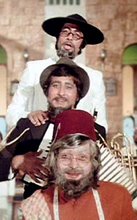
The valleys of northwest are ruled by madmen who care more about the length of one's beard than anything else. In the delta of the east, paramilitary revolts and kills the commander and wife. In the vast democratic experiment in the middle doesn't exist in the huge swatch of territory ruled by Naxalites.
Meanwhile, a singer passes away. A singer who wanted to see the promised day:
Jab zulm-o-sitam ke kohe-garaan rui ki tarah ud jaayenge,
Hum mahkoomon ke pau tale, jab dharti dhar dhar dharkegi…
Sab taaj uchale jaenge
Sab takht girae jaenge…
Uthega An-al-Huq ka nara jo mai bhi hoon aur tum bhi ho…
Radicals of left and right are trying to realise their utopian vision in Desh. History warns us against grand experiments, but the status quo is not sustainable either.
Iqbal Bano didn't see the promised day. Is it too late for us too?
Showing posts with label listening. Show all posts
Showing posts with label listening. Show all posts
Saturday, April 25, 2009
Saturday, December 15, 2007
Heroes, villains and ideas
Bangladesh is marking its liberation from Pakistani occupation this weekend. And a few weeks from now, Indians will celebrate the founding of their republic. During these weeks, TV channels in that part of the world play patriotic tunes. This post is about two such songs — both about the land and gold — and how they display a betrayal of a fundamental tenet of each nation’s foundation.
Let’s start with the Bangladeshi song Shona shona shona. The song says the land, mati, of Bangladesh is better than gold, and under this land sleeps many heroes: Rafiq, Shafiq, Barkat, Titu Mir and Isa Khan.
Who are these heroes? Rafiq, Shafiq and Barkat were killed by the authorities during the language riot of 1952 — a milestone moment in Bangladesh’s nationalism. Titu Mir defied the East India Company and organised a peasant revolt in the 19th century. Isa Khan was a Bengali chieftain who resisted the Mughals in the 16th century.
Notice how all of these heroes are Muslim men? Bangladesh was supposed to be a secular people’s republic. The song was written in the late 1960s, when the ethos of secularism and a progressive society were at the mainstream of Bangladeshi politics. And yet, the song didn’t include Surya Sen or Pritilata Waddedar (Chittagong-based militant revolutionaries killed by the Raj in the 1930s).
The Indian Republic of course has the word secularism in its official name. But you wouldn’t know the supposedly secular nature of the republic from one of the most played song on Indian channels in the week preceding its anniversary in January. The song Mere desh ki dharti proclaims that the land produces gold and diamond, and India is home to these heroes: Gautam, Nanak, Gandhi, Subhas Bose, Tagore, Hari Singh Nalwa, Lal Bahadur Shastri, Bhagat Singh and Jawaharlal Nehru. So, the pantheon of Indian heroes includes a fascist and a warlord, but no Muslim or women. We didn’t expect Noor Inayat Khan to be honoured, but surely the Rani of Jhansi or Tipu Sultan deserves a mention.
Both Bangladeshi and Indian songs are from the 1960s, a time when overtly communal politics seemed to be on the wane in our part of the world, a time when women’s rights were being recognised by the society at large. And yet, two very well known songs of that era, listing the respective nations’ heroes, failed to find a place for the silent minorities that make up the majority of those nations.
And today, four decades hence, the very ideas of secular liberalism are under threat in our part of the world. In Bangladesh, villains who committed genocide in their fight against those ideas in 1971 became resurgent. In India, villains who committed genocide in 2002 to turn India into a Hindu state are gathering strength.
Secularism, liberty, equality of opportunity between genders, these ideas are worth fighting for regardless of nationalism or historical divisions. Indeed, I believe those ideas are more valuable than tribalism or dispute over real estate. This December, or this January, when we hear patriotic songs, let’s think about these ideas, and dedicate ourselves to them.
Let’s start with the Bangladeshi song Shona shona shona. The song says the land, mati, of Bangladesh is better than gold, and under this land sleeps many heroes: Rafiq, Shafiq, Barkat, Titu Mir and Isa Khan.
Who are these heroes? Rafiq, Shafiq and Barkat were killed by the authorities during the language riot of 1952 — a milestone moment in Bangladesh’s nationalism. Titu Mir defied the East India Company and organised a peasant revolt in the 19th century. Isa Khan was a Bengali chieftain who resisted the Mughals in the 16th century.
Notice how all of these heroes are Muslim men? Bangladesh was supposed to be a secular people’s republic. The song was written in the late 1960s, when the ethos of secularism and a progressive society were at the mainstream of Bangladeshi politics. And yet, the song didn’t include Surya Sen or Pritilata Waddedar (Chittagong-based militant revolutionaries killed by the Raj in the 1930s).
The Indian Republic of course has the word secularism in its official name. But you wouldn’t know the supposedly secular nature of the republic from one of the most played song on Indian channels in the week preceding its anniversary in January. The song Mere desh ki dharti proclaims that the land produces gold and diamond, and India is home to these heroes: Gautam, Nanak, Gandhi, Subhas Bose, Tagore, Hari Singh Nalwa, Lal Bahadur Shastri, Bhagat Singh and Jawaharlal Nehru. So, the pantheon of Indian heroes includes a fascist and a warlord, but no Muslim or women. We didn’t expect Noor Inayat Khan to be honoured, but surely the Rani of Jhansi or Tipu Sultan deserves a mention.
Both Bangladeshi and Indian songs are from the 1960s, a time when overtly communal politics seemed to be on the wane in our part of the world, a time when women’s rights were being recognised by the society at large. And yet, two very well known songs of that era, listing the respective nations’ heroes, failed to find a place for the silent minorities that make up the majority of those nations.
And today, four decades hence, the very ideas of secular liberalism are under threat in our part of the world. In Bangladesh, villains who committed genocide in their fight against those ideas in 1971 became resurgent. In India, villains who committed genocide in 2002 to turn India into a Hindu state are gathering strength.
Secularism, liberty, equality of opportunity between genders, these ideas are worth fighting for regardless of nationalism or historical divisions. Indeed, I believe those ideas are more valuable than tribalism or dispute over real estate. This December, or this January, when we hear patriotic songs, let’s think about these ideas, and dedicate ourselves to them.


Thursday, August 09, 2007
A-A-A on the Song of Hind
Some time ago, we wrote about songs of Hind. We didn’t cover the song of Hind — Iqbal’s Tarana-e-Hind (audio and lyrics here). We did, however, discuss the song.
Amar:
I read something by Naipaul to the effect that Iqbal never identified with Hind. I don’t really remember what Naipaul said. But here’s what I’ve been thinking.
Iqbal says: Sare Jahan se achachha Hindustan hamara, hum bulbulen hain iski yeh gulistan hamara. Generally we assume he means everyone in Hindustan. But then he also says: Aiy ab-e-rood-i-Ganga woh din hain yaad tujhko, utra tere kinare jab karavan hamara. Here he seems to be talking about Muslims specifically when he says hamara.
If one use of hamara seems to be as a Muslim, then isn't it inconsistent to interpret the other hamaras as meaning Muslims and Hindus and Christians and Buddhists and Jews and Sikhs and tribals and Zoroastrians and Jains?
But then, he does say: Mazhab nahin sikhata apas men bair rakhna, Hindi hain ham watan hai Hindustan hamara. And when he says aapas mein, it seems to imply different religions...
So my query about Ganga is, in this bit of song he seems to use hamara for Muslims, whereas other bits are supposed to be all communities. Of course Muslims are part of hamara, so it's not necessarily wrong, but I was just wondering what he was thinking.
Anthony:
I think Iqbal seems to be using a nuanced multilayered concept of identity. He has a sentence mentioning himself: Iqbal! koi mehram apna nahin jahan men Ma'loom kya kisi ko dard-i-nihan hamara. Then there is the Muslim identity in the Ganga line. And overlaying all this is the Hindi identity.
Another reading of it could mean all hamaras are referring to Muslim Hind. But when he says Hindustan hamara (hamara being Muslim Hind), he isn't suggesting Hind is no one else's (unlike the Hindutva brigade). Rather, he means Hindi Muslims are Hindis and Hindustan is their watan. That is, he rejects Muslim separatism and urges Muslims to accept a sort of Hindustan nationalism.
This reading is just as valid.
One way to decipher this is to see where the poem was originally published.
Amar:
Here is what google pulls up.
“Centenary Of Iqbal's Tarana-e-Hind
by nkdatta8839@[EMAIL PROTECTED] (nkdatta8839) Aug 20, 2004 at 06:25 PM
Mohammad Iqbal composed the poem "Tarana-e-Hind" on August 10, 1904,
and sent it to Munshi Daya Narain Nigam, editor of Zamana of Kanpur. It was published in the September issue of the journal. The following month it was published in Makhzan of Lahore, edited by Abdul Qadir “
Check this line out: Yunan-o-misr-o-Roma sab mit gaye jahan se, ab tak magar hai baqi nam-o-nishaan hamara.
Surely the reference to the surviving civilization when Greece, Rome and Egypt are destroyed refers to the recorded Desi civilization of 4500 years. And he uses hamara here, so clearly he identifies with that as well, which Naipaul and the Hindutva moan doesn't happen. There we go, this guy identifies with everyone. He is one comfortable guy. He belongs everywhere.
Anthony:
Iqbal is clearly identifying with Hind, there's no doubt about that. Naipaul and the Hindutva are clearly wrong on this (and many other) count. The question is, whether he is urging only Muslims to identify with Hind, or is his message directed at everyone.
I presume these magazines were in Urdu, with primary readership being Muslim, and thus it's probably safe to say that he is urging his fellow Muslims to accept Hindustan and reject Muslim separatism. Mind you, this doesn't make the poem sectarian by itself — non-Muslims can still identify with Hindustan just as much as anyone else.
Amar:
While I agree these magazines were probably in Urdu, I don't think we have any reason to think he is focussing on Muslims. He wrote in Urdu, so he published in Urdu magazines. Why would he be appealing to Muslims any more than to Sikhs or Hindus? I have seen plenty of old timers, Sikh and Hindu, who were familiar with Urdu (one relative was still subscribing to Urdu papers in Delhi in the 1980s, another who was English principal made a hobby of doing Urdu crosswords), and the editor of the first magazine also seems to have been Hindu.
Anthony:
You're right. Urdu was used more widely than Hindi 100 years ago and his readership probably included as many non-Muslims as Muslims. Okay then, he was definitely endorsing Hindustan nationalism — so Naipaulian Hintdutva types are wrong. Even the most sectarian interpretation of this is championing Hind.
Akbar:
Yeah man, championing Hind, even if it means fantasizing a rule over Nepali-Tibetan glaciers: Parbat woh sab se uncha hamsaya aasmaan ka, woh santari hamara, woh pasban hamara.
Sunday, July 08, 2007


Saturday, July 07, 2007
Why has PTV co-opted Talat Mahmood as a Pakistani?
The PTV website, ptv.com.pk, has an online library of songs by Pakistani singers, called Pakistani Evergreen Hits. Except that Talat Mahmood, who features on this list, is surely not Pakistani.
So what is going on? On what ingenious grounds have the worthy folk at PTV seen it fit to co-opt Talat Mehmood as a Pakistani? Is there something to the Talat story that we are missing, some mysterious connection which renders his hits Pakistani Evergreen Hits?
Any idea? I have emailed PTV in search of an explanation, and will let you know what they have to say.
So what is going on? On what ingenious grounds have the worthy folk at PTV seen it fit to co-opt Talat Mehmood as a Pakistani? Is there something to the Talat story that we are missing, some mysterious connection which renders his hits Pakistani Evergreen Hits?
Any idea? I have emailed PTV in search of an explanation, and will let you know what they have to say.
Thursday, April 12, 2007
Remembering Dr King

A few months ago, I had the chance to stand in the footstep of Dr Martin Luther King Jr in Washington DC (you can see the actual speech here). Earlier this month, we marked the assassination of this remarkable man.
Early morning, April 4
A shot rings out in the Memphis sky
Free at last, they took your life
They could not take your pride
Thus sing U2 about the event. But who were ‘they’? Like the other assassinations of the 1960s — the Kennedy brothers and Malcolm X — conspiracy theories abound. As Rage Against the Machine sing: They murdered King after he spoke out on Vietnam; ‘they’ being J Edgar Hoover. Hoover is also the ultimate villain in James Ellroy’s American Tabloid trilogy — I cannot wait for the TV adaptation, perhaps Anthony Hopkins will play Hoover, and Johny Depp one of the misfit protagonists.
In addition to who killed Dr King, there is another mystery here. You see, Dr King was shot in the evening, at about 6pm. So what do U2 mean by a shot ringing out in the early morning?
Tuesday, February 13, 2007
self-introspection - music
A space to look more closely at the songs which affect my mood.
1. Aap ki nazron ne samjha
singer: Lata Mangeshkar
lyrics: Raja Mehndi Ali Khan
film: Anpadh (1962)
2. Aaayega aanewala
singer: Lata Mangeshkar
lyrics: J Nakshab
film: Mahal (1949)
3. Ajeeb dastaan hai yeh
singer: Lata Mangeshkar
lyrics: Shailendra
film: Dil Apna aur Preet Parai (1960)
4. Jurm-e-ulfat pe
singer: Lata Mangeskhar
lyrics: Sahir Ludhianvi
film: Taj Mahal (1963)
5. Mujhe tumse kuchh bhi na chahiye
singer: Mukesh
lyrics: Shailendra
film: Kanhaiya (1959)
...mujhe mere haal pe chod do (!)
6. Na jao saiyan chuda ke baiyan
singer: Geeta Dutt
lyrics: Shakeel Badayuni
film: Sahib Bibi aur Ghulam (1962)
7. Tum mujhe bhool bhi jao
singer: Sudha Malhotra
lyrics: Sahir Ludhianvi
film: Deedi (1960)
8. Waqt ne kiya
singer: Geeta Dutt
lyrics: Kaifi Azmi
film: Kagaz ke Phool (1959)
1. Aap ki nazron ne samjha
singer: Lata Mangeshkar
lyrics: Raja Mehndi Ali Khan
film: Anpadh (1962)
2. Aaayega aanewala
singer: Lata Mangeshkar
lyrics: J Nakshab
film: Mahal (1949)
3. Ajeeb dastaan hai yeh
singer: Lata Mangeshkar
lyrics: Shailendra
film: Dil Apna aur Preet Parai (1960)
4. Jurm-e-ulfat pe
singer: Lata Mangeskhar
lyrics: Sahir Ludhianvi
film: Taj Mahal (1963)
5. Mujhe tumse kuchh bhi na chahiye
singer: Mukesh
lyrics: Shailendra
film: Kanhaiya (1959)
...mujhe mere haal pe chod do (!)
6. Na jao saiyan chuda ke baiyan
singer: Geeta Dutt
lyrics: Shakeel Badayuni
film: Sahib Bibi aur Ghulam (1962)
7. Tum mujhe bhool bhi jao
singer: Sudha Malhotra
lyrics: Sahir Ludhianvi
film: Deedi (1960)
8. Waqt ne kiya
singer: Geeta Dutt
lyrics: Kaifi Azmi
film: Kagaz ke Phool (1959)
Saturday, November 18, 2006
the moth and the flame
One must have sympathy for the flame. How can the flame understand the effect on the moth of their encounter? The flame is unaffected, how would it know the moth's hurt?
***
Munni Begum's La Pila De Saqiya though takes the other view:
Jo jalata hai kisiko, khud bhi jalta hai zaroor,
shamma bhi jalti rahi, parvana jal jane ke baad
What scorches another, surely also burns itself
the flame continued to burn after the moth was burnt
***
Munni Begum's La Pila De Saqiya though takes the other view:
Jo jalata hai kisiko, khud bhi jalta hai zaroor,
shamma bhi jalti rahi, parvana jal jane ke baad
What scorches another, surely also burns itself
the flame continued to burn after the moth was burnt
Sunday, October 15, 2006
life/death
In the 196X film Guide about two tragic lives (and lovers), the divine Waheeda Rehman lip-syncs (while the equally divine Lata Mangeshkar sings) the dilemna she sees before her:
Aaj phir jeenay ki tamanna hai, aaj phir marney ka irada hai
Today there is still the desire to live, today there is still the intention to die
On the other hand, Habib Wali Mohammad somewhere around the same time gives voice to a different concern:
Marney ki duaen kyun mangun, jeenay ki tamanna kaun kare
Why should I pray for death, (but) who has reason to desire life?
Both lines reflect an internal struggle - to choose between living and dying. But where in the former, Waheeda is tempted by each option - the possibilities of life, the escape of death, Habib reflects the reality of true despair - no hope at all, whether in life or in death.
Aaj phir jeenay ki tamanna hai, aaj phir marney ka irada hai
Today there is still the desire to live, today there is still the intention to die
On the other hand, Habib Wali Mohammad somewhere around the same time gives voice to a different concern:
Marney ki duaen kyun mangun, jeenay ki tamanna kaun kare
Why should I pray for death, (but) who has reason to desire life?
Both lines reflect an internal struggle - to choose between living and dying. But where in the former, Waheeda is tempted by each option - the possibilities of life, the escape of death, Habib reflects the reality of true despair - no hope at all, whether in life or in death.
Thursday, October 12, 2006
Paradise city
It was the very early 1990s, before Nirvana and Pearl Jam, before the megaconcerts by Metallica and U2. Terminator 2 was still a forthcoming movie. But its ‘theme song’, You could be mine, was all over music channels. That song had clips from the movie, especially the iconic scene where the T-800 first meets John Connor, drops its bouquet of roses and takes out the gun to shoot the T-1000 that is chasing John. This was not the first metal song I was exposed to. Scorpions’ Wind of change was the rage after the Berlin Wall fell. And Survivors’ Eye of the tiger was a familiar tune. But those were ‘soft rock’, and Terminator 2 publicity brought the ‘hard stuff’ to me. I soon raided a friend’s collection and got myself a mixed tape — new CDs were too expensive, and technology to write CDs were years away. This tape had Aerosmith old and new (Sweet emotion, Walk this way with RUN DMC and Janie’s got a gun), Bon Jovi (Living on a prayer, and some other stuff that I don’t remember), Def Leppard (some tracks from Hysteria) and Paradise City, Welcome to the jungle and Sweet child o’mine. Guns N’ Roses became my favourite band right away. Then Use Your Illusions I and II were out — my first original albums (still tapes). But Paradise City was, and still is, far and away the best hard rock song I’ve ever heard. And that’s why it’s in the list (the others discussed already are: Srabon and Get back).
Saturday, September 30, 2006
Get back
They say that, in the West, everyone has a Beatles story.
There’s the guy who sipped wine sitting on a rug in a balcony facing the ocean, until the hostess dashed his hopes of a happier end to the night by telling him that she had work early morning, all the while Norwegian wood played on the stereo. Then there’s the girl who had her high school admirer sing Eight days a week during recess. Someone remembers being worried because he didn’t feel any higher while listening to A day in the life. Some remember driving around the Pacific Coast in a beat up Pintara listening to the White Album. There is the married couple who fought over whether Help marked the end of the early Beatles or the beginning of the middle Beatles. There’s the guy who would insist on playing the last half of Abbey Road uninterrupted. There’s the girl who hates Beatles covers, but loves I am Sam. And there’s the boy who saw strangers cry the day music died.
And everyone can relate to those four — George the quiet genius, Ringo with that goofy laugh, and Paul is really quite a good guy once you know him, and John, oh then there’s John.
Such Beatles stories are not the sole preserve of the West — a brother once told me how his mother would make dinner while playing Rubber Soul, so twenty years on, he can smell ghee-fried paratha listening to Girl.
I have no such story about Get Back. I don’t know why it is my favorite Beatles track. It is not easy to pick a single Beatles song, but this is the one I chose.
This is not the Beatles track with the most influential lyrics. Nor does it have the most groundbreaking musical technique. In fact, it is in many ways a straightforward rock and roll number. Perhaps this is what Paul meant when he said get back to where you once belonged. Perhaps. Real aficionados know that there are bootleg versions where the song urges a Paki to get back to where he belongs — this was meant to be a political satire denouncing racism. I, of course, had no idea of this when I first heard the song. And I still don’t know what Sweet Loretta Martin thought she was a woman but she was another man means.
There’s the guy who sipped wine sitting on a rug in a balcony facing the ocean, until the hostess dashed his hopes of a happier end to the night by telling him that she had work early morning, all the while Norwegian wood played on the stereo. Then there’s the girl who had her high school admirer sing Eight days a week during recess. Someone remembers being worried because he didn’t feel any higher while listening to A day in the life. Some remember driving around the Pacific Coast in a beat up Pintara listening to the White Album. There is the married couple who fought over whether Help marked the end of the early Beatles or the beginning of the middle Beatles. There’s the guy who would insist on playing the last half of Abbey Road uninterrupted. There’s the girl who hates Beatles covers, but loves I am Sam. And there’s the boy who saw strangers cry the day music died.
And everyone can relate to those four — George the quiet genius, Ringo with that goofy laugh, and Paul is really quite a good guy once you know him, and John, oh then there’s John.
Such Beatles stories are not the sole preserve of the West — a brother once told me how his mother would make dinner while playing Rubber Soul, so twenty years on, he can smell ghee-fried paratha listening to Girl.
I have no such story about Get Back. I don’t know why it is my favorite Beatles track. It is not easy to pick a single Beatles song, but this is the one I chose.
This is not the Beatles track with the most influential lyrics. Nor does it have the most groundbreaking musical technique. In fact, it is in many ways a straightforward rock and roll number. Perhaps this is what Paul meant when he said get back to where you once belonged. Perhaps. Real aficionados know that there are bootleg versions where the song urges a Paki to get back to where he belongs — this was meant to be a political satire denouncing racism. I, of course, had no idea of this when I first heard the song. And I still don’t know what Sweet Loretta Martin thought she was a woman but she was another man means.
Monday, September 25, 2006
On Srabon
Srabon is the fourth month in Bengali calendar. Falling in July-August, it is when the monsoon rains sweep the delta. With the rains come the seasonal floods that shut down the countryside. Rains also affect the urban middle class with their restless minds (udashi mon) and poetry (kobita). And that’s what Different Touch’s song ‘Srabon’ is all about. It is not, however, a traditional Bangla song. Rather, it sounds like something from that other great delta musical tradition — Srabon, then, is Padma meets Mississippi. In 1990, when the band released their eponymous album, this was not the biggest hit. The band itself was neither the first Bangla rock act nor the most popular — Azam Khan, Souls and Feedback preceded them by years (a very interesting recollection halfway down this link), while Ayub Bachchu and James easily sold more albums. But this was the first song I really liked, and these days it is considered a veritable classic. So this was in the first one to be listed. I have no idea where these guys are now. If anyone does, feel free to write to my brothers Amar and Akbar.
Thursday, September 14, 2006
On Radha-Krishna
Lagaan is by any reckoning a groundbreaking Bollywood film. But a Bollywood film it is, with its fair share of songs and dances. My favorite song-dance sequence is the one where the villagers, well Gauri and Bhuvaan and their friends, celebrate Krishna’s birthday. In the song, the girl complains that Radha is anxious about Krishna’s philandering ways and the boy replies that Radha should be understanding because there’s no one else in Krishna’s heart but Radha. When the meaning of the song is translated to her, Elizabeth asks Gauri: Is Radha Krishna’s wife?
Oh no, Krishna’s wife is Rukmini! — is the reply.
If you’re not familiar with the story of Radha and Krishna, it’s natural to think that they are a married couple. Of course Radha-Krishna are anything but married — here is what wiki says about them. Imagine the shock the Victorian girl would have got upon realizing that the villagers were celebrating an extra-marital affair in such exuberant manner.
In the popular culture of the West, Krishna is associated with George Harrison and his mates. In the popular culture of Desh, reference to Radha-Krishna and Krishna’s affairs with the Gopis go back many centuries. And they span most part of Desh — Gita Govinda and other Bhakti songs are sung in every modern Desi language.
And they are thriving in one unexpected place, among the Bangladeshi diaspora in Londonistan. These days, many people think that British Muslim youths are all about slaying the infidel. But British Muslims like Kaya and Habib are also pumping out albums like Krishno, with songs that celebrate the union of Radha and Krishna in the Nikunja Temple. Partly influenced by the diaspora bands, Bangladeshi rock bands have looked to folk songs for ideas in recent years.
Lyrics of some these folk songs can be quite scandalous to the prudish ear. And Radha-Krishna is not the only forbidden love they sing about. The story of Yusuf-Zulekha and Chandidas-Rajakini are also popular. Maybe these songs have some deeper meaning about man’s unison with God, maybe they really are about illicit love. Whatever it is, there are more British Bangladeshi kids dancing to this beat than shouting about Jihad.
And that is a good thing. In a different time in a different place, people thought that rock music would change the world. We know better to expect that songs can silence guns. But wouldn’t it be nice if we were wrong?
Oh no, Krishna’s wife is Rukmini! — is the reply.
If you’re not familiar with the story of Radha and Krishna, it’s natural to think that they are a married couple. Of course Radha-Krishna are anything but married — here is what wiki says about them. Imagine the shock the Victorian girl would have got upon realizing that the villagers were celebrating an extra-marital affair in such exuberant manner.
In the popular culture of the West, Krishna is associated with George Harrison and his mates. In the popular culture of Desh, reference to Radha-Krishna and Krishna’s affairs with the Gopis go back many centuries. And they span most part of Desh — Gita Govinda and other Bhakti songs are sung in every modern Desi language.
And they are thriving in one unexpected place, among the Bangladeshi diaspora in Londonistan. These days, many people think that British Muslim youths are all about slaying the infidel. But British Muslims like Kaya and Habib are also pumping out albums like Krishno, with songs that celebrate the union of Radha and Krishna in the Nikunja Temple. Partly influenced by the diaspora bands, Bangladeshi rock bands have looked to folk songs for ideas in recent years.
Lyrics of some these folk songs can be quite scandalous to the prudish ear. And Radha-Krishna is not the only forbidden love they sing about. The story of Yusuf-Zulekha and Chandidas-Rajakini are also popular. Maybe these songs have some deeper meaning about man’s unison with God, maybe they really are about illicit love. Whatever it is, there are more British Bangladeshi kids dancing to this beat than shouting about Jihad.
And that is a good thing. In a different time in a different place, people thought that rock music would change the world. We know better to expect that songs can silence guns. But wouldn’t it be nice if we were wrong?
Tuesday, July 18, 2006
the hopeless struggle
The rationale and logic of human struggle fascinates me. Most bizarre of all is the knowingly futile struggle, where there is no hope or illusion of redemption or success. What motivates man to continue in such circumstances? I have failed to offer any explanation in the past, though I have occasionally stared at moths and wondered. The Russians have a saying - to the success of our hopeless task! Perhaps I need to ask one of them to explain.
Instead, I have been reading Thomas Mann's Death in Venice in recent days. The summary on the back cover was what caught my eye, and it has the following to say about the central character and his story: "His pitiful pursuit of the object of his affection and its inevitable and pathetic climax are told here..."
The inevitable and pathetic climax, it is obvious from the title, is death. This seems quite consistent, for example, with the case of the moths.
I have been listening to music too. I recently discovered Na to caravan ki talaash hai (lyrics: the incomparable Sahir Ludhianvi). Here, a male and female singer sing two differing perspectives of the world. The latter is more intriguing. The male version is hopeful. But the woman's opening words are:
Mere na muraad junoon ka, hai ilaaj koyee to maut hai
For my hopeless passions, if there's any cure, it's death
Death seems well accepted as the inevitable climax by all hopeless strugglers. Indeed, they seem to aspire to little else. But death is inevitable for all, both hopeful and hopeless. Perhaps the difference is merely that for the hopeful, it is an unwelcome interruption, but for us hopeless, it is the awaited conclusion.
Instead, I have been reading Thomas Mann's Death in Venice in recent days. The summary on the back cover was what caught my eye, and it has the following to say about the central character and his story: "His pitiful pursuit of the object of his affection and its inevitable and pathetic climax are told here..."
The inevitable and pathetic climax, it is obvious from the title, is death. This seems quite consistent, for example, with the case of the moths.
I have been listening to music too. I recently discovered Na to caravan ki talaash hai (lyrics: the incomparable Sahir Ludhianvi). Here, a male and female singer sing two differing perspectives of the world. The latter is more intriguing. The male version is hopeful. But the woman's opening words are:
Mere na muraad junoon ka, hai ilaaj koyee to maut hai
For my hopeless passions, if there's any cure, it's death
Death seems well accepted as the inevitable climax by all hopeless strugglers. Indeed, they seem to aspire to little else. But death is inevitable for all, both hopeful and hopeless. Perhaps the difference is merely that for the hopeful, it is an unwelcome interruption, but for us hopeless, it is the awaited conclusion.
Tuesday, July 11, 2006
Aap ki Nazron ney samjha – Your ogling has understood *
Either I am infatuated or this song is too good. The poetry, the vocals and the rhythm just flow. Lata is at her best in this song . Dilip kumar once complemented her in the words ‘In ki awaaz Khuda ka ek karishma hai’ – ‘Her voice is the miracle of God.’
‘Kyon mein toofan sey daroon, mera sahil aap hain’ - ‘Why should I fear the storm when you are my shore’. I hope my future wife (whoever she maybe) says these bold words for me. (I may not hang around on the shore if there is a bloody toofan).
The reason for listening to so many love songs lately is the result of watching Fanaa. Twice that is or thrice actually - once on the laptop (pirated version Zindabaad), to copy out the missing words of poetry.
Why? It’s a gr8 film. Everybody hates it except me and amar. The film has everything. Action, romance, comedy, poetry, kids section, etc.etc.
Sure the nikah scene (marriage) was inconsistent and nonsense (u need six witnesses from both sides to have a nikah – oh well u can’t use rabbits in Kashmir wilderness), the drinking muslim guy was pathtic….but hey many muslims drink in the memory of their dead wives (especially at Duabi airport) it was all round good entertaiment. The rishi kapoor dummy floating under ice was hilarious.
At least from my point Pakistan also got to be a victim of Kashmiri terrorism.
The reason people hate this movie is because Amir Khan once again exceeded everyone’s expectations of the kind of genre he can act in.
Lag ja galey, kay phir yeh haseen raat ho na ho.
Come into my arms, as this night may never come again.
The context in which this song was played in the movie gave the song new meaning and life. Lovely song. However quite crude by desi standards, as the girl is openly inviting a man to hug her as this night may not be, and to ogle her as this moment may never come. Too bad Rehan Qadri is not a practicing Muslim and same for Ms. Impregnated before marriage twice abandoned Zoony.
Watching a desi film in an Inglistani (Brtish) cinema is an interesting experience. The turnover of people leaving the cinema is quite high…especially after the opening scene (which is song and dance generally). If not leaving then hooting is an excellent recourse. Genuine audiences who are regulars come in teams the size of indoor footall teams.
Leading the group would be a stocky sari clad aunty, who would keep making the most beautiful chic among the group move from seat to seat to avoid young hot blooded studs like me and amar from staring at her. Oh well….we saw what we had come to see.
Sadly as I am back in the land of two holy Holy mosques with out cinemas or theatres and I continue to look forward to another Amir Khan movie.
* Excuse the literal translation. The complete title should be ‘your eyes have accepted me as able for your love.’
‘Kyon mein toofan sey daroon, mera sahil aap hain’ - ‘Why should I fear the storm when you are my shore’. I hope my future wife (whoever she maybe) says these bold words for me. (I may not hang around on the shore if there is a bloody toofan).
The reason for listening to so many love songs lately is the result of watching Fanaa. Twice that is or thrice actually - once on the laptop (pirated version Zindabaad), to copy out the missing words of poetry.
Why? It’s a gr8 film. Everybody hates it except me and amar. The film has everything. Action, romance, comedy, poetry, kids section, etc.etc.
Sure the nikah scene (marriage) was inconsistent and nonsense (u need six witnesses from both sides to have a nikah – oh well u can’t use rabbits in Kashmir wilderness), the drinking muslim guy was pathtic….but hey many muslims drink in the memory of their dead wives (especially at Duabi airport) it was all round good entertaiment. The rishi kapoor dummy floating under ice was hilarious.
At least from my point Pakistan also got to be a victim of Kashmiri terrorism.
The reason people hate this movie is because Amir Khan once again exceeded everyone’s expectations of the kind of genre he can act in.
Lag ja galey, kay phir yeh haseen raat ho na ho.
Come into my arms, as this night may never come again.
The context in which this song was played in the movie gave the song new meaning and life. Lovely song. However quite crude by desi standards, as the girl is openly inviting a man to hug her as this night may not be, and to ogle her as this moment may never come. Too bad Rehan Qadri is not a practicing Muslim and same for Ms. Impregnated before marriage twice abandoned Zoony.
Watching a desi film in an Inglistani (Brtish) cinema is an interesting experience. The turnover of people leaving the cinema is quite high…especially after the opening scene (which is song and dance generally). If not leaving then hooting is an excellent recourse. Genuine audiences who are regulars come in teams the size of indoor footall teams.
Leading the group would be a stocky sari clad aunty, who would keep making the most beautiful chic among the group move from seat to seat to avoid young hot blooded studs like me and amar from staring at her. Oh well….we saw what we had come to see.
Sadly as I am back in the land of two holy Holy mosques with out cinemas or theatres and I continue to look forward to another Amir Khan movie.
* Excuse the literal translation. The complete title should be ‘your eyes have accepted me as able for your love.’
Wednesday, June 07, 2006
Conservative rock songs
Back in late 2002 or early 2003, with the invasion of Iraq imminent, South Park ran an episode where the town folks were divided among the rock music people and the country music people. The former were liberal anti war progressive gay loving cheese eating surrender monkeys. The latter represented the conservative patriotic moral values redneck burger eating warmongers. In the South Park world, conservatives did not rock and roll, and country lovers supported the war. Of course in the real world there is a Texan country band that opposes the war. And now it turns out that conservatives too listen to rock music. National Review has recently compiled a list of top 50 conservative rock songs. Here are the top 10.
1. Won’t Get Fooled Again — The Who
Meet the new boss / Same as the old boss
Plus ça change, plus c'est la même chose. And what can be more conservative?
2. Taxman — The Beatles
George Harrison tells you: Now my advice for those who die / Declare the pennies on your eyes.
3. Sympathy for the Devil — The Rolling Stones
The Devil inspired Pontius Pilate, that coup in St Petersburg and the Blitzkrieg, and he will tell you that: Every cop is a criminal / And all the sinners saints.
4. Sweet Home Alabama — Lynyrd Skynyrd
Big wheels keep on turning, and those Neil Young hating Southern men keep voting for GOP.
5. Wouldn’t It Be Nice — The Beach Boys
We could be married / And then we’d be happy
6. Gloria — U2
Well we know that Bono is Christian.
7. Revolution — The Beatles
This is the version where if you talk about destruction, John Lennon wants to be counted out.
8. Bodies — The Sex Pistols
It’s not an animal / It’s an abortion
9. Don’t Tread on Me — Metallica
So be it / Threaten no more / To secure peace is to prepare for war, or as Thomas Jefferson said, ‘The price of freedom is eternal vigilance’.
10. 20th Century Man — The Kinks
I was born in a welfare state / Ruled by bureaucracy / Controlled by civil servants / And people dressed in grey / Got no privacy got no liberty / ’Cause the 20th-century people / Took it all away from me
The full list is here. The only one to make to an A-A-A list is Sympathy for the Devil, not the least because of its reference to Bombay.
Hat tip: Marginal Revolution.
1. Won’t Get Fooled Again — The Who
Meet the new boss / Same as the old boss
Plus ça change, plus c'est la même chose. And what can be more conservative?
2. Taxman — The Beatles
George Harrison tells you: Now my advice for those who die / Declare the pennies on your eyes.
3. Sympathy for the Devil — The Rolling Stones
The Devil inspired Pontius Pilate, that coup in St Petersburg and the Blitzkrieg, and he will tell you that: Every cop is a criminal / And all the sinners saints.
4. Sweet Home Alabama — Lynyrd Skynyrd
Big wheels keep on turning, and those Neil Young hating Southern men keep voting for GOP.
5. Wouldn’t It Be Nice — The Beach Boys
We could be married / And then we’d be happy
6. Gloria — U2
Well we know that Bono is Christian.
7. Revolution — The Beatles
This is the version where if you talk about destruction, John Lennon wants to be counted out.
8. Bodies — The Sex Pistols
It’s not an animal / It’s an abortion
9. Don’t Tread on Me — Metallica
So be it / Threaten no more / To secure peace is to prepare for war, or as Thomas Jefferson said, ‘The price of freedom is eternal vigilance’.
10. 20th Century Man — The Kinks
I was born in a welfare state / Ruled by bureaucracy / Controlled by civil servants / And people dressed in grey / Got no privacy got no liberty / ’Cause the 20th-century people / Took it all away from me
The full list is here. The only one to make to an A-A-A list is Sympathy for the Devil, not the least because of its reference to Bombay.
Hat tip: Marginal Revolution.
Sunday, May 07, 2006
Top 20 Bangla songs
The BBC Bangla Service recently asked its listeners about their favourite songs. The results are available here. Some quick observations.
1. Of the 20 songs, 12 extol the motherland or commemorate the nation’s struggles for freedom. That is, according to the BBC listeners, good music is all, well mostly, about patriotism. These include classic paeans (Dhono dhanney pushpe bhora) as well as more recent ones (Ami Banglai gaan gaai).
2. Songs about the difficulties Bengalis had with Pakistan feature prominently (six of the dozen are from that era). There is, however, no song praising India in the dozen.
3. The other eight include four exhibiting internationalist/humanitarian ideas, including two revolutionary songs by Nazrul.
4. Coffee house, voted the top song of the 20th century six years ago, comes in at number 4. There are only four songs from post-partition West Bengal, and none recorded in the past four decades. Does it mean that West Bengalis don’t listen to the BBC? Or no good music has been made in Calcutta since the 1960s?
5. None of the 20 songs make it to the A-A-A list. And if you’re wondering, this Banglabandhu-dominated list is topped by, what else but, Amar sonar Bangla.
1. Of the 20 songs, 12 extol the motherland or commemorate the nation’s struggles for freedom. That is, according to the BBC listeners, good music is all, well mostly, about patriotism. These include classic paeans (Dhono dhanney pushpe bhora) as well as more recent ones (Ami Banglai gaan gaai).
2. Songs about the difficulties Bengalis had with Pakistan feature prominently (six of the dozen are from that era). There is, however, no song praising India in the dozen.
3. The other eight include four exhibiting internationalist/humanitarian ideas, including two revolutionary songs by Nazrul.
4. Coffee house, voted the top song of the 20th century six years ago, comes in at number 4. There are only four songs from post-partition West Bengal, and none recorded in the past four decades. Does it mean that West Bengalis don’t listen to the BBC? Or no good music has been made in Calcutta since the 1960s?
5. None of the 20 songs make it to the A-A-A list. And if you’re wondering, this Banglabandhu-dominated list is topped by, what else but, Amar sonar Bangla.
Thursday, May 04, 2006
Amar Akbar Anthony select their favorite music
Amar
1. aashiyan jal gaya - habib wali mohammad
2. magar ai haseena - saleem raza
3. laga chunari main daag - manna dey
4. jurm-e-ulfat pe - lata mangeshkar
5. abhi to main jawaan hoon - mallika pukhraj
6. mujh se pehli si muhabbat - noor jahan
7. bolero - ravel
8. choli ke peeche kya hai - ila arun
9. that would be me - chino xl
1O. dead wrong - notorious big
11. el amor brujo - falla
12. dies irae - verdi
13. the infernal dance of king khachtei - stravinsky
14. montagues and capulets - profikiev
15. thaiyya thaiyya - sukhvinder/suba?
16. hum dekhenge - iqbal bano
17. yeh hawa yeh raat - talat mahmood
18. jo yeh dil deewana - mohd rafi
19. yeh desh hai veer jawanon ka - mohd rafi
2O. phir mujhe deed-e-tar yaad aaya - talat mahmood
21. chandi ka badan - rafi / manna dey / asha etc.
Akbar [editor: akbar bhai, please to edit and write name of missing singers]
1. Koi Mijh sey poochay - Mohammad Rafi
2. Tootay huay Khawabon nay -
3. Shaam-e--ghum kii kasam - Talat Mahmood
4. Meri yaad mein tum aansoo na bahana.
5. Bolero - Ravel
6. Dasht-e-Tanhai - Iqbal Bano
7. Hum Dekhenge - Iqbal Bano
8. Abdul Qader and Didi - Khalid Didi
9. Jab shaam Dhale from the film Sur
10. Phir aajana Dil kay armano ka Lut jaana - Lata Mangeshkar
11. Mehfil mein jal uthi Shamaa - Lata Mangeshkar
12. Mere Mehboob - Kishore Kumar
13. Awara hoon - Mukesh
14. Jab koi Pyar sey bulaye gaa - Mehdi Hassan
15. Man in the Mirror- Michael Jackson
16. Billie Jean - Michael Jackson
17. We will Rock you - Queen
18. All of Cat Stephens
19. Bachpan kii Mohabbat Ko
20. I will be watching you.
Anthony: here are my 21, in the chronological order by which they came to be liked.
1. Srabon - Different Touch
2. Get back - The Beatles
3. Paradise city - Guns N’ Roses
4. Black magic woman - Santana
5. Layla - Derek and the Dominos
6. Rattle and Hum (album) - U2
7. Sympathy for the devil - The Rolling Stones
8. All along the watchtower - Jimi Hendrix
9. Yeh Chand sa raushan chehra - Mohammed Rafi
10. Sitting on the dock of the bay - Otis Redding
11. Theme from Shaft - Isaac hayes
12. Ta deem - Nusrat Fateh Ali Khan and Asian Dub Foundation
13. Allah hu - Junoon
14. Exodus - Bob Marley and the Wailers
15. Sound of silence - Simon and Garfunkel
16. Bangladesher dhol - SD Burman
17. Ei raat tomar amar - Hemanta Mukherjee
18. Neel dariya - Abdul Jabbar
19. Yeh kahan aa gaye hum - Lata and Amitabh Bachchan
20. Krishna - Habib
21. Mora ekti phool ke banchabo bole - Apel Mahmud
Conclusions
Music on every AAA list: Zero
Music on 2 AAA lists: Hum Dekhenge, and Bolero
Singers on every AAA list: Mohammad Rafi and Lata Mangeshkar. Perhaps the two greatest music legends of Desh.
1. aashiyan jal gaya - habib wali mohammad
2. magar ai haseena - saleem raza
3. laga chunari main daag - manna dey
4. jurm-e-ulfat pe - lata mangeshkar
5. abhi to main jawaan hoon - mallika pukhraj
6. mujh se pehli si muhabbat - noor jahan
7. bolero - ravel
8. choli ke peeche kya hai - ila arun
9. that would be me - chino xl
1O. dead wrong - notorious big
11. el amor brujo - falla
12. dies irae - verdi
13. the infernal dance of king khachtei - stravinsky
14. montagues and capulets - profikiev
15. thaiyya thaiyya - sukhvinder/suba?
16. hum dekhenge - iqbal bano
17. yeh hawa yeh raat - talat mahmood
18. jo yeh dil deewana - mohd rafi
19. yeh desh hai veer jawanon ka - mohd rafi
2O. phir mujhe deed-e-tar yaad aaya - talat mahmood
21. chandi ka badan - rafi / manna dey / asha etc.
Akbar [editor: akbar bhai, please to edit and write name of missing singers]
1. Koi Mijh sey poochay - Mohammad Rafi
2. Tootay huay Khawabon nay -
3. Shaam-e--ghum kii kasam - Talat Mahmood
4. Meri yaad mein tum aansoo na bahana.
5. Bolero - Ravel
6. Dasht-e-Tanhai - Iqbal Bano
7. Hum Dekhenge - Iqbal Bano
8. Abdul Qader and Didi - Khalid Didi
9. Jab shaam Dhale from the film Sur
10. Phir aajana Dil kay armano ka Lut jaana - Lata Mangeshkar
11. Mehfil mein jal uthi Shamaa - Lata Mangeshkar
12. Mere Mehboob - Kishore Kumar
13. Awara hoon - Mukesh
14. Jab koi Pyar sey bulaye gaa - Mehdi Hassan
15. Man in the Mirror- Michael Jackson
16. Billie Jean - Michael Jackson
17. We will Rock you - Queen
18. All of Cat Stephens
19. Bachpan kii Mohabbat Ko
20. I will be watching you.
Anthony: here are my 21, in the chronological order by which they came to be liked.
1. Srabon - Different Touch
2. Get back - The Beatles
3. Paradise city - Guns N’ Roses
4. Black magic woman - Santana
5. Layla - Derek and the Dominos
6. Rattle and Hum (album) - U2
7. Sympathy for the devil - The Rolling Stones
8. All along the watchtower - Jimi Hendrix
9. Yeh Chand sa raushan chehra - Mohammed Rafi
10. Sitting on the dock of the bay - Otis Redding
11. Theme from Shaft - Isaac hayes
12. Ta deem - Nusrat Fateh Ali Khan and Asian Dub Foundation
13. Allah hu - Junoon
14. Exodus - Bob Marley and the Wailers
15. Sound of silence - Simon and Garfunkel
16. Bangladesher dhol - SD Burman
17. Ei raat tomar amar - Hemanta Mukherjee
18. Neel dariya - Abdul Jabbar
19. Yeh kahan aa gaye hum - Lata and Amitabh Bachchan
20. Krishna - Habib
21. Mora ekti phool ke banchabo bole - Apel Mahmud
Conclusions
Music on every AAA list: Zero
Music on 2 AAA lists: Hum Dekhenge, and Bolero
Singers on every AAA list: Mohammad Rafi and Lata Mangeshkar. Perhaps the two greatest music legends of Desh.
Monday, February 27, 2006
Talat Mehmood, the little brother of Mohammad Rafi
Talat’s singing career story is a sad one. I will not tell you as mentioned in Wikipedia or documented articles. I will tell you as his distant grandson told me about him.
He ran away from his home. He wanted to become a star. He was one of those Nakhrailu (fussy) categories of ‘sensitive artists’ who cannot bear to hear loud noises and are perfectionists about Urdu words. One of those Faiz Ahmed Faiz type soft spoken hippie liberals, who want to do everything from singing, acting to directing but end up doing very little and generally failing.
But his voice was pure silk. The little tremble in his voice, peeved off Naushad and an array of music directors. But that tremble is what makes all of us hum along to his songs. But he was rejected by music director after music director, as his style would remain that classical ‘Ghazal King’ unlike Rafi sahib, with his dynamic voice, could sing to any tune and sing as the music directors wished.
People joke that Rafi was the big brother of Talat. Talat would be the guy who would get the leftover songs, like the leftover whisky from Rafi’s bottle*. He would be the guy who would boldly venture out to act and make movies but fail miserably, while wise old Rafi would focus on singing and daily Riaz (voice practice).
Shaame-gham kii Kasam is one song which is definitely not left over and it epitomizes the true worth of Talat as a ‘King of Ghazal’, where even the great Rafi sahib was no match.
It is sad that Talat sahib stopped singing in 60s. But then time moved on but Talat didn’t. He remains today in my car stereo, as the silky voice which soothes me with the song ‘Meri Yaad mein tum naa aansoo Bahana’ (don’t shed tears in my memory) **
*No evidence has been found of Talat’s or Rafi’s joint drinking habits, hence the writer does not claim that these two singers used to drink heavily or at all. They did perform Hajj together in 1978/79 though.
**Attempted tributes to Talat on his death anniversary recently in Lahore (as shown on Indus Music Channel), were hopeless. Who can ever dance on a Talat Mehmood song?! Only overly ambitious Lahoris can.
And who can sing ‘meri yaad mein tum aansoo naa bahana’ (Don’t shed tears in my memory) with a Punjabi accent?!! Surprise, surprise…only Lahoris can! My fellow country men just downgraded a legend into a bhangra sensation!!
He ran away from his home. He wanted to become a star. He was one of those Nakhrailu (fussy) categories of ‘sensitive artists’ who cannot bear to hear loud noises and are perfectionists about Urdu words. One of those Faiz Ahmed Faiz type soft spoken hippie liberals, who want to do everything from singing, acting to directing but end up doing very little and generally failing.
But his voice was pure silk. The little tremble in his voice, peeved off Naushad and an array of music directors. But that tremble is what makes all of us hum along to his songs. But he was rejected by music director after music director, as his style would remain that classical ‘Ghazal King’ unlike Rafi sahib, with his dynamic voice, could sing to any tune and sing as the music directors wished.
People joke that Rafi was the big brother of Talat. Talat would be the guy who would get the leftover songs, like the leftover whisky from Rafi’s bottle*. He would be the guy who would boldly venture out to act and make movies but fail miserably, while wise old Rafi would focus on singing and daily Riaz (voice practice).
Shaame-gham kii Kasam is one song which is definitely not left over and it epitomizes the true worth of Talat as a ‘King of Ghazal’, where even the great Rafi sahib was no match.
It is sad that Talat sahib stopped singing in 60s. But then time moved on but Talat didn’t. He remains today in my car stereo, as the silky voice which soothes me with the song ‘Meri Yaad mein tum naa aansoo Bahana’ (don’t shed tears in my memory) **
*No evidence has been found of Talat’s or Rafi’s joint drinking habits, hence the writer does not claim that these two singers used to drink heavily or at all. They did perform Hajj together in 1978/79 though.
**Attempted tributes to Talat on his death anniversary recently in Lahore (as shown on Indus Music Channel), were hopeless. Who can ever dance on a Talat Mehmood song?! Only overly ambitious Lahoris can.
And who can sing ‘meri yaad mein tum aansoo naa bahana’ (Don’t shed tears in my memory) with a Punjabi accent?!! Surprise, surprise…only Lahoris can! My fellow country men just downgraded a legend into a bhangra sensation!!
Saturday, February 25, 2006
On God (Part II)
The clarification in parentheses should suggest that this piece is not about the supernatural being that many get so excited about. No, this is about a song I really like: God Part II by U2.
A sequel must have an original, and the original is God, a track from John Lennon’s first post-Beatles album. It’s nowhere near as famous as Imagine or Give peace a chance, or as evocative as Working class hero, but upon release, God still attracted controversy. In it, Lennon declares his disbelief in magic, I-ching, Bible, Tarot, Hitler, Jesus, Kennedy, Buddha, Mantra, Gita, Yoga, Kings, Elvis, Zimmerman or Beatles. Instead, he said: I just believe in me. This statement would not have been out of place in the greedy eighties or the post-modern nineties, but in 1970, the lovey dovey sixties was still fresh, and many were still hoping for a Beatles reunion. Lennon of course courted far worse controversy with the Christians half a decade earlier when he said that the fab four were bigger than Jesus.
Bono wrote the sequel both as a tribute and reply to Lennon. Whereas the original repudiates every icon, the sequel is much more nuanced. The sequel asks whether there can be any virtue without the ability to choose evil. It points out how easy it is to make categorical statements denouncing forced entry and rape even though it is all too easy to be tempted. And while Lennon expresses his belief in self, Bono says he believes in love.
The lyrics and the history aside, the song is an important turning point for U2 stylistically. Appearing towards the end of Rattle and Hum, it is very different from the rest of the album. Instead of the blues-gospel-folk inspired tunes, this is much more like what would be in Achtung Baby and beyond. It has a ferocious tempo, beginning with perhaps the best drumming in Larry Mullen Jr’s career, with the guitar and bass following around the third verse, and about a minute into the song, the combination gives an electric effect, like a machine gun blazing away. And then just into the fourth minute, the song abruptly stops. And I am also going to stop here — you can get a much better appreciation of the song by listening to Bono than reading me.
Ps: I’d like to believe, even though I don’t see any reason to; but I do imagine.
A sequel must have an original, and the original is God, a track from John Lennon’s first post-Beatles album. It’s nowhere near as famous as Imagine or Give peace a chance, or as evocative as Working class hero, but upon release, God still attracted controversy. In it, Lennon declares his disbelief in magic, I-ching, Bible, Tarot, Hitler, Jesus, Kennedy, Buddha, Mantra, Gita, Yoga, Kings, Elvis, Zimmerman or Beatles. Instead, he said: I just believe in me. This statement would not have been out of place in the greedy eighties or the post-modern nineties, but in 1970, the lovey dovey sixties was still fresh, and many were still hoping for a Beatles reunion. Lennon of course courted far worse controversy with the Christians half a decade earlier when he said that the fab four were bigger than Jesus.
Bono wrote the sequel both as a tribute and reply to Lennon. Whereas the original repudiates every icon, the sequel is much more nuanced. The sequel asks whether there can be any virtue without the ability to choose evil. It points out how easy it is to make categorical statements denouncing forced entry and rape even though it is all too easy to be tempted. And while Lennon expresses his belief in self, Bono says he believes in love.
The lyrics and the history aside, the song is an important turning point for U2 stylistically. Appearing towards the end of Rattle and Hum, it is very different from the rest of the album. Instead of the blues-gospel-folk inspired tunes, this is much more like what would be in Achtung Baby and beyond. It has a ferocious tempo, beginning with perhaps the best drumming in Larry Mullen Jr’s career, with the guitar and bass following around the third verse, and about a minute into the song, the combination gives an electric effect, like a machine gun blazing away. And then just into the fourth minute, the song abruptly stops. And I am also going to stop here — you can get a much better appreciation of the song by listening to Bono than reading me.
Ps: I’d like to believe, even though I don’t see any reason to; but I do imagine.
Subscribe to:
Posts (Atom)