Showing posts with label poets. Show all posts

Wednesday, April 11, 2007

Shikwa-e-Khuda

Insaan Khuda sey;


Jis ko chahtay they ussi ko Gawaya

Khuda sey Roothtay hain Kay

Us Jaisa ek aur kyon nahi banaya.


Khuda Insaan Sey;

Ek hi To banaya hai

Is liya to chaha hai

Ek bhi na hoti

To Chahat bhi na hoti.

-----------------------------------

Sigh! Translation -:-(

Complaint-e-Khuda

Man complaining to God:

The One I loved, I Lost

Disappointed I am with GOD

Why a duplicate was not made!?*


God responding to Man;

One was meant to be made

Hence love remained

If even one was not to be

Love would cease to sway.

-------

*yes- this is a parody translation- the real thing is a bore.

Format and Title borrowed from Iqbal's Shikwa and Jawab-e-Shikwa.

On death of solitude

Recently a friend experienced a moment of solitude for a few days. On being asked the reason for such solitude, none was forth coming

As per internet dictionary solitude is defined as ‘the state of being or living alone; seclusion: to enjoy one's solitude’

To most people this state is temporary release from everyday drudgery of life. However I think people fail to miss the fact in spirit we are permanently in solitude. Our soul/spirit is in permanent turmoil, trying to escape this reality of being stuck in our bodies. It seeks release/freedom from the solitude of body.

The only way out is death.

Sounds negative? But then if people try to improve their situation by trying to achieve freedom in this plain, they remain in perpetual state of desires and never happy with the existing situation. The more they get the more they want.

Death. regarded as benign word with negative connotations. However, it is a sweet word. It represents freedom/escape. The ultimate escape. Rebirth and re-incarnation make death pointless. Rebirth in the same world of solitude – does not make sense.

The freedom as a result of death is where the spirit frees itself from permanent solitude and turmoil of this world. It finds its true path. The path leading to becoming One with the creator.

The freedom transcends all other conceived notions of freedom in this earth. Once this path is recognized then it does not matter where a person lives but when he/she/it lives.


To quote my friend Amar;

Darkness is all, no other ends - only delays,
Ourselves unkown, there's no other way
to escape and be more
than what we are now.


Allahspeed.

Monday, April 09, 2007

Insult-e-Ghalib

Aye ghalib! Ishq* ka bana phirta hai tu charagh

Gumrah ho gaye hain, mohabbat ka kaisa hai yeh pursuroor andaz.

Ishq kay barey bol tunay likkhey,

Himmat nahi, ataq gaye hai halaq main dil kii baat.

Aye ustaad-e-hali,

Sikhaya nahi ishq tunay huddodon kay paar,

Tanhai mein rehgaye hain (teray chahney wale),

Dikha hi dey apnay bhujtay charagh ka kamal.

Sharabi phar kar tujhe, kartein hain khuda ko yaad,

Kyon kartey hain sarey, sharab ko badnaam!!?


On seeing the movie Mirza Ghalib, I clearly got the impression he was a weakling of a person
who would have loved to settle in NZ and live off tax payer funded unemployment benefit and munch KFC! Loser!


Sigh! Translation for the unfortunate;


Insult-e-Ghalib


O Ghalib! Regarded you are as the guiding light of Ishq

But lost we remain, such are the ways of love.

Spoken big word you have on Ishq

But will is lost – the words remain stuck in their throat

O Teacher of Hali!

Taught you have not, Ishq beyond the boundaries

Remain abandoned your followers

Hoping to see the miracle of you dimming lamp

The drunkard remembers God after reading you

Why is the wine blamed for everyone’s woes!?


* Passion/Lust

Sunday, April 08, 2007

Tempratur-e-Ishq

Tax season is on and its getting hot in Saudi. Brothers Amar is probably busy or were busy with tax, and who knows what Anthony gets up to, and nobody is watching the world cup except for Bengalis and Sri Lankans-

and love is a hanging around a bit late in the air -

So for those delusional enough to beleive in love before marriage - there's a better substitute - Ishq (passion/Lust) - and I dedicate the verses below to all Passion laden Asshiqs -Salam-e-Ishq!!!


You are the summer in my shivering nights

You are the cool breeze in my humid days

But the stars guide if it were not for you

Hopeless I am without your soothing voice.

Life is a bit less, with no smile from you.


Without your shadow I die useless,

With your hand I live careless.

Your every breath makes me want to live

A hundred lives

But your one downcast look

Causes the pain of a lover’s death.

Shiver I do in the summer nights for you,

May cool breezy days become humid for you.

Saturday, March 10, 2007

1940-47: Hooker’s Freedom Song

(Parody of the Freedom poem ‘Sarfaroshi ki Tamanna’ written by Indian Revolutionary Ram Prasad Bismil)

Here’s what a hooker from the 1930s/40s Independence struggle song would be. I wrote the urdu version which is much more in tune with the original, however for the english readers I have attempted a translation.

Enjoy!

Urdu Version
=========

Jism Faroshi Kii Tamanna Ab Hamaray dil mein hai
Dhandha hai Thup, Jab sey Gandhi aur Jinnah nay kiya hai gand
Pachas rupay kay truck driver sey behtar, goray ka diya hua zakhm.

Azmaya hai humnay sab barey logon ko,
Bata dein gaye aaj unki kamzoriyan bistar mein hum!
Jism Faroshi Kii Tamanna Ab Hamaray Dil mein hai

Nehru ko Azmaa kay dekha, nikla usk kharab lun
Gandhi ka to dus saal ki umar mein ho gaya sub kuch khatam
Netaji Bose ka hai sub sey chota, aur kuch bolnay ka nahi hummay dum
Jinnah ka humko maloom nahin pee kay rehta hai who hamesha tun!
Mountbatten kay uppar paisa hai khatam
Radcliffe kii maa kasam, Bhagat kay pass ek pota (testicle) hai Kum

Jism Faroshi Kii Tamanna Ab Hamaray Dil mein hai!

English Version
============

The desire to sell our body is in our hearts
Business is down, ‘cause Gandhi Jinnah have made such a mess
Better be inflicted by the white man than the fifty rupee pathan truck driver

Tried I have all these big men
Reveal I shall their weaknesses in bed
The desire to sell our body is in our hearts

Nehru failed like a rusty machine on first trial
Gandhi had lost everything at the age of ten
Netaj’s was so small, I have no words to express my shock!
Know we nothing about Jinnah, for he remained always drunk.
Mountbatten was the one with money to really spend
I swear by Radcliffe, Bhaghat had one testicle less.

The desire to sell our body is in our hearts.


Inquilaab Zindabad!!!

Tuesday, February 13, 2007

self-introspection - music

A space to look more closely at the songs which affect my mood.

1. Aap ki nazron ne samjha
singer: Lata Mangeshkar
lyrics: Raja Mehndi Ali Khan
film: Anpadh (1962)

2. Aaayega aanewala
singer: Lata Mangeshkar
lyrics: J Nakshab
film: Mahal (1949)


3. Ajeeb dastaan hai yeh
singer: Lata Mangeshkar
lyrics: Shailendra
film: Dil Apna aur Preet Parai (1960)


4. Jurm-e-ulfat pe
singer: Lata Mangeskhar
lyrics: Sahir Ludhianvi
film: Taj Mahal (1963)


5. Mujhe tumse kuchh bhi na chahiye
singer: Mukesh
lyrics: Shailendra
film: Kanhaiya (1959)


...mujhe mere haal pe chod do (!)

6. Na jao saiyan chuda ke baiyan
singer: Geeta Dutt
lyrics: Shakeel Badayuni
film: Sahib Bibi aur Ghulam (1962)


7. Tum mujhe bhool bhi jao
singer: Sudha Malhotra
lyrics: Sahir Ludhianvi
film: Deedi (1960)


8. Waqt ne kiya
singer: Geeta Dutt
lyrics: Kaifi Azmi
film: Kagaz ke Phool (1959)

Saturday, November 18, 2006

the moth and the flame

One must have sympathy for the flame. How can the flame understand the effect on the moth of their encounter? The flame is unaffected, how would it know the moth's hurt?

***

Munni Begum's La Pila De Saqiya though takes the other view:

Jo jalata hai kisiko, khud bhi jalta hai zaroor,
shamma bhi jalti rahi, parvana jal jane ke baad

What scorches another, surely also burns itself
the flame continued to burn after the moth was burnt

Sunday, November 12, 2006

"Iqbal", Koi Mahram Apna Nahin Jahaan Mein
Maalum Kya Kisi Ko Dard-e-Nihaan Hamaara

We Do Not Have A Confidant In The World, "Iqbal"
No-one Knows What Sorrows Lurk Within Our Heart

- Mohammad Iqbal, translation from here

Sunday, October 15, 2006

life/death

In the 196X film Guide about two tragic lives (and lovers), the divine Waheeda Rehman lip-syncs (while the equally divine Lata Mangeshkar sings) the dilemna she sees before her:

Aaj phir jeenay ki tamanna hai, aaj phir marney ka irada hai
Today there is still the desire to live, today there is still the intention to die

On the other hand, Habib Wali Mohammad somewhere around the same time gives voice to a different concern:

Marney ki duaen kyun mangun, jeenay ki tamanna kaun kare
Why should I pray for death, (but) who has reason to desire life?

Both lines reflect an internal struggle - to choose between living and dying. But where in the former, Waheeda is tempted by each option - the possibilities of life, the escape of death, Habib reflects the reality of true despair - no hope at all, whether in life or in death.

Tuesday, July 11, 2006

Aap ki Nazron ney samjha – Your ogling has understood *

Either I am infatuated or this song is too good. The poetry, the vocals and the rhythm just flow. Lata is at her best in this song . Dilip kumar once complemented her in the words ‘In ki awaaz Khuda ka ek karishma hai’ – ‘Her voice is the miracle of God.’

‘Kyon mein toofan sey daroon, mera sahil aap hain’ - ‘Why should I fear the storm when you are my shore’. I hope my future wife (whoever she maybe) says these bold words for me. (I may not hang around on the shore if there is a bloody toofan).

The reason for listening to so many love songs lately is the result of watching Fanaa. Twice that is or thrice actually - once on the laptop (pirated version Zindabaad), to copy out the missing words of poetry.

Why? It’s a gr8 film. Everybody hates it except me and amar. The film has everything. Action, romance, comedy, poetry, kids section, etc.etc.

Sure the nikah scene (marriage) was inconsistent and nonsense (u need six witnesses from both sides to have a nikah – oh well u can’t use rabbits in Kashmir wilderness), the drinking muslim guy was pathtic….but hey many muslims drink in the memory of their dead wives (especially at Duabi airport) it was all round good entertaiment. The rishi kapoor dummy floating under ice was hilarious.

At least from my point Pakistan also got to be a victim of Kashmiri terrorism.

The reason people hate this movie is because Amir Khan once again exceeded everyone’s expectations of the kind of genre he can act in.

Lag ja galey, kay phir yeh haseen raat ho na ho.

Come into my arms, as this night may never come again.


The context in which this song was played in the movie gave the song new meaning and life. Lovely song. However quite crude by desi standards, as the girl is openly inviting a man to hug her as this night may not be, and to ogle her as this moment may never come. Too bad Rehan Qadri is not a practicing Muslim and same for Ms. Impregnated before marriage twice abandoned Zoony.

Watching a desi film in an Inglistani (Brtish) cinema is an interesting experience. The turnover of people leaving the cinema is quite high…especially after the opening scene (which is song and dance generally). If not leaving then hooting is an excellent recourse. Genuine audiences who are regulars come in teams the size of indoor footall teams.

Leading the group would be a stocky sari clad aunty, who would keep making the most beautiful chic among the group move from seat to seat to avoid young hot blooded studs like me and amar from staring at her. Oh well….we saw what we had come to see.


Sadly as I am back in the land of two holy Holy mosques with out cinemas or theatres and I continue to look forward to another Amir Khan movie.


* Excuse the literal translation. The complete title should be ‘your eyes have accepted me as able for your love.’

Monday, July 10, 2006

The moth

It was not my intention to write anything, but a moth just fell on my head. I brushed it away, and it lay on the floor for a minute, before it started to move again. And then it flew straight back up to the lights on the ceiling, hovering and flittering around them like a compulsive-neurotic.

In classical urdu poetry, and I expect persian and other regional and desi languages too, the moth is a metaphor for the romantic, the lover. The light or flame that is the object of the moth's attentions [affections] represents the beloved. The moth is drawn to the flame the way a lover is to his beloved, but ultimately both the flame and the beloved are unattainable, and the ultimate fate of those who draw too close is to be consumed and destroyed by their own obsession. What compels a moth to hurtle to his own doom, of his own accord heading closer and closer to a fire that will destroy him? Who can explain this fatal attraction, this headlong plunge towards one's own destruction?

Lata sings in the song Aayega Aanewala of a lover's longing for her lost beloved. Here, the flame is absent, but even then there is a reference to the metaphor of the moth and the flame. The pain of the lover is described thus: deepak bagair kaise, parvane jal rahe hain? There is no flame, yet why do the moths still burn?

Meanwhile my moth has better sense than most. He has abandoned the light and is now cooling his passions in a corner of the room. Not all moths are as foolish as lovers.

Saturday, July 08, 2006

Result of Post Mortem

As I read my good friend Amar's Post mortem, I could only think of the following verses


Insaan ki khwaish ki koyee intihaa nahin
Do gaz zameen chahiye, do gaz kafan ke bad.


There is no end to the desire of man
after two yards of (burial) cloth,
he wants two yards of land*


* All credit to Son of amar for translation. He dropped his ongoing work of translating Quran in madrassah and spent a year translating these two lines for me. Thank you Son of Amar.

Thursday, July 06, 2006

post mortem

Disclaimer: There is no need for alarm. There is no intention for this post to require actioning in the immediate or near future, it is simply a declaration of wishes in respect of an inevitable and unpredictable event which there is no harm in being prepared for.

When I am dead, I do not wish to be burned/cremated - I do not like the idea of such extreme heat. I do not wish to join the bone collections of the christian graveyard or the muslim kabristan - they do not seem cheerful places. I do not want to be chopped up in pieces and fed to the birds - I admire the efficiency, but I don't like knives. I don't like the idea of being permanently drowned either, so don't leave me underwater. It is not reasonable to expect permanent repose in an urban environment, where one's presence would be an inconvenience to the living, until the body was inevitably disposed of in a waste heap.

Instead, please dispose of my body, to the extent it is practical and possible, in accordance with this rubai by Omar Khayyam:

Ah, with the Grape my fading Life provide,
And wash my Body whence the Life has died,
And in a Windingsheet of Vine-leaf wrapt,
So bury me by some sweet Garden-side.

Ideally near a river, and where a cool breeze blows, where it doesn't get too hot in the summer and where the rain is pleasant and enjoyable.

Friday, May 05, 2006

Kabhi ham mein tum mein bhi chaah thi, kabhi ham mein tum mein bhi rah thi
Kabhi ham bhi tum bhi the aashna, tumhein yaad ho ke na yaad ho

- Momin Khan Momin [translated here]

Sunday, February 12, 2006

on wine

Though yesterday's love does not today care
There is one hope friend, so do not despair
Love may have been your first intoxicant
But alcohol is the poison beyond compare

***

There was one I loved who is no longer mine
But I have discovered a pleasure more divine
Here is a companion who does not forsake me
What greater bliss than the company of wine?

***

From the Thabri-nama

Sunday, January 01, 2006

translating Ramayana and other thoughts

I was searching for the original Sanskrit verse by Valmiki which has been translated with such tenderness by John Brough:


Blow, wind, to where my loved one is,
Touch her, and come and touch me soon:
I'll feel her gentle touch through you,
And meet her beauty in the moon.

These things are much for one who loves -
A man can live by them alone -
That she and I breathe the same air,
And that the earth we tread is one.


When I find the original sanskrit, I will update it here, but so far all I have found is this hilariously abominable translation of a different passage, but on the same theme: Ram's reaction to the loss of Sita.

"Oh, Lakshmana, very evidently demons have either gorged up Seetha, or perhaps abducted her, because she is not returning to me who am whiny indeed for her. [3-62-7b, 8a]

"Indeed these teary-eyed mobs of deer look as if to explain that nightwalkers have gluttonised my lady. [3-62-8b, 9a]

And then a little later, Ram continues to share his true concerns and thoughts with remarkable honesty:

"Those two roundish bosoms of my ladylove which always deserved the application of pleasantly looking red-sandalwood's paste might definitely be unshiny, as they might be bedaubed with muddy blood when they are extricated from her body for devouring. [3-63-8]


And with this brilliant work of translation, high drama is transformed into high farce. And yet, the result is mainly because of a literal translation of the original. Perhaps the Hindutva brigade should consider campaigning for a ban on Ramayana and other classical literature, lest the passions of our young maidens be inflamed, their chaste minds corrupted, and the morality and soul of our nation fall into decay!

Now you know the real reason your grandmother spends all day in the prayer room reading Ramayana and Mahabharata.

***

The sanskrit originals appear to be as follows:

vaahi vaata yataH kanyaa taam spR^iSTvaa maam api spR^isha
tvayi me gaatra samsparshaH candre dR^iSTi samaagamaH 6-5-6

bahv etat kaamayaanasya shakyam etena jiivitum
yad aham saa ca vaama uurur ekaam dharaNim aashritau 6-5-10


Though it seems that Brough has failed to mention Sita's charming thighs, which Ram refers to in the original. Literal translations given at http://www.valmikiramayan.net/

“Oh, wind! Flow from the side of my beloved. Touch her and touch me too. It is through you that I get a contact of her limbs. It is through moon that I get a contact of her eyes.”

“It is enough for me, who is passionate, that Seetha with charming thighs and myself are resting on one the same earth and on this fact I am able to survive.”


Ram should surely have been more restrained in the detailed praises he went into of Sita's physical charms, he could have ended up creating lots of rivals in love.

Thursday, December 01, 2005

love, wine, despair, death

I had briefly touched upon the thabri-nama earlier, and mentioned how the main themes of the poet's work were love, wine, despair, death.

I have since been re-reading my (19th century english translation) copy of the text and doing some research, and have made some interesting discoveries. The four lines prefacing each section of the book also combine to form a rubai that summarises the thabri-nama, as well as unlocking the inter-relationship between the four themes. Without further ado then:

love - we thought to find happiness in romance
wine - then sought solace in alcoholic trance
despair - but every pleasure hid greater sorrow
death - now all hope rests with Shiva's dance

(more to follow)

Monday, November 28, 2005

On Khayyam (...continued)

Anthony's reminiscing on Khayyam takes Amar on a reverie as well. The verses Anthony quotes or composes give us not just a brief overview of the central themes of Khayyam's Rubaiyyat; they also replicate faithfully the type of verse he employs.

A Rubaiyyat is simply a collection of Rubais. A Rubai in turn is a quatrain, a self-contained verse of four lines, but with the additional burden that the first, second and fourth lines must rhyme. Khayyam's verses were all rubais, and both of Anthony's summary verses are as well, in homage and imitation.

The Rubai does not appear to have found much popularity among the persian and urdu poets of Desh, who seemed to prefer more challenging, restrictive structures like the ghazal which posed a sterner test of their technical and linguistic virtuousity. But there were exceptions.

****

You have heard perhaps of the thabri-nama? An admittedly minor work by a failed poet of a forgotten age, the name means "the history of the mocked", a work of an autobiographical nature. Laughed at and scorned by fortune, society and love, the poet, who went by the takhallus "the mocked" committed his rather poor poetry to paper before committing suicide at a young age. Both his existence and death seem to have largely gone unnoticed subsequently, though there is an occasional mention in contemporary sources. But what interests us is the structure and content of his poems. His poems are all written in the traditional rubai form, with the a-a-b-a rhyme scheme, and accompanied by his narratives, they tell us of a life lived within the cliches of classical poetry. The poems are arranged in four sections: love, wine, despair, death, and this is also effectively the chronology of the poet's life.

Of course, while thabri is amusing for his unconsciously cliched emotions and behaviour, and for living his life as if it were an unoriginal classical poem, there are no doubt superior Desi poets for the enthusiast to study. I am too illiterate to have read any of them, but one internet site recommends Yagana, Firaq, Josh and Anis among the urdu ones if you are interested.

ps: more on thabri-nama here

Thursday, November 24, 2005

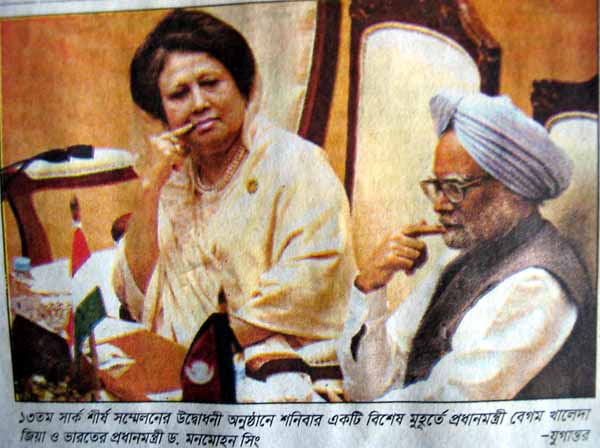
photo: another failed romance

At the Saarc summit


another failed romance: notice how the suitor has became nervous and tongue-tied, notice how the object of his affections has cruelly started mocking him

He thinks in mournful ghazal:

rahi na taqat-e-guftaar, aur agar ho bhi
to kis ummeed pe kahiye ki aarzoo kya hai

I've lost my power of speech, but even if I hadn't
with what hope could I give voice to my desire?

She thinks in mocking qawwali:

koyee marta hai mare, ham pe ehsaan nahin
unse kyoon bat karein, jinse pehchan nahin!

if he dies over me, let him die
It is not a kindness to me!
why should i talk to someone,
who is no acquaintance of mine!

Tuesday, November 22, 2005

Wine

Amar: The wine made from our crushed desires is the sweetest and most intoxicating.

Anthony: No, the wine mixed with the enemy's blood is the sweetest.

Akbar: No, all wine is bitter.