Showing posts with label reading. Show all posts

Friday, May 08, 2009

On the White Tiger

I finished Aravind Adiga’s The White Tiger in two nights. Let me begin with some quick observations.

  • The prose is very simple and crisp. There is no Rushdiesque long sentences. But it is still quite evocative.
  • Adiga describes poverty very accurately, but without sentimentalism or development porn. I was reminded of Satyajit Ray’s movies.
  • However, unlike Ray’s rural movies — and very much like his urban movies — Adiga has a strong, albeit subtle, subversive tone. I like subversion.
  • I am never going to be able to look at a driver the same way again.

Recommendation: yes.

Monday, June 30, 2008

A-A-A talk Fatherland

Akbar: I am reading Fatherland. In so many ways the Nazi Germany is similar to Saudi Arabia. For example Saudis require all nationals to get pre-marital medical check up, which is also mentioned in Fatherland.

Anthony: I’d have thought most totalitarian regimes have that kind of behaviour in common. Anyhow, what do you think of the story?

Akbar: It’s good. Better than the movie. But the ending was, well, hmm.. shrug.

Anthony: Yes, the ending was thoroughly disappointing.

Amar: Yeah, it's a total copout. If I remember correctly, it is that they succeed in giving the information to the Americans, who are stunned by the horror of what happened and stop becoming friends with the Germans. A better novel, more chilling and probably more believable, would have been to give the information to the Americans, then realise the Americans have known it all along, and that they don't really care — it makes sense to be friends with the Germans, and raking up past just gets in the way.

Or have I got the ending wrong?

If I have it right, I think it was probably the Publishers who made him change the ending to appeal to Americans — I can't believe such a good writer would pick such a crappy ending.

Akbar: The book leaves it ambiguous as to what happens — it implies without saying the information gets across — it doesn't deal with what happens afterwards.

It's the movie which shows the information reaching the Americans at the last moment, and stopping the American rapprochement with the Germans.

Amar: I still think the better ending would be the throwing of cold water on the fire of hope.

Tuesday, May 06, 2008

I didn't get 'Life of Pi'

First published in September 2001, Life of Pi by Canadian author Yann Martel is a novel that explores religion and spirituality. It won the prestigious Booker Prize in 2002. This alone is a good reason for reading the book, and if you haven’t, don’t read any further because it may spoil an otherwise good yarn for you.

This is not a book review as such. Rather, it shows why I didn’t get the ‘deeper meaning’ of the novel.

The novel promises a story that will make one believe in God. So, what’s the story? Well, there is this confused kid who gets shipwrecked and survives 200 something days in the Pacific Ocean. Pretty amazing stuff. The thing is, there are two versions of the story, one more fantastic and less sad than the other. There is no way to tell which is true. The only thing we know is that the ship sank and the boy survived. And so it is with God, we’re told.

I read it and went, huh?

Okay, so we — the human civilisation — are a ‘miracle’. For life to form, we need a certain kind of star, and a planet that is a certain distant from the star, with a certain kind of atmosphere and mass and structure. Then that life will have to evolve in a certain way for there to be any intelligence. And the intelligence will have to be used in a certain way for there to be any civilisation. And chances of all this happening is very low, and yet here we are.

We have two sets of stories to choose from. One story has a cosmic being / nature / supreme order / authority / God that gives this ‘miracle’ a sense of meaning and purpose. The other story says that yes it’s a low probability event, but it has happened and there is no underlying rhyme or reason for it.

The first is a more fantastic story. The second is sad because it means that our lives don’t really mean much — the whole unbearable lightness of being.

I knew all this before reading Life of Pi. So after reading the book, I thought huh, this is not making me believe in God any more than what I did (or didn’t) before. But then I thought, hmm, perhaps the idea of the book is to put doubt into the minds of believers. But that just sounds far-fetched.

Then I remembered something I read about the Holocaust survivors. The ones who were religious going in found their faith strengthened — didn’t their very survival prove God’s existence? Those who were doubters on the other hand became even more so — what kind of God allows his chosen people to get wiped out?

I guess so it is with this book — believers will believe, and the doubters will doubt.

Tuesday, May 15, 2007

The Proteus Operation

A dose of Keynesian policies avoided the Great Depression and the rise of militaristic fascism; the capitalist democracies of the West instituted social safety nets; the Soviet Union avoided Stalinism and became a social democracy; following independence, the third world prospered through liberal policies; and by the first quarter of the 21st century, a liberal global order of unprecedented peace and prosperity looked achievable within a generation.

The oligarchs and aristocrats were the losers in this world. They built a machine that could transport people from this world to another world back in time. They went back to the Weimar Germany, where Corporal Hitler’s rise to power was assisted. Similar manoeuvring elsewhere, coupled with the delivery of the nuclear weapon, led to an Axis victory in World War II.

By 1975, the United States was the only liberal democracy left, with all other continents stifling under fascist brutality. However, an elite spy operation uncovered the secret of the Third Reich’s rise. The Americans built their own machine, and a dozen people were sent to the late 1930s.

This group succeeded in getting Churchill to 10 Downing Street and FDR to run for a third term. FDR set up ‘the Manhattan Project, where Einstein, Fermi, Szilard and other leading physicists figured out the science of ‘time travel’, which turns out to be not time travel at all, but travel between alternate universes.

What happens then? I guess you’ll just have to read the book. Try out a chapter here.

----

Why hasn’t this been turned into a movie yet? One reason is that there is way too much information to be packed into a 150-minute movie. Under a lesser director there is a risk that the movie will sag. Who would make a good director? Martin Scorsese hasn’t done a sci-fi movie. But he has read period films, solid action flicks and character dramas. And this story abounds with period details, solid action scenes in New York and occupied Europe, and scope for intense character development.

The people travelling from the dystopian world to the 1930s where the action takes place included a couple of spook types: a taciturn Italian-American (could be played by Leonardo Di Caprio) and his talkative buddy (Matt Damon could play him). Their boss is another major character, Daniel Day Lewis will could play him. And finally there is the taciturn dude’s love interest — a Jazzstress that Naomi Watts would be perfect for.

Monday, January 29, 2007

The Counter-Orientalism of Salman Rushdie

There is a delightfully wicked story in Midnight's Children about a boy whose mother dresses him up as a holy-man. She fashions an improbable story about him being a superior being with miraculous powers who has come to Earth from the heavens. The boy soon becomes the latest religious craze, attracting a large and devoted following while his mother rakes in the moolah.

The joke is partly on the many unlikely God-men and women Desh throws up, and their eager and uncritical followers. But Rushdie also relishes subverting the conventional orientalist stereotypes - the boy's mother does not get her idea from exotic Indian myth and legend, but from reading her son's Superman comics! And so the origins of just the kind of strange and absurd story that has historically been portrayed in the West as peculiarly oriental turn out to lie in a 20th century American pop-culture icon.

Elsewhere too, Rushdie takes inspiration from western sources. There is a scene earlier in the book where the heavily pregnant Mrs Amina Sinai visits Shri Ram Ram Seth the seer and fortune teller, who prophesises in cryptic verse the future of her unborn-child. I would like to speculate on a possible western inspiration for this scene.

Before I begin, two points: Firstly, this is only my personal speculation, and may not be correct. Secondly, I am not familiar with the literary or critical analysis of Midnight's Children, and may therefore be possibly repeating what others have already said. I do not know - what follows is based solely on my own reading of the two texts mentioned.

My candidate for the inspiration behind the prophecy of Ram Ram Seth is I, Claudius, a historical novel of the Roman Empire written by the English poet Robert Graves and first published in 1934. The book was hugely successful - the cover of my copy describes it as 'this century's classic historical novel', while BBC produced a television series of the same name based on the book.

There are a number of similarities between Midnight's Children and I, Claudius. Both are fictional first-person narratives which use the narrator's own life mainly as a means to chronicle significant periods in history - Midnight tells the 20th century history of India, while I, Claudius covers first century of Rome as an Empire. Both are written as private autobiographies of men who find their lives and their fate deeply interwoven with their country's.

In both novels, a prophecy is given early in the story. This prophecy foreshadows the events that are to follow, hinting to us about what will happen later. Both are given in cryptic verse whose full import is not immediately clear, but becomes obvious later. In Midnight's the fortune is recited by a poor fortune-teller of uncertain reputation, while in I, Claudius, it was recorded from the predictions of the Sybils at Cumae, women famed in ancient Greece and Rome for their ability to predict the future.

It is unlikely that someone as well-read and erudite as Rushdie would not have been aware of I, Claudius, especially as he was trying to do something very similar in aim to Graves - retelling history on a grand scale, but through one individual's eyes. So he could have read it, and certainly there are many similarities already noted between the books, and the role and telling of the prophecies in them. But this in itself is merely circumstantial - what convinced me of this idea was some rather prominent similarities in the actual verses as well.

For example, in I, Claudius, the prophecy repeatedly contains the phrase 'his son, no son" . In Midnight's Children, the prophecy has similarly 'he shall have sons without having sons". Actually, both use paradox more widely than that - the I, Claudius prophecy additionally has paradoxical lines like "A hairy man that is scant of hair" - Midnight's has "He will be old before he is old! And he will die...before he is dead."

There is transposition also: I, Claudius has "every man's woman, and each woman's man", while Midnight has similarly 'there will be knees and a nose, a nose and knees."

Both prophecies end in death of course, but this is probably nothing remarkable. And yet, consider the improbably similar last lines. I, Claudius concludes with 'And blood shall gush from his tomb' and Midnight's with 'he will die...before he is dead'.

So there's my theory, make of it what you will. If it is true, the origins of Shri Ram Ram Seth the fortune teller could be traced from Rushdie to Graves to the exotic history and legends of Classical Greece and Rome. And Rushdie knocks yet another iconic cliche of orientalism on its head. Which is not to say that the East isn't a crazy and extraordinary place. It definitely is. But we, both in the east and west, need to recognize that the West is no less crazy or extraordinary either. We are all strange and weird!

Tuesday, November 28, 2006

Love: The Tale of King Bhartrihari

The complete story of Bhartrihari is not just a tale of a king, but also that of a lover, a poet, a grammarian, a philosopher, and an ascetic. This is only a small part of that tale.

One fine day, a devout Brahmin and his wife came to the court of King Bhartrihari, and supplicating before him, presented him with a strange looking piece of fruit. The Brahmin explained he had spent most of his life undertaking austere penances and meditations in praise of the Gods, and pleased with him, the Gods had blessed him and granted him this fruit, the amar-phal. Any one person who ate the fruit would have the gift of immortality. But the Brahmin did not desire to live forever while his wife, whom he loved dearly, should grow old and die, and therefore he had come to offer the fruit to the King.

The King was very pleased with this present, and rewarded the couple generously. But once they had left and the fruit was in his possession, he became uncertain of what to do with it. The obvious thing would be to eat it. To have the gift of immortality would make him equal in stature to the Gods! Further, was he not a good and just ruler, he reasoned, and therefore it would be for the betterment of his kingdom and subjects if he were to reign indefinitely.

But something in his heart stopped him from eating the fruit. It was love. Bhartrihari was obsessively in love with his Queen, and he could not bear the thought of living without her. It would be better that she should live, and he have the comfort of knowing that at least she would be with him the rest of his life. Better a few moments with her, he thought, than an eternity without! He went and gave his Queen the fruit.

The young Queen felt the same way too, but not about her husband. She was having an affair with the King's handsome and trusted advisor, who made her swoon with his suggestive glances. She accepted the fruit from her husband, but secretly gave it to the King's advisor.

The King's Advisor heart though was set on another woman. He was hopelessly enthralled with a long-eyed and slender-waisted poetry-reciting Courtesan of his acquaintance, and he wanted to impress her more than anything else in the world. He gave her the fruit.

Now the Courtesan had met and known many rich and great men, and she despised almost all of them, including the King's Advisor. But there was one man whose kindness and concern for others had captured her heart, and though her feelings remained unspoken, she was very much in love. She went and gave the fruit to the man she admired - the good King Bhartrihari.

Bhartrihari accepted the fruit from the Courtesan, and understood what had happened. He saw the infidelity of his wife, and also the love of the courtesan for him. He concluded:

She who is always in my thoughts prefers
Another man, and does not think of me.
Yet he seeks for another's love, not hers;
And some poor girl is grieving for my sake.
Why then, the devil take
Both her and him; and love; and her; and me

That night, Bhartrihari put on the robes of an ascetic and stole away, leaving behind his wife, his palace and his kingdom. Some say he never returned, renouncing all things and becoming a great philosopher and poet. Or less romantically, a grammarian. Some suggest that Bhartrihari was a man who could not make up his mind whether to follow the sensual or ascetic path. Each time he chose one path, he would see its deficiences and the attractions of the other. And so he would move back and forth from pleasure and renunciation. Who can say they know for sure the truth!

***

The tale of King Bhartrihari continues a haphazard survey of that universal predicament - the unreliability of love. We have previously seen in The Madness of King Shahryar, a different reaction from Bhartrihari's to a lover's infidelity. Poets appear a particularly miserable lot. Whether the Thabri, or Momin, or Ghalib, or Raaz, all their relationships seem to end badly. We saw failed romances wherever we looked, but we kept looking anyway. Sadly, we have not had time to correct the gender bias in our choices. We would have particularly liked to sympathise with poor Sita, whose husband Ram would tastelessly demand proof of fidelity from her after she had been kidnapped by a villain! We have wonderered whether monasticism isn't a better option, but like Bhartrihari, couldn't make up our mind. Not all love is so fickle though. We have sympathised with moths, who hurl themselves at their flame. We have admired the great romance of Hir and Ranjha, and sighed over our love of Madhuri. Ominously, all these great romances also end badly. In conclusion, we are no wiser than when we started, which was not very wise at all.


***

Sunday, November 19, 2006

Irritative Fight-Club Syndrome

Reading chapter 13 of Fight club while suffering from a bout of Irritative Bowel Syndrome (IBS) can be a traumatic experience, but not regrettable.

IBS as defined in google searches as ‘An irritative and inflammatory disorder of the intestine.’

IBS as experienced by one of the brothers AAA – ‘irritant pain in butt- hole spreading down the right hip and ending on the right testicle’

To top it, reading fight club to distract one self from the pain is even worse. If the description of the IBS above is not foul enough, then fight club fills in the sadistic blanks.

IBS combined with fits of giggling at Tyler waiting/serving tables in hotel, at the soap cakes made from the discarded fat of Marla’s mother and the narrator checking Marla’s boobs for breast cancer while recalling his childhood memory of his penis being frozen by science students. – Hilarious.


Fight Club is a good read and highly recommended by the brothers AAA.

Sunday, November 12, 2006

"Iqbal", Koi Mahram Apna Nahin Jahaan Mein
Maalum Kya Kisi Ko Dard-e-Nihaan Hamaara

We Do Not Have A Confidant In The World, "Iqbal"
No-one Knows What Sorrows Lurk Within Our Heart

- Mohammad Iqbal, translation from here

Sunday, October 29, 2006

Now I am become death, the destroyer of worlds

The atom bomb has been in the news again recently, with North Korea successfully testing a device earlier this month, the Iranian nuclear programme under scrutiny and suspicion all year, and our very own Anthony lecturing us on Nukes.
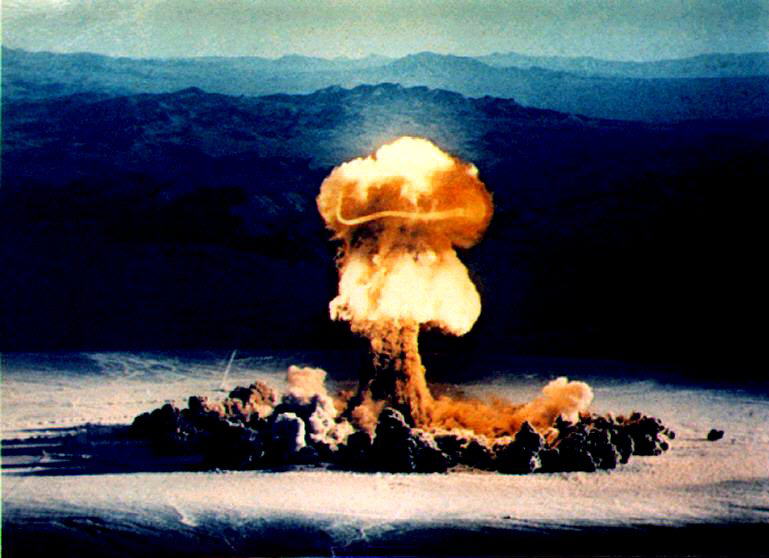
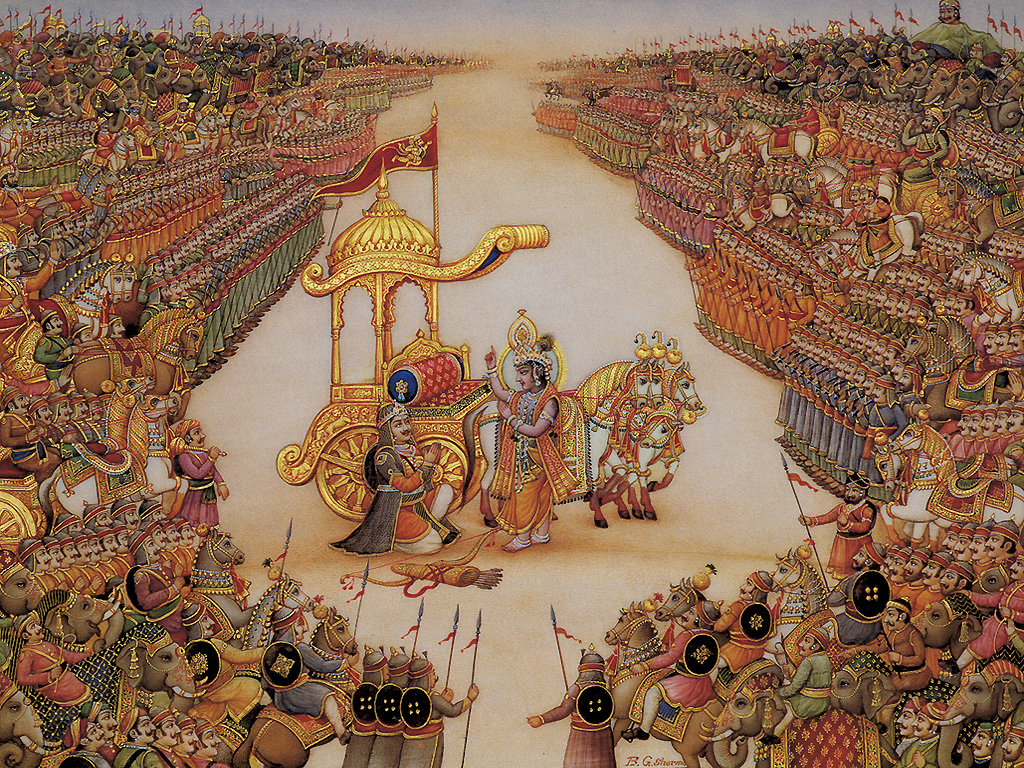
There's a famous (and true: see video) story about the moment the first atom bomb was tested, in the deserts of the American West. As Robert Oppenheimer, the scientist dubbed the father of the bomb, watched the first mushroom cloud appear on the horizon, the full horror of his own accomplishments struck him, and he was moved to recite the words of Krishna from the Bhagavad Gita:

I am become death, the destroyer of worlds.

***

I remembered this as I was reading the Bhagavad Gita recently, because I couldn't find these words in my translation. The verse Oppenheimer had in mind was 11:32, which Juan Mascaro (The Bhagavad Gita, transl. Juan Mascaro, Penguin Books, 1962 1st edition) gave instead as follows:

I am all-powerful Time which destroys all things.

***

I was annoyed by two things about the translation Oppenheimer used.

Firstly, and the minor detail, was the grammar. There appears to be no reason to use the grammatically incorrect 'I am become', when the correct wording would have been 'I am' or 'I have become', and which could have been used. It appeared to be a case of translating something incorrectly to make it sound more exotic and foreign - as Edward Said may have noted in Orientalism (I can't remember where I read it, and I can't think where else it might have been. Rushdie?), there seemed a touch of suggestion that here was something so strange and foreign and absurd, that it could not even be translated correctly and sensibly.

Secondly, and the major issue, was the very fundamental one of what the original verse said. To say One is Death has far more sinister overtones than saying One is Time, and certainly while Time is in a way Death - as a character in Fight Club says, On a long enough time line, the survival rate for everyone drops to zero - there is a huge difference in idea, intent, and meaning. Was Krishna simply saying he was Time, and Oppenheimer misinterpreting it to Death? Was the most popular quote from the Gita in the western world actually a mistranslation?

I decided to look into this further.

***

The relevant line in the original sanskrit is as follows:

kalo 'smi loka-ksaya-krt
(source:http://www.asitis.com/11/32.html)

As I had no issue with 'the destroyer of worlds' = 'which destroys all things', I was only concerned with the first half of the line: kalo'smi. This could be translated as I am 'Kalo'. So what did 'Kalo' in this context refer to? Death or Time?

I decided to see if others had considered this matter. They had indeed, and in some detail. There was a paper called 'The Gita of J. Robert Oppenheimer' by James Hijiya, Professor of History at the University of Massachusetts, which explained that Oppenheimer was significantly influenced by Arthur Ryder (a Sanskrit scholar who had taught Oppenheimer), whose translation of the Gita used Death instead of Time. I have reproduced footnote 50 of his paper in full:

"Ryder’s translation here is a little peculiar but defensible. Ever since the first rendering of the Sanskrit text into English in 1785, most experts have translated this word not as Death but as Time. Cf. Charles Wilkens, The Bhagvat-Geeta (London: C. Nourse, 1785; Gainesville, Fla.: Scholars’ Facsimiles & Reprints, 1959), 93; Besant, Bhagavad-Gita, 116; Prabhavananda and Isherwood, Bhagavad-Gita, 123; S. Radhakrishnan, The Bhagavadgita (New York: Harper & Brothers, 1948), 279; Eknath Easwaran, The Bhagavad Gita (Petaluma, Calif.: Nilgiri Press, 1985), 154; Barbara Stoler Miller, The Bhagavad-Gita (New York: Columbia University, 1986), 103; Dominic Goodall, Hindu Scriptures (Berkeley: University of California, 1996), 260.
There are, however, exceptions. Franklin Edgerton, The Bhagavad Gita (Cambridge: Harvard University, 1944), 58, renders the word as “Time (Death).” Miller, Bhagavad-Gita, 103, translates the word in question and a following phrase as “time grown old”; Radhakrishnan, Bhagavadgita, 279, as “time . . . grown mature.” The passage of a vast expanse of time implies death, thus making “Death” a legitimate translation. In his rendering of the passage, Oppenheimer followed his teacher, Ryder. This variant was especially appropriate for describing a nuclear explosion, which could bring a great deal of Death in very little Time."


***

The footnote answered most of my questions, but I would like to note the following:

The reasons for the difficulty are obvious for the Hindustani speaker just by looking at words in contemporary usage with the K-L consonant sounds. There are words like Kal, Kaal, Kala, which we associate with concepts of time, but there is also the goddess associated with death, Kali.


***

But one can in this instance also look within the Gita to see other instances where concepts of Time or Death are mentioned, and consider the vocabulary employed for them. I am more familiar with Adhyayas (Cantos) 1 and 2, where in 1:1, Sama is used for Time, and where in 2:37, Hato is used for Death. Unhelpfully, Kal is used for neither situation. It is used elsewhere in the book, including Adhyaya 11, but I did not have, well, the time(!) for a thorough review, and decided against an incomplete one.

***

In summary, we wondered whether Oppenheimer wasn't misquoting the Gita. We laid out the reason for our wondering thus, and then found that someone had already done a lot of research on the topic, which revealed that most translators thought so, but there was a minority in support. Since we are libertarians and see no harm in minorities taking divergent opinions where there is no harm to others, I will not be criticizing Mr Oppenheimer's choice of translation, though I do not think I agree with it.

Sunday, October 22, 2006

vikram and baital: the doom that befalls all men

How, indeed, could he hope to escape the doom which has fallen equally upon Brahma the Creator, Vishnu the Preserver, and dreadful Shiva the Three-eyed Destroyer[23]?

***

translation: he meets a woman.

vikram and baital: her exceeding beauty

By reason of her exceeding beauty, her face was a full moon shining in the clearest sky; her hair was the purple cloud of autumn when, gravid with rain, it hangs low over earth; and her complexion mocked the pale waxen hue of the large-flowered jasmine. Her eyes were those of the timid antelope; her lips were as red as those of the pomegranate's bud, and when they opened, from them distilled a fountain of ambrosia. Her neck was like a pigeon's; her hand the pink lining of the conch-shell; her waist a leopard's; her feet the softest lotuses. In a word, a model of grace and loveliness was Dangalah Rani, Raja Bhartari's last and youngest wife.

- from the Introduction of Vikram and the Vampire, translated by Richard Burton

poets and men of letters are always trying to describe the undescribeable - a woman's beauty.

vikram and baital: at first sight

Suddenly the eyes of the Raja's son and the [maiden] met. She started back with a little scream. He was fascinated by her beauty, and began to say to himself, " O thou vile Karma,[51] why worriest thou me?"

Hearing this, the maiden smiled encouragement, but the poor youth, between palpitation of the heart and hesitation about what to say, was so confused that his tongue crave to his teeth.

- from the beginning of Baital's first story, as translated by Richard Burton in Vikram and the Vampire

Whether a first century hindi tale of the fantastic, or a twenty-first century hollywood chick-flick, the first sight of the beauty invariably confounds the tongue of a good man.

Tuesday, July 18, 2006

the hopeless struggle

The rationale and logic of human struggle fascinates me. Most bizarre of all is the knowingly futile struggle, where there is no hope or illusion of redemption or success. What motivates man to continue in such circumstances? I have failed to offer any explanation in the past, though I have occasionally stared at moths and wondered. The Russians have a saying - to the success of our hopeless task! Perhaps I need to ask one of them to explain.

Instead, I have been reading Thomas Mann's Death in Venice in recent days. The summary on the back cover was what caught my eye, and it has the following to say about the central character and his story: "His pitiful pursuit of the object of his affection and its inevitable and pathetic climax are told here..."

The inevitable and pathetic climax, it is obvious from the title, is death. This seems quite consistent, for example, with the case of the moths.

I have been listening to music too. I recently discovered Na to caravan ki talaash hai (lyrics: the incomparable Sahir Ludhianvi). Here, a male and female singer sing two differing perspectives of the world. The latter is more intriguing. The male version is hopeful. But the woman's opening words are:

Mere na muraad junoon ka, hai ilaaj koyee to maut hai
For my hopeless passions, if there's any cure, it's death

Death seems well accepted as the inevitable climax by all hopeless strugglers. Indeed, they seem to aspire to little else. But death is inevitable for all, both hopeful and hopeless. Perhaps the difference is merely that for the hopeful, it is an unwelcome interruption, but for us hopeless, it is the awaited conclusion.

Monday, June 19, 2006

Everything you love will reject you or die. Everything you ever create will be thrown away. Everything you are proud of will end up as trash.

- Chuck Palahniuk, author of Fight Club and no doubt a reincarnation of some Buddhist monk

Tuesday, June 06, 2006

On romantic tragedies

Amar and Akbar watched a romantic tragedy the other night. I watched it a week or so before my brothers, and when they asked me for my opinion, I did say that when all is said and done, Fanaa is a romantic tragedy. Now dear reader, don’t get me wrong, I have nothing against romantic tragedies. I just think they are rather hard to do. And I’m not the only one. No less a person than the Bard thought so. Allow me to explain.

William Shakespeare wrote 37 plays. Romeo and Juliet was the 28th, so one can assume that he was a quite experienced storyteller when he penned the story that ends with a pair of star-cross’d lovers taking their lives.

Now how does this taking life business happen?

Friar Lawrence helps Juliet by providing a sleeping draught that will make everyone think she's dead. Romeo is then supposed to come to her tomb and take her away. When the wedding party arrives to greet Juliet next day they think she is dead. The Friar sends a colleague to warn Romeo to come to the Capulet's family monument, but the message doesn't get through. Instead, upon hearing that Juliet is dead, Romeo returns to Verona and takes poison and dies just as Juliet awakes from her drugged sleep. She learns what has happened from Friar Lawrence and stabs herself.

Romeo and Juliet, the first romantic tragedy the Bard penned, was a big hit. Upon finding the successful formula of the taking of multiple lives in confusing circumstances, he ended four of his remaining nine plays in similar manner.

In the rotten state of Denmark, Hamlet duels with Laertes where Claudius plots for Hamlet to die either on a poisoned rapier, or from poisoned wine. The plans go wrong, and basically everyone dies.

Okay, Hamlet is not a romantic tragedy you say. Hmmm, maybe, but Othello surely is. And how does the Moore of Venice meet his end? He accuses Desdemona of infidelity, and after a brief argument, smothers her (obviously someone named Ataullah — Othello in English — has Quranic licence (4:34) to smack their bitch up). Desdemona dies but says Othello is innocent. Eventually it is revealed that Iago is the villain, and Othello commits suicide.

Antony and Cleopetra is another romantic tragedy where Shakespeare used the multiple death formula. Here, Cleopatra goes to her tomb and sends a message to Antony that she is dead. Antony is devastated and decides to kill himself. But wait, he botches the suicide and wounds himself without dying. His followers take him to Cleopatra's tomb, where he dies in her arms. Of course Cleopatra wasn’t dead, but now that Antony is dead, what can she but to kill herself?

You see dear reader, romantic tragedies are not easy to do. They are actually so hard that upon finding a successful formula, even Shakespeare chose to stick to it rather than try something new.

Wednesday, May 17, 2006

On the Code (1)

The code? Of course I mean The Da Vinci Code. As if there could be any other code. I’m going to shamelessly join the bandwagon created by the movie and the book — yes, did you know there’s a book? Of course you knew, only the high-browed toffs wouldn’t have heard of it, and you, dear reader are no high-browed toff, are you? — and post what I wrote about the book in mid-2004 (before there was A-A-A). And no, I still haven't finished Eco's book.

-------

Let me begin with a quick prĂ©cis of the book. The protagonist is a Harvard professor of symbology (study of symbols) who finds himself the prime suspect of the murder of the curator of the Louvre museum. The curator was murdered because he is privy to the secret of the Holy Grail — that Jesus married Mary Magdalene and their descendents survive to the modern day. The protagonist is assisted by the curator’s grand daughter. Other interested parties include an eccentric British historian, a persistent French police officer, and an ultra Catholic sect. And the clue to the secret, of the Grail as well as whodunit, can be found in Leonardo Da Vinci’s work — hence the name.

The book abounds with these clues. For instance, the Star of David apparently symbolises the yin and the yang in perfect harmony. Or the Fibonacci sequence, the sequence of numbers 2, 3, 5, 8…. where each number is the sum of the 2 numbers preceding it, and the ratio of each number to its preceding one is the inverse of the ratio plus one, and this ratio approaches 1.61 as the sequence approaches infinity, and this limit, phi, is abundant in nature (it’s the ratio of your height from head to toe to your navel’s height), so abundant indeed that the ancients called it the divine number. Now these are nice trivia to know, I guess to impress girls in parties. Well, I think so anyway, but I digress. Back to the book.

Some of the things discussed in the book are true (the Fibonacci sequence for instance). Others I’m not so sure about: google suggests conflicting stories about the Priory of Sion or the Templar Knights. And I definitely don’t know enough about the early Christian history to have a view on what Jesus really did or did not do in the 1st century. Jesus being intimate with Mary Magdalene is not a particularly new idea: Scorcese did a movie on that theme. There are more interesting twists on Jesus: Bulgakov had Jesus as Pontius Pilate’s herbalist, Charles McCarry has him being a Roman agent provocateur, and then there is always Life of Brian.

But all this is beside the point as this is not a book on the origin of Christianity or a meditation on the meaning of it all. The Economist says it’s no Foucault’s Pendulum. And that it is not. Whereas that book I failed to finish despite half a dozen attempts over the past few years, this book was read within a weekend.

And that is because it’s a ripping yarn. Sure, the characters are two dimensional, but that’s alright, because you want to see whodunit. In fact, the characters are made for movie — the protagonist is described as resembling Harrison Ford. It’s a good action-adventure book. Action-adventure book? Yes, as in a book that you’d want to watch in the big screen. It’s a page turner. Short, sharp sentences, and crisp, if somewhat wooden dialogues. But, once again, you don’t care, because, yes, you want to know whodunit.

It’s a formula book, but it’s a formula that works. How? I think that a murder mystery stands or falls on this: can you figure out whodunit half way through the yarn? If you can, then it’s crap. Can you in this one? Well, I thought I knew who the bad guy was fairly early on. But then I wasn’t so sure. Then, just about when I was convinced it’s not who I think it is, bang! Mr Brown keeps you guessing, and thus, the book works. In that respect, it’s right up there with the best of Crichton, Forsythe or Harris.

Thursday, May 11, 2006

On romance

Amar talked about Hir Ranjha a while ago. This story is the subject of a Bollywood classic that has been described as the Punjabi Romeo and Juliet. Reading this, a sister pointed out that this description was inaccurate, because Hir and Ranjha, unlike the star-crossed lovers, did not come from feuding families. Countering it, a brother noted that the feuding family is irrelevant as the point of these tragedies is love not the feud.

Another brother noted that this great romance was not noted in that great arbiter of Desiana, its page 259 contains: Once upon a time there were Radha and Krishna, and Rama and Sita, and Laila and Majnu; also (because we are not unaffected by the West) Romeo and Juliet, and Spencer Tracy and Katherine Hepburn.

This led to yet another sister making another observation: Angrez and Hollywood romances are from the West, sure, but Laila and Majnu are also from a land that is to the west of Desh. After much googling, we ascertained that the origin of the story of Laila Majnu is pre-Islamic Arabia (that is Jahiliya for you believers).

So, what is the West? And what is Desi? Difficult questions to answer, and Brothers A-A-A don’t pretend to have any, except to note that patatar (that is aloo) is also from somewhere else, but is aloo-ghobi not Desi?

Anyway, Laila Majnu is also the subject of a Bollywood classic, and the Bollywood version looks like it is set in the Islamic Republic of Romance. Check it out if you can, while I go and check out the Laila Majnu and Hir Ranjha of the Blighty.

Friday, May 05, 2006

Kabhi ham mein tum mein bhi chaah thi, kabhi ham mein tum mein bhi rah thi
Kabhi ham bhi tum bhi the aashna, tumhein yaad ho ke na yaad ho

- Momin Khan Momin [translated here]

Monday, March 27, 2006

Love is like baldness [cont.d]

and other insights from and thoughts on The Adventures of Hir and Ranjha by Waris Shah (transl. Usborne)

this continues from the first installment of Love is like baldness

Chapters 15 and 16: Hir's father decides it's time she gets married. He is tempted to give her to Ranjha - what better way than marriage to kill this romance? But a good muslim father must take into account many things. And so Hir is married off to the Kheras instead, because they are a. of much higher caste than the lowly Ranjhas, and b. the only fools in Punjab who have not heard of Hir's affair.

Chapter 17: Waris Shah builds the tension by switching from one emotional scene to another.

...thus did Hir lament on being parted with Ranjha
is followed immediately by
Meanwhile the buffaloes were ill at ease...

Chapter 17 cont.d: The Kheras must also be the most absent-minded people in Punjab. The large baraat heads back to their village Rangpur in celebratory mood, without noticing the romantic Ranjha following them. But surely they would have been aware of the beautiful new bride they were taking home, the new daughter of the village, the wife of one of their sons? But to hear Waris tell it, Hir finding herself alone and the Kheras merry making, made a signal to Ranjha, called him into her palanquin and embraced him tenderly.

These two are addicted to danger! Not for them running away, it has to be making out in the middle of the girl's wedding baraat or nothing.

Chapter 17 cont.d: There's an exciting and pointless tirade against the Jats generally. Sadly my translation omits it.

Chapter 18: Hir is now at her new home. Meanwhile, Ranjha resolves to become a fakir and 'bore his ears'. Not to mention everyone else's. He also decides to bring back Hir.

It is not clear why he needs to be a fakir to bring back Hir, or how being an ascetic is even consistent with pursuing his beloved. But anyhow...

Chapter 19: A year passes. Hir sends Ranjha a message. Ranjha rejoices and again resolves to become a fakir, and bring back Hir. Ranjha is somewhat lazy.

Chapter 20: Ranjha finds himself a holy man to be his Guru. The Guru likes what he sees: My lad, your looks are saucy... The guru continues dreamily: ...you have painted your eyes with lamp-black; you play on the flute and stare at women. You tie up cows and milk them. He makes it sound so kinky.

Sunday, March 26, 2006

read Monstrum

the winter snows of Moscow cover many of the city's flaws: the glum architecture, and the grime and clutter of its breakneck growth. But the winter and the snow also reveal other, hidden aspects of modern Russia: the superpower status it still retains among its neighbours; the desperation that lurks beneath the oil-fuelled glitz; the brutality, lawlessness and all-permeating corruption.

and

...another group that is symptomatic of Russia's post-Soviet condition: Moscow's street children, products of the widespread family breakdown that the collapse of the Soviet empire and the end of communism brought with them.

In 2002, Vladimir Putin, Russia's president, declared that the problem of child homelessness in Russia had reached “threatening proportions”. The nation's runaways then numbered in the millions...last year the interior minister declared that Russia was living through a new wave of child homelessness, comparable to those induced by the civil war and the second world war.

A winter's tale Feb 16th 2006, The Economist

A tale of a grim Moscow winter, the city's streets swarming with armies of homeless street-children. I am reminded of Donald James's Monstrum. A great thriller by a brilliant but mysteriously under-rated author, it is not as widely-read and acclaimed as it deserves to be. But even Monstrum is a lot better known than James's first great book - the prophetic The Fall of the Russian Empire, published in 1982. Anyway, note to self, must re-read Monstrum, and must visit Moscow...